
Scroll Saw Blades for Intricate Cuts: Guide
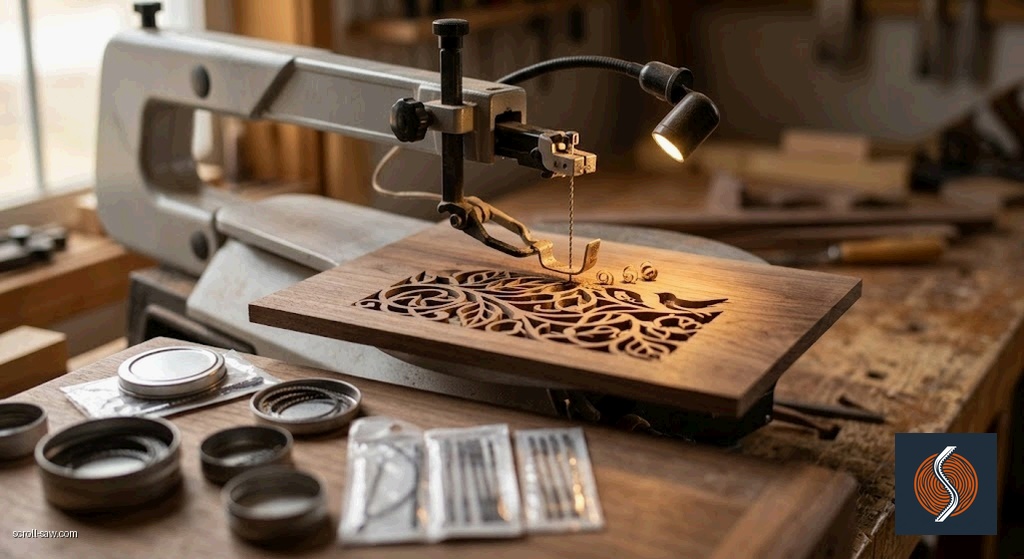
Scroll Saw Blades for Intricate Cuts: Guide
Intricate cuts are what the scroll saw is best at. No other stationary saw can turn as tight, hold detail as fine, or produce interior cutouts as cleanly. But intricate cutting demands the right blade for the specific pattern and material. Wrong blade choice and even a perfect saw produces bad results.
Here is a straight guide to blade selection for intricate cuts, with the sizing chart, geometry choices, and technique that produce clean detail work every time.
What counts as intricate
Bridges under 1/8 inch between adjacent cutouts.
Interior curves with radius under 1/8 inch.
Multiple interior cutouts in a single piece.
Fine lettering in wood or plastic.
Portrait or silhouette work with hundreds of internal cuts.
Layered patterns where each layer has fine detail.
Fretwork with tight repeating patterns.
Any cut in one of those categories qualifies as intricate. It calls for small blade sizes, specialized geometries, and careful technique.
Blade sizes for intricate cuts
| Blade size | Width | TPI | Intricate use |
|---|---|---|---|
| #3/0 | 0.006 in | ~40 | Extreme detail in very thin stock |
| #2/0 | 0.008 in | 32 | Portrait scrolling, tiny bridges |
| #1 | 0.010 in | 26 | Fine fretwork in 1/8 to 1/4 in |
| #3 | 0.012 in | 20 | Standard fretwork, small ornaments |
| #5 | 0.015 in | 16 | Coarse intricate work in thicker stock |
Blade geometries for intricate cuts
Reverse-tooth in small sizes. Cleans underside of plywood and thin stock. Standard for two-sided fretwork.
Precision ground in small sizes. Cleanest walls in hardwood. Highest cost per blade.
Spiral. Cuts in any direction without turning the workpiece. Best for portrait scrolling and patterns with tight, unpredictable curves.
Skip-tooth in small sizes. Standard geometry when reverse or ground is unavailable.
Crown-tooth. For plastics with intricate detail.
For most wood intricate work, reverse-tooth #1 or #3 is the workhorse choice.
Matching blade to intricate project and material
| Project | Material | Thickness | Blade |
|---|---|---|---|
| Christmas ornament fretwork | Baltic birch ply | 1/8 in | Reverse-tooth #3 |
| Portrait scroll art | Cherry or walnut | 1/4 in | Spiral #2/0 or #1 |
| Victorian scroll panel | Cherry | 1/4 in | Reverse-tooth or ground #1 or #3 |
| Layered puzzle pieces | Baltic birch ply | 1/2 in | Reverse-tooth #5 |
| Miniature ornaments | Basswood | 1/8 in | Skip-tooth #3 |
| Small brass name plate | Brass sheet | 1/32 in | Metal-cutting #2/0 or #1 |
| Fretwork clock face | Walnut | 1/4 in | Reverse-tooth or ground #1 or #3 |
| Silhouette portraits | Walnut | 1/4 in | Spiral #1 |
| Fretwork Christmas tree | Cherry | 1/4 in | Reverse-tooth #3 |
| Decorative lettering | Baltic birch | 1/4 in | Reverse-tooth or spiral #1 or #3 |
Threading blades for interior cuts
Intricate patterns almost always have interior cutouts that require threading the blade through a starter hole:
-
Drill a starter hole inside each cutout area, close to but not on the pattern line. Use a small bit (1/32 to 1/16 inch depending on blade size).
-
Loosen blade tension.
-
Remove the top end of the blade from its clamp.
-
Thread the blade through the starter hole.
-
Reinstall the top end and retension.
-
Cut the interior shape.
-
Loosen tension, remove blade, move to next hole, repeat.
For patterns with dozens of interior cuts, this process takes as long as the cutting itself. Practiced scrollers can thread a blade in under 30 seconds.
Setup for intricate cutting
Firm tension. Small blades benefit from higher tension than large blades. Pluck test should ring clearly.
Low to moderate speed. Middle SPM range for hardwood, lower for softwood. Fast speeds heat fine blades and dull them quickly.
Very light feed. Less pressure than with general-purpose blades. Pushing bends fine blades sideways.
Bright task lighting. Intricate cuts need to be seen clearly. Adjustable LED task lamp at the saw improves accuracy.
Magnifier if needed. Optional for older eyes or extreme detail. Some scrollers mount magnifying lamps at the saw.
Technique for intricate cuts
Cut inside the pattern line. Intricate work does not tolerate sanding. Cut on or slightly inside the line and adjust as needed.
Turn the workpiece, not just the blade. Rotate the wood to follow curves; the blade cannot turn as tightly as the workpiece can.
Support fragile pieces. As interior cuts progress, the workpiece becomes fragile. Use zero-clearance inserts or backing to support the work.
Work in short sessions. Intricate cuts strain eyes and hands. Take breaks; do not push through fatigue and make mistakes.
Change blades before they dull. Fine blades wear invisibly. When the cut starts requiring more pressure or the walls look torn, change.
Managing blade breakage in intricate work
Fine blades break in intricate cuts. Plan around it:
Buy in bundles. A dozen or more of each fine size you use.
Change during pattern pauses. Rather than pushing until the blade snaps, change during natural breaks.
Reduce tension slightly if breakage is frequent.
Check feed pressure. Heavy feed causes most fine blade breakage.
Have spare blades within reach of the saw so a broken blade does not force a long shop-search break in concentration.
Common intricate cut problems
Cut walls torn or fuzzy. Blade dull or wrong geometry. Switch to reverse-tooth or precision ground; consider changing blade brand.
Blade drifts off the pattern. Blade dull, tension too low, or feed uneven. Address one at a time.
Small bridges break during cutting. Bridges too narrow for the wood grain, or feed too heavy. Redesign bridges perpendicular to grain, feed lighter.
Blade heats up rapidly. Speed too high, or blade already dull. Slow down and change blade.
Cut wanders in tight curves. Turn workpiece rather than trying to steer blade. Consider spiral blade for very tight patterns.
Interior cutout looks rough on the underside. Standard blade; switch to reverse-tooth.
Bottom line
Intricate cuts on a scroll saw use small blades (#3/0 to #5) with specialized geometries (reverse-tooth for plywood, ground for hardwood finish, spiral for portraits). Match blade to specific pattern and material. Thread blades through starter holes for interior cutouts. Tension firmly, feed lightly, cut slowly. Buy in bundles because fine blades break. Practice makes intricate cutting fast and consistent; the first Victorian scroll art panel takes hours, the tenth takes far less.
FAQ
What blade for intricate scroll saw work? #1 or #3 reverse-tooth or precision ground for most wood work; spiral for portrait scrolling.
How do I cut interior cutouts? Drill a starter hole, thread the blade through, reclamp and retension, cut the interior shape, remove and move to next.
Which blade for portrait scrolling? Spiral in #2/0 or #1. Cuts in any direction without turning the workpiece.
Do intricate blades break often? Yes. Small thin blades snap under sideways force. Buy in bundles.
Which brand for intricate cuts? Pegas, Niqua, or Olson PGT. Cheap brands wear unevenly and break quickly.
Can I sand fine details after cutting? Minimally. Fine detail does not tolerate sanding. Cut precisely instead.
Do I need a magnifier? Helpful for very fine work or aging eyes. Not required.
References
-
Pegas Scroll Saw blade documentation, pegas-swiss.com
-
Niqua blade catalog, niqua.de
-
Olson PGT precision ground blades, olsonsaw.com
-
Steve Good, Scroll Saw Workshop on fretwork, scrollsawworkshop.blogspot.com
-
Flying Dutchman blade selection, mikesworkshop.com


