
Scroll Saw Blades That Cut in All Directions: Guide
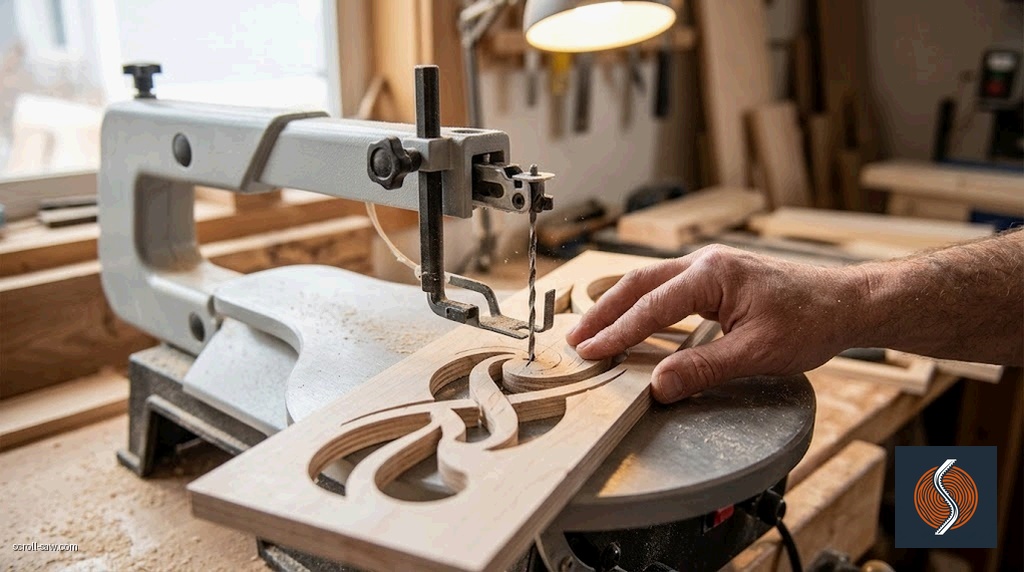
Scroll Saw Blades That Cut in All Directions: Guide
Blades that cut in all directions are called spiral blades, and they are one of the specialized tools every scroller eventually needs. Instead of teeth on one edge only, spiral blades have teeth wrapped 360 degrees around the blade axis. They cut in any direction without turning the workpiece, which makes them ideal for portrait scrolling, silhouettes, and any pattern with many tight interior curves.
Here is how spiral blades work, what specs to look for, and when they beat straight blades for a given cut.
What makes a blade cut in all directions
A standard scroll saw blade has teeth on one edge. The blade cuts only in one direction (forward, from the perspective of the person at the saw), and to change direction you turn the workpiece.
A spiral blade has teeth ground around the entire circumference of a round or twisted-flat blade. Every position around the blade has cutting teeth. Result: the blade cuts wherever it is pushed, regardless of workpiece orientation.
Manufacturing: most spiral blades start as flat blades with cut teeth, then are twisted to bring the teeth around the axis. Some premium spirals are ground round from bar stock.
Sizing
Spiral blades follow the same size numbering scale as flat blades:
| Size | Diameter | TPI approx | General use |
|---|---|---|---|
| #2/0 | 0.020 in | 40 | Portrait scrolling, fine detail |
| #1 | 0.024 in | 32 | Fine fretwork, silhouettes |
| #3 | 0.028 in | 26 | Standard spiral cutting |
| #5 | 0.032 in | 20 | Coarse spiral, thicker stock |
Kerf
Spiral blades cut wider kerfs than flat blades of the same nominal size. A #3 spiral cuts about 0.030 to 0.035 inches wide; a #3 flat cuts about 0.015 inches.
The wider kerf is unavoidable: the blade is round, so the cut is at least as wide as the blade diameter, plus a little for tooth clearance.
For most decorative work, kerf width is invisible in the finished piece. For inlay or puzzle work, use flat blades where kerf matters.
Turning radius
Spiral blades turn in place. Effective turning radius: zero, or as close as it gets. This is the main reason to use them.
A #5 flat blade cannot turn in a 1/8 inch radius corner without bending. A #5 spiral blade cuts through that corner without hesitation because it does not need to turn.
Finish quality
Spiral blades leave rougher cut walls than flat blades. Reasons:
-
Teeth cut sideways as well as forward. The blade abrades more than it slices.
-
Wider kerf. More material removed per pass, coarser finish.
-
Vibration. Spiral blades vibrate slightly more than flat blades under load.
For finish-quality work in hardwood, spirals are not the choice. For decorative and portrait work where the walls will be sanded or the roughness is acceptable, spirals save enormous time.
When to use spiral blades
Portrait scrolling. Silhouettes and detailed figures cut from thin stock with hundreds of interior cuts.
Patterns with many tight interior curves. Where turning the workpiece would be awkward.
Patterns with reversing curves. Where the cut direction changes sharply.
Fretwork with tight corners. When flat blade corner technique becomes tedious.
Small ornaments with complex interior detail.
When to avoid spiral blades
Long straight cuts. Spirals wander because there is no directional preference.
Finish-quality hardwood. Cut walls are rougher than flat blades.
Inlay work. Wide kerf ruins fit tolerances.
Puzzle cutting. Wide kerf leaves visible gaps between pieces.
Thick stock. Spirals struggle in stock over 3/4 inch.
Setup for spiral blades
Firm tension. Spirals benefit from higher tension than the visual pluck test suggests.
Low to moderate speed. Fast speeds increase vibration and wall roughness.
Very light feed. Fingertip pressure only. Pushing bends the blade and worsens finish.
Directional bias in feed. Even though the blade cuts in every direction, feeding straight forward gives the cleanest cut. Cut segments straight when possible; rotate for curves.
Installed like a standard blade. Any orientation cuts because teeth wrap 360 degrees, but the manufacturer’s suggested up direction gives best clamping alignment.
Brand recommendations
Pegas Modified Spiral. Best-in-class spiral for wood.
Flying Dutchman FD-Spiral. Wide selection through mikesworkshop.com.
Olson Spiral. Widely available; standard performer.
Niqua Spiral. German precision at moderate cost.
Budget brands work for practice; premium brands last longer per bundle.
Technique tips
Rotate the workpiece slightly for curves. Even though spirals cut in any direction, small rotation helps track the pattern line cleanly.
Feed straight forward for long lines. Reduces wandering.
Change blades before they dull. Dull spirals wander badly; new spirals cut cleanly.
Sand walls after cutting if surface finish matters. Spirals always leave more marks than flat blades.
Use higher tension than flat blades of the same size. Loose spirals wander.
Common problems
Cut walls very rough. Normal for spirals. Sand after cutting, or switch to flat blade if wall quality matters.
Blade wanders on straight lines. Normal for spirals. Use flat blades for long straight cuts.
Blade breaks quickly. Feed too heavy, tension too low, or blade already dull. Fix all three.
Cut too wide. Spirals cut wider than flat blades. Design patterns to allow for it.
Blade fits loosely in clamp. Some clamps designed for flat blades do not grip round spirals well. Use blade-clamp inserts or switch to a saw designed for both types.
Spiral blades for other materials
Metal spirals. Some manufacturers make metal-cutting spirals for very thin sheet.
Plastic spirals. Rare; crown-tooth flat blades cut plastic better.
Ceramic (diamond spirals). Diamond-coated wire blades work like spirals in ceramic. See separate guides.
Bottom line
Spiral blades cut in all directions because their teeth wrap 360 degrees around the axis. They handle tight-corner and portrait work that would take hours with flat blades. Trade-offs: rougher cut walls, wider kerf, worse tracking on straight lines. Use spirals when the pattern demands them; use flat blades otherwise. Buy premium brands for the sizes you use most.
FAQ
What is a spiral scroll saw blade? A blade with teeth ground around the entire circumference. Cuts in any direction without turning the workpiece.
When should I use a spiral blade? Portrait scrolling, patterns with many tight interior curves, and any cut with sharp reversing turns.
Are spiral blades better than flat blades? For tight corners and portraits, yes. For finish quality and straight cuts, no.
Which brand for spirals? Pegas or Flying Dutchman for premium; Olson for standard availability.
Why do my spirals wander on straight lines? Normal. Spirals cut in every direction, so they have no bias toward straight travel. Use flat blades for straight cuts.
Can I install a spiral blade any direction? Yes, teeth wrap 360 degrees. Install with the manufacturer’s suggested up direction for best clamping.
Do spiral blades work on metal? Some metal-cutting spirals exist for thin sheet. Look at Flying Dutchman or Pegas.
References
-
Pegas Scroll Saw spiral blade documentation, pegas-swiss.com
-
Flying Dutchman FD-Spiral guide, mikesworkshop.com
-
Olson Saw Company spiral blades, olsonsaw.com
-
Steve Good, Scroll Saw Workshop on spiral cutting, scrollsawworkshop.blogspot.com


