
Scroll Saw Blades Up or Down: Selection Guide
Scroll Saw Blades Up or Down: Selection Guide
The up-or-down question usually comes from a new scroller looking at a freshly unwrapped blade and trying to decide which way it goes into the saw. The answer is short: teeth face down and forward. But the question also comes up in a subtler form when scrollers see reverse-tooth blades and wonder whether the bottom teeth are supposed to face up. That, too, is intentional.
Here is a practical selection guide that covers the mechanical up-or-down question, when reverse-tooth blades make sense, and how blade direction interacts with material and pattern.
The mechanical answer
Every scroll saw cuts on the down-stroke. The blade moves up and down; cutting happens on the way down.
For teeth to cut on the down-stroke, they have to face:
-
Down (pointed edges toward the floor)
-
Forward (pointed edges toward the person standing at the saw)
Install the blade with that orientation and it cuts correctly.
Signs your blade is upside down
Even experienced scrollers install a blade upside down occasionally. Symptoms:
The wood burns. No cutting; just friction.
Feed rate drops to zero. You cannot push the workpiece through.
The blade heats rapidly. No chip clearance.
The workpiece lifts off the table. No cutting force to hold it down.
All four symptoms disappear when you reinstall the blade correctly.
Reverse-tooth blades: partly up on purpose
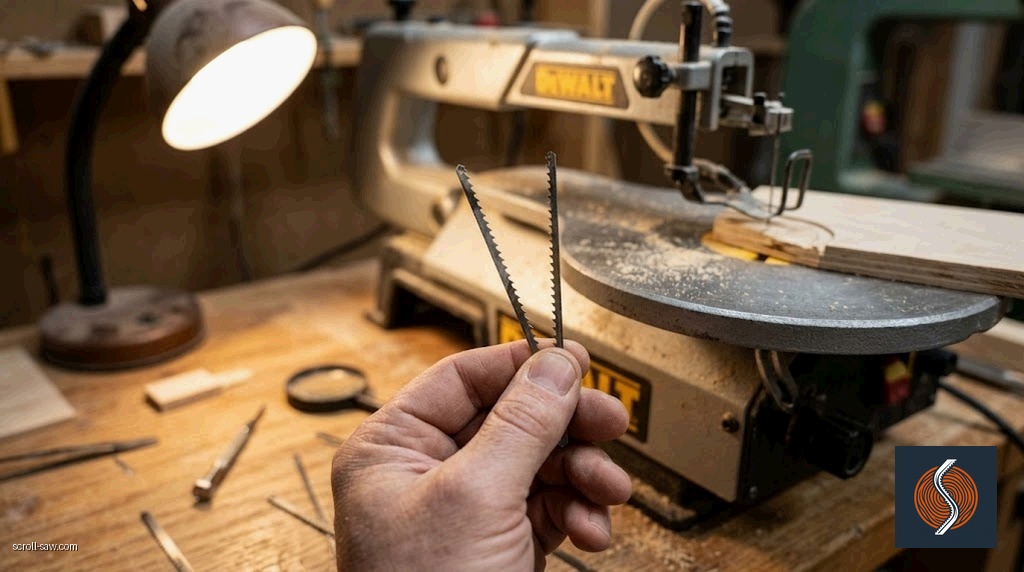
Reverse-tooth blades have most teeth pointing down, but the bottom 1/2 to 3/4 inch of teeth point up. This is intentional. The down-facing teeth cut on the down-stroke. The up-facing bottom teeth clean the underside of the workpiece as the blade rises.
Result: cleaner underside, especially in plywood and layered stock that would otherwise show splintering on the back face.
Install a reverse-tooth blade with the majority of teeth pointing down and forward, exactly like a standard blade. The reverse teeth at the bottom end up facing up naturally.
Common misunderstanding: some scrollers see the up-facing bottom teeth and think the blade was made wrong. It is intentional. Leave it.
Spiral blades: teeth in every direction
Spiral blades have teeth wrapped 360 degrees around the axis. Every position around the blade has cutting teeth. Install with any orientation and the blade cuts.
The practical guideline: install with the labeled top of the bundle facing up. Clamps align better with the intended orientation.
Selection guide by material
Solid wood, both faces visible
Skip-tooth or precision ground. Standard down-facing teeth. The underside will have slight tool marks but nothing that a light sanding cannot handle.
Plywood or veneered stock
Reverse-tooth. The up-facing bottom teeth clean the underside splinters that plywood is prone to. This is the main use case for reverse-tooth.
Fretwork where both faces show
Reverse-tooth in fine sizes (#1 or #3). Cleans both faces.
Portrait scrolling with tight curves
Spiral. Direction is not a factor because teeth wrap around the blade.
Metal (brass, aluminum, thin steel)
Metal-cutting blades in down-facing orientation. Same rule: teeth down and forward.
Plastic (acrylic, polycarbonate)
Crown-tooth or skip-tooth. Standard down-facing installation.
Selection guide by pattern
Long outlines, few interior cuts
Skip-tooth in the size that matches material. Fast cutting; clean walls.
Interior cutouts, standard detail
Skip-tooth or reverse-tooth depending on whether the underside will show.
Many small interior cutouts
Reverse-tooth in fine sizes for the underside cleanliness.
Sharp corners, reversing curves
Spiral. Cuts in any direction without pivoting the workpiece.
Fine lettering
Reverse-tooth in fine sizes for two-face cleanliness, or spiral for tight corners.
Setup regardless of blade type
Whichever blade type and direction you choose:
Verify direction before cutting. Look at the installed blade; teeth should face you and downward. Run a fingernail along the edge to feel the teeth catch.
Tension firmly. Pluck the blade for a clear ring.
Speed appropriate to material. Middle SPM for hardwood, upper middle for softwood, lower for plastics.
Feed light. Fingertip pressure only.
All four setup factors matter regardless of blade direction.
Common up-or-down mistakes
Installing blade upside down. The classic mistake. Wood burns; feed is impossible.
Flipping a blade 180 degrees to reverse direction. Wrong flip. To change direction on a plain-end blade, flip end-for-end, not side-to-side.
Assuming reverse-tooth blades install upside down. They install with most teeth down like a standard blade.
Not checking direction after replacing a blade. Every install should include a direction check. Takes seconds.
Trying to use a reverse-tooth blade as a standard blade by installing it “correctly” instead of “reverse.” There is no “reverse” installation for a reverse-tooth blade. It installs with most teeth down, exactly like a standard blade.
When up-or-down is not the fix
If your blade is installed correctly (teeth down and forward, verified with fingertip check) and the cut is still bad, look elsewhere:
Tension too loose. Blade wanders; retension until pluck test rings.
Feed too heavy. Blade bends sideways; feed lighter.
Speed wrong for material. Adjust SPM.
Blade dull. Change blade.
Wrong blade size for material. Match size to thickness and detail.
Direction is one of many setup factors, and it is the easiest to verify. If direction is correct, look at the others.
Quick verification checklist
Before every cut on a fresh blade:
-
Look at the blade: teeth should point toward you and downward.
-
Run a fingernail along the front edge; teeth should catch.
-
Confirm the blade is tensioned (pluck test rings).
-
Set saw speed appropriate to material.
-
Cut a scrap; verify smooth cutting under fingertip pressure.
Steps 1 and 2 catch direction problems. Steps 3 and 4 catch setup problems. Step 5 catches everything else.
Bottom line
Scroll saw blades install with teeth pointing down and forward. Reverse-tooth blades install the same way, with most teeth down; the up-facing bottom teeth are intentional and clean the underside. Spiral blades cut in any direction. Verify direction with a visual and fingertip check before every workpiece. Choose blade type based on material and pattern, then set up correctly for the specific job.
FAQ
Do scroll saw blade teeth face up or down? Down and forward.
Why do some blades have up-facing teeth at the bottom? Reverse-tooth blades intentionally have up-facing bottom teeth that clean the underside of the workpiece.
What happens if I install a blade upside down? The wood burns; feed is impossible; blade heats fast.
How do I check if the blade is installed correctly? Look at the teeth; they should face you and down. Run a fingernail along the edge; teeth should catch.
Do spiral blades have a specific direction? Less critical because teeth wrap 360 degrees. Install with the labeled top facing up.
Which blade for plywood? Reverse-tooth. The up-facing bottom teeth clean the plywood underside.
Which blade for finish-quality hardwood? Precision ground down-facing blade in the appropriate size.
References
-
Olson Saw Company blade installation guide, olsonsaw.com
-
Pegas Scroll Saw setup documentation, pegas-swiss.com
-
Steve Good, Scroll Saw Workshop on blade direction, scrollsawworkshop.blogspot.com
-
DeWalt DW788 owner’s manual, dewalt.com


