
Scroll Saw Blower Specification: Complete Guide
Scroll Saw Blower Specification: Complete Guide
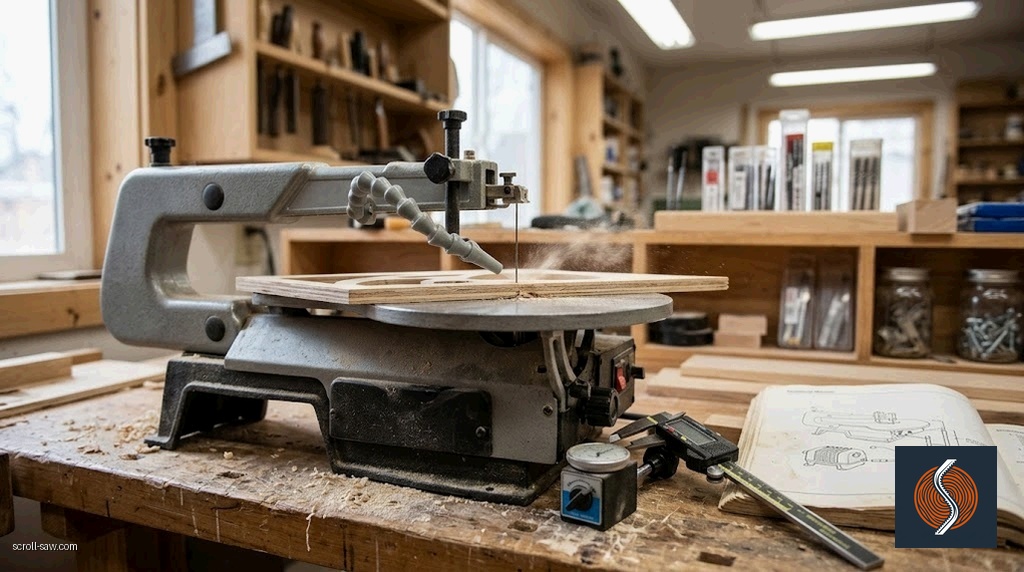
The blower on a scroll saw is a small piece of tubing that directs a stream of air at the cut line to blow sawdust away from where you are looking. It is not glamorous. It is often overlooked in reviews and setup guides. But the blower is what makes the difference between following your pattern line clearly and squinting through a pile of dust every few seconds.
Getting the blower right (right nozzle, right air source, right position) is a fifteen-minute setup that pays back every time you sit at the saw. Here is how to specify a blower correctly for your setup.
What a scroll saw blower does
The blower is a flexible tube or rigid arm that ends at a nozzle positioned near the blade. Air flows through the tube and exits at the nozzle, aimed at the cut line to clear sawdust as it accumulates.
Without a working blower:
-
Sawdust piles on the pattern line and obscures where you are cutting
-
Fine detail becomes invisible under fines
-
Every 20 to 30 seconds you have to pause and blow the dust off yourself
-
Cut quality suffers because you cannot see the line
With a working blower:
-
Pattern line stays visible throughout the cut
-
No pause-and-blow interruptions
-
Consistent cut quality because you can see where the blade is
-
Less inhaled sawdust in your breathing zone
Air source options
Scroll saw blowers get their air from one of three sources:
Built-in bellows. Many mid-range and premium saws include a small bellows driven by the saw’s motion. Every up-stroke pumps air; every down-stroke sucks air in. Simple; no external components; air volume tied to saw speed.
External aquarium pump. A small silent air pump (aquarium type) provides constant airflow. Extra cost around $10 to $20 for the pump. Advantage: airflow independent of saw speed.
Shop compressor with regulator. Overkill for most home shops but effective. Regulate to about 2 to 5 psi at the nozzle. Advantage: strong steady airflow.
No blower at all. Some cheap or entry-level saws omit the blower entirely. Adding one is a $15 aftermarket upgrade.
Nozzle types
The nozzle at the end of the tube determines air pattern:
Single-hole nozzle. Directs a narrow stream at one point. Simple; effective; easy to aim.
Fan nozzle. Spreads air across a wider area. Good for blades that cut in different directions.
Adjustable nozzle. Rotates or bends to change direction. Convenient.
Straw or tube nozzle. DIY option using a drink straw or brass tube. Cheap; works.
Most premium scroll saws ship with a single-hole nozzle on an adjustable arm.
Tube diameter
Blower tubes range from 1/8 inch (very thin) to 3/8 inch (thick). Standard is 3/16 to 1/4 inch. Diameter affects:
Airflow volume. Larger tubes carry more air.
Rigidity. Thicker tubes hold position better.
Reach. Thicker tubes bend less freely.
For most scroll saws, 1/4 inch is a good compromise.
Loc-Line as the flexibility standard
Many scrollers upgrade the stock blower with Loc-Line, a modular flexible coolant tubing system originally designed for machine tool coolant delivery.
Loc-Line advantages:
-
Snap-together segments allow custom length
-
Bends to any position and holds it firmly
-
Interchangeable nozzles
-
Widely available at machine tool suppliers and Amazon
Cost: about $10 to $20 for a full kit that includes tubing, magnetic base, and multiple nozzle types.
Positioning the blower
The nozzle should be:
About 1 to 2 inches from the blade. Close enough to blow effectively; far enough to see past.
Aimed at the cut line just ahead of the blade. Blows dust off the line before it can obscure your view.
Positioned so it does not interfere with the workpiece. Should not bump the wood or block your view.
Adjustable easily. You will reposition it based on cut direction and workpiece size.
Airflow tuning
Too much airflow:
-
Blows sawdust into your face
-
Scatters fine chips across the shop
-
Kicks dust into the saw’s motor area
Too little airflow:
-
Dust piles on the cut line
-
Fine detail obscured
Adjust the pump or bellows output until the cut line stays clear without blowing dust into your eyes.
Common blower problems
No airflow. Bellows disconnected, pump unplugged, tube kinked, or nozzle clogged.
Weak airflow. Bellows leaking, tube perforated, pump underpowered, or restriction somewhere in the line.
Airflow blows dust wrong direction. Reposition nozzle; sometimes a small angle change makes a big difference.
Blower vibrates loose during cutting. Tighten mounting; consider Loc-Line for firmer positioning.
Sawdust piles despite blower running. Position too far from cut line, or airflow too weak. Move nozzle closer or increase airflow.
When to upgrade the blower
Upgrade if:
-
Stock blower cannot keep up with dust volume
-
Positioning is awkward and slow to adjust
-
Airflow is inconsistent (bellows leaking or worn)
-
You want independent control (external pump instead of saw-driven bellows)
Upgrade options:
-
Loc-Line replacement tube. Under $20.
-
Aquarium pump. Under $20.
-
Combined kit with pump and Loc-Line. Under $40.
Dust management beyond the blower
The blower moves dust off the cut line, but the dust still ends up somewhere. Complete dust management:
Dust collection at the blade throat. Shop vac with a small-diameter adapter positioned under or behind the blade. Captures dust before it settles.
Overhead dust hood. For serious dust-producers.
Air filtration. Ceiling-mounted air cleaner for the shop as a whole.
Personal PPE. Dust mask for extended cutting; safety glasses always.
Blower alone is not dust collection. It moves dust; something else has to remove it.
Specifying a blower for a new setup
For a scroll saw purchase or upgrade:
-
Confirm the saw has a blower. Most modern saws do; cheaper ones may not.
-
Confirm the blower is adjustable. Fixed-position blowers are hard to work with.
-
Test the airflow. At the store or with a demo, verify the blower actually clears dust.
-
Plan upgrade path if needed. Loc-Line and aquarium pump kits install in under an hour.
-
Add dust collection. Blower is only half of dust management.
Bottom line
The scroll saw blower is essential for seeing the cut line clearly. Get the specification right (air source, nozzle type, tube diameter, positioning) at setup and it becomes invisible in operation. Upgrade the stock blower with Loc-Line and an aquarium pump if the built-in bellows is weak or inconvenient. Pair the blower with proper dust collection for complete dust management.
FAQ
What is a scroll saw blower? A small tube that directs air at the cut line to clear sawdust from where you are looking.
Do I need a blower on my scroll saw? Yes. Without one, sawdust piles on the pattern line and obscures your view every 20 to 30 seconds.
How do scroll saw blowers get their air? Built-in bellows driven by the saw, external aquarium pump, or shop compressor.
Can I upgrade my scroll saw blower? Yes. Loc-Line flexible tubing plus an aquarium pump for $30 or less.
Where should the blower nozzle sit? 1 to 2 inches from the blade, aimed at the cut line just ahead of the blade.
Is the blower enough for dust management? No. Blower moves dust off the line. Pair with dust collection to capture it before it settles.
What if my saw does not have a blower? Add an aftermarket kit with Loc-Line and an aquarium pump. Under $30.
References
-
Loc-Line product line, locline.com
-
Steve Good, Scroll Saw Workshop on shop setup, scrollsawworkshop.blogspot.com
-
DeWalt DW788 owner’s manual, dewalt.com
-
Bear Woods scroll saw accessories, bearwood.com


