
Scroll Saw Blower Hose: Selection Guide
Scroll Saw Blower Hose: Selection Guide
The hose (or tube) that carries air from the blower’s air source to the nozzle at the blade is usually an afterthought. Factory hoses work well enough that most scrollers never touch them. But when the factory hose wears out, kinks, or turns out to be too short for a bench setup, the replacement decision comes down to a handful of specs that determine whether the new hose helps or gets in the way.
Here is how to choose a scroll saw blower hose that matches your machine and your workflow.
What the hose does
The blower hose carries air from the air source (bellows, aquarium pump, or shop compressor) to the nozzle positioned near the blade. It has to:
-
Deliver the airflow without significant loss
-
Bend to reach from air source to blade
-
Hold shape in the position you set it
-
Not vibrate loose during cutting
-
Not interfere with workpiece movement
A good hose does all five without you noticing. A bad hose kinks, leaks, or bounces around during cutting.
Hose materials
Rubber or vinyl tubing. Standard factory material. Flexible, cheap, but tends to sag and not hold position.
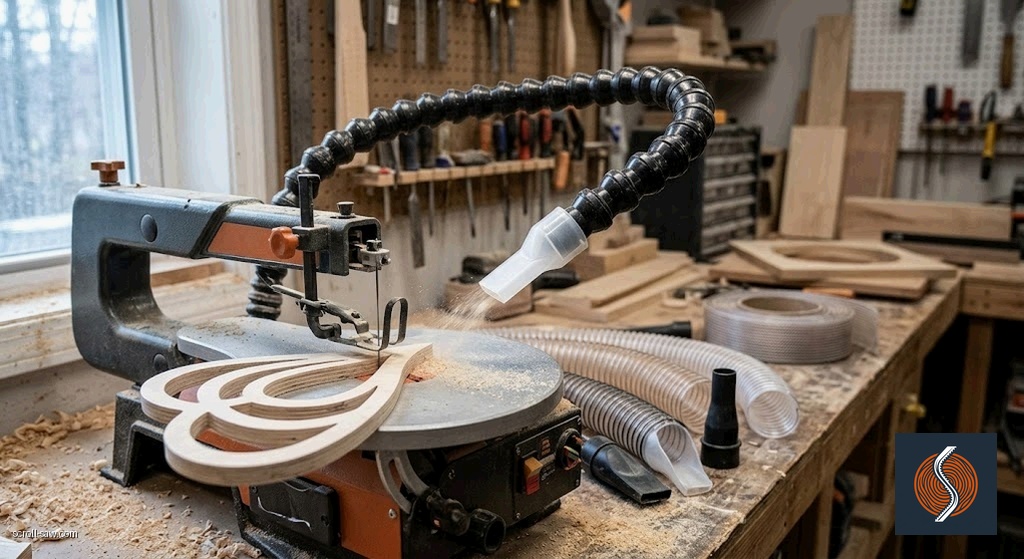
Loc-Line polymer segments. Snap-together modular tubing. Holds position firmly, easy to reconfigure, wide range of nozzles compatible.
Copper or brass tubing. Rigid; holds position permanently. Fine for a fixed setup; annoying to reposition.
Coiled polyurethane tubing. Retracts when not in use. Fine for compressor setups; unusual for scroll saw blowers.
Silicone tubing. Highly flexible; used for aquarium pump connections. Kinks easily under sharp bends.
For most scroll saw applications, Loc-Line polymer is the best all-around choice.
Hose diameter
Inside diameter affects airflow and rigidity:
1/8 inch (~3 mm). Very small. Fine for weak aquarium pumps. Kinks easily.
3/16 inch (~5 mm). Common factory size. Adequate airflow; flexible.
1/4 inch (~6 mm). Standard for Loc-Line and most aftermarket kits. Best all-around.
3/8 inch (~10 mm). Higher-airflow setups with compressor. Overkill for most.
1/2 inch (~13 mm). Large-airflow shop compressor with regulator. Rare for scroll saw.
For most scrollers, 1/4 inch inside diameter is the sweet spot.
Hose length
Measure the distance from air source to blade nozzle, then add:
-
6 to 12 inches for routing flexibility
-
Extra length if you want to swap between saws or move the setup
Too short: hose pulls on the nozzle and shifts position.
Too long: hose sags, kinks, or gets in the way.
Most setups use 12 to 36 inches of hose total.
Fittings
Hose ends connect to:
Air source. Barbed fitting for aquarium pumps; threaded or quick-connect for compressors.
Nozzle. Push-fit or threaded for Loc-Line; barbed for standard tubing.
Ensure the fittings on your hose match your air source and nozzle. Adapter fittings exist for most combinations but add complications.
When to replace the factory hose
Airflow noticeably weaker. Hose might be leaking or cracked.
Hose is stiff and cracked. Rubber and vinyl degrade over time.
Hose sags and will not hold position. Factory hose has lost its flex memory.
Hose is too short for a new setup. Bench arrangement changed or moved to a new saw.
Hose kinks at every bend. Wrong material or diameter for the required routing.
Aftermarket hose options
Loc-Line 1/4 inch modular kit. $15 to $25. Best all-around upgrade. Snap-together segments, magnetic base, multiple nozzles.
Loc-Line 1/8 inch modular kit. $10 to $20. For smaller setups or weaker pumps.
Silicone aquarium tubing. $2 to $5. Cheap replacement for aquarium-pump setups.
Vinyl tubing from hardware store. $3 to $8. Cheap general replacement.
Compressor coiled hose with regulator. $20 to $40. If moving to shop compressor.
Installing a new hose
-
Unplug the saw and any pumps.
-
Remove the old hose by disconnecting from both fittings.
-
Cut the new hose to length if it does not come pre-cut.
-
Connect one end to the air source (bellows outlet, pump barb, or compressor regulator).
-
Route the hose along the saw arm without sharp bends or kinks.
-
Connect the other end to the nozzle.
-
Secure the hose to the saw arm with clips or zip ties if needed.
-
Test airflow with the pump or saw running. Verify air exits the nozzle at expected volume.
-
Cut a scrap and confirm the nozzle stays in position.
Common hose problems
Hose kinks at a bend. Wrong material or diameter for that bend radius. Switch to Loc-Line or reroute.
Hose sags and nozzle drifts. Loc-Line holds position better than rubber. Upgrade.
Hose leaks air. Fitting loose or hose punctured. Retighten or replace section.
Hose vibrates loudly. Loose against saw arm. Secure with clip or zip tie.
Airflow weaker than expected. Hose too small in diameter for the pump output. Upgrade to larger diameter.
Hose interferes with workpiece movement. Reroute or shorten. Loc-Line lets you reconfigure easily.
Hose routing for different setups
Standard saw-mounted blower. Hose runs along the upper arm from bellows to nozzle. Keep it out of your view.
Bench-mounted arm blower. Hose runs from pump on floor or bench to arm base. Route to avoid tripping hazards.
External aquarium pump. Hose runs from pump (usually on bench or floor) to saw arm and up to nozzle. Keep pump 3+ feet from the saw to reduce vibration transmission.
Compressor setup. Hose runs from regulator (mounted on wall or bench) to nozzle. Include a quick-disconnect for easy setup change.
Hose maintenance
Wipe the hose exterior periodically to remove sawdust buildup that could clog nozzles.
Check for cracks and leaks every few months. Especially rubber and vinyl hoses.
Replace kinked sections rather than trying to straighten them permanently.
Blow out the interior if debris accumulates. Aquarium pump reverse-flow can push out dust.
Store extra hose length coiled loosely rather than tight coils that create kinks over time.
Workflow considerations
The hose should:
Support easy repositioning of the nozzle for different workpieces.
Not require tools to reroute for a new project setup.
Allow swapping nozzles without disconnecting the entire hose.
Not block your view of the pattern line.
Not block access to the saw’s controls or blade tension mechanism.
Loc-Line addresses all five better than any other option; that is why most upgrade paths land there.
Bottom line
The scroll saw blower hose is a small component with outsized effect on cutting workflow. Choose the right material (Loc-Line for most upgrades), the right diameter (1/4 inch is the sweet spot), the right length (measured plus 6 to 12 inches slack), and the right fittings for your air source and nozzle. Route the hose cleanly along the saw arm without kinks. Upgrade the factory hose when it sags, kinks, or leaks; a Loc-Line kit under $25 usually solves the problem.
FAQ
What is a scroll saw blower hose? The tube that carries air from the blower’s air source to the nozzle at the blade.
What material is best for a scroll saw blower hose? Loc-Line polymer segments for most upgrades. Holds position and easy to reconfigure.
What diameter should the hose be? 1/4 inch inside diameter is the best all-around size.
How long should the hose be? Measure air source to nozzle, add 6 to 12 inches for routing.
When should I replace the factory hose? When airflow drops, hose cracks, hose sags, or hose kinks at bends.
Where do I buy scroll saw blower hose? Loc-Line at machine tool suppliers or Amazon. Silicone or vinyl at hardware stores.
Can I use aquarium tubing as blower hose? Yes for aquarium-pump setups. Kinks easily; not as durable as Loc-Line.
References
-
Loc-Line product line, locline.com
-
DeWalt DW788 owner’s manual, dewalt.com
-
Steve Good, Scroll Saw Workshop on shop setup, scrollsawworkshop.blogspot.com
-
Bear Woods scroll saw accessories, bearwood.com


