
Scroll Saw Business Card Holder: Complete Guide
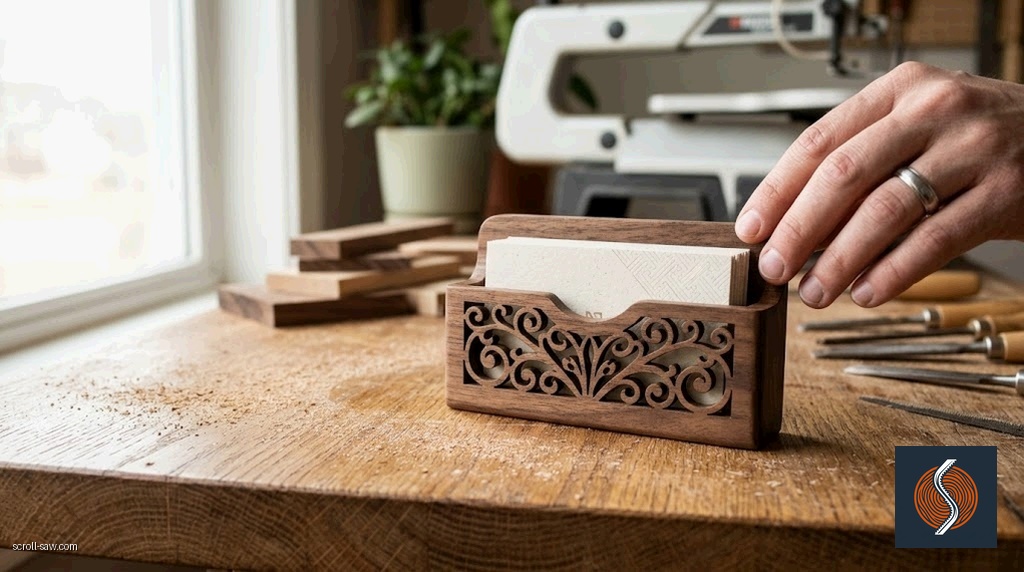
Scroll Saw Business Card Holder: Complete Guide
A business card holder is one of the classic scroll saw projects: small enough to finish in an afternoon, useful enough to give away or sell, and detailed enough to show off good scroll work. Made from 1/4 inch hardwood with a simple cutout for the cards and a small fretwork element on the front, it costs about a dollar in material and sells for $10 to $30 at craft shows.
Here is a practical guide covering design, blade selection, cutting sequence, and finishing for a scroll-cut business card holder.
Design overview
The basic design has three parts:
Back panel. A rectangular piece of hardwood, typically 3.5 inches wide by 2.75 inches tall by 1/4 inch thick.
Base. A slightly larger rectangular piece, 4 inches wide by 1.25 inches deep by 1/2 inch thick.
Card slot. A shallow groove or channel in the base that holds the bottom edge of the business cards.
Decorative options:
-
Fretwork pattern cut through the back panel (initials, monogram, silhouette, geometric design)
-
Chamfered or shaped edges
-
Contrasting wood species for base and back panel
-
Stand-up angled back panel supported by side pieces
Material selection
Cherry. Classic choice. Warm color, easy to cut, finishes beautifully.
Walnut. Rich dark color. Slightly harder to cut than cherry; excellent finish.
Maple. Very hard; clean cuts. Contrasts well with dark card slots.
Baltic birch plywood. Cheapest option; very flat; ideal for beginners. Less premium look.
Oak. Prominent grain; good for larger designs where the grain adds to the look.
For a first project, Baltic birch is the safest. For a gift or sale piece, cherry or walnut.
Blade selection
For 1/4 inch hardwood body and back panel:
Skip-tooth #5 for outlines and simple cuts.
Reverse-tooth #3 or #5 for fretwork on the back panel where the underside will show.
Precision ground #5 for finish-quality edges if you want minimal sanding.
For 1/2 inch base:
Skip-tooth #7 for outline cuts.
Straight-cut only. No fretwork in the base unless the design calls for it.
Cutting sequence
Prep
-
Print or draw the pattern. Include back panel outline, fretwork pattern, base outline, and card slot location.
-
Attach pattern to stock with spray adhesive or rubber cement.
-
Drill starter holes for interior fretwork cutouts. Use a 1/16 inch bit.
Cut back panel
-
Cut the exterior outline. Skip-tooth #5, moderate speed, light feed.
-
Cut interior fretwork. Thread the blade through starter holes, cut interior shapes, remove and move to next hole. Reverse-tooth #3 or #5.
-
Sand the fretwork edges if needed. Small files help.
Cut base
-
Cut the base outline from 1/2 inch stock. Skip-tooth #7.
-
Cut the card slot. Either:
-
Groove option. Router table with a 1/16 or 1/8 inch straight bit. Cut a groove 1/4 inch deep at a slight backward angle (about 10 degrees).
-
Cut-through option. Cut a shallow rectangular slot through the base at the same angle. Cards drop into the slot and rest on the base underneath.
A router-cut groove is cleaner. A scroll-cut slot works if you do not have a router.
Assemble
-
Test fit the back panel into the card slot. Should fit snugly with slight backward angle.
-
Glue the back panel into the slot with wood glue.
-
Clamp lightly and let dry for 24 hours.
-
Sand the entire assembly with 220 grit.
Finish
-
Apply finish of choice: shellac, wipe-on polyurethane, tung oil, or lacquer.
-
Two coats minimum. Sand lightly between coats with 320 grit.
-
Add felt or leather to the base bottom to protect surfaces the holder sits on.
Fretwork pattern ideas
Monogram. Letter or initials of the recipient.
Silhouette. Bird, tree, dog, cat, mountain scene, family crest.
Geometric. Celtic knot, mandala, art deco pattern.
Corporate logo. For business gifts. Requires clean pattern conversion.
Occupation symbol. Musical instrument, sports gear, tool.
For first attempts, start with a simple geometric pattern. Save intricate silhouettes for after you have practiced fretwork technique.
Dimensions and card capacity
Standard US business cards are 3.5 inches by 2 inches. Design for slightly larger:
-
Back panel width: 3.75 inches (0.25 inch clearance)
-
Back panel height: 2.75 inches (holds cards up to 2 inches wide with 0.75 inch showing above base)
-
Slot depth: 1/4 inch (holds cards stable without loose wobble)
-
Slot angle: 10 to 15 degrees back for stability
-
Card capacity: 20 to 30 cards typical
Adjust dimensions for other card sizes (metric cards are 85 by 55 mm).
Finishing details
Felt on the base. Cut felt slightly smaller than the base outline; adhere with contact cement.
Leather on the base. More premium than felt. Cost $2 to $5 per holder.
Chamfered edges. Small chamfer on the back panel top edge softens the look.
Beveled base edges. Add subtle detail with a small router bit or hand-plane.
Contrast inlay. For advanced work, inlay contrasting wood in the fretwork areas.
Common mistakes
Card slot too tight. Cards will not go in. Cut slot slightly wider than the card thickness.
Card slot too loose. Cards flop around. Cut slot to fit snugly.
Back panel too tall. Cards get hidden behind. Keep back panel visible above card top edge but not so tall it dominates.
Back panel too thin. Cracks in the fretwork. Use 1/4 inch minimum for detailed fretwork.
Base too small. Holder tips backward. Make the base at least 1.25 inches deep for stability.
Fretwork too intricate for stock thickness. Bridges break during cutting. Simplify pattern or use thicker stock.
Finish too glossy. Distracting on a small piece. Satin or matte finish looks more refined.
Pricing for sale
Craft show pricing for scroll-cut business card holders:
-
Simple design in Baltic birch: $8 to $15
-
Standard design in cherry or walnut: $15 to $25
-
Complex fretwork or personalized: $25 to $40
-
Corporate logo custom order: $30 to $60 depending on complexity
Material cost per holder is $0.50 to $2.00. Labor is the main input; a batch of 10 takes about a full day.
Gift and sale ideas
Groomsmen gifts. Personalized with initials or wedding date.
Retirement or promotion gifts. Custom monogram or professional symbol.
Real estate agent giveaways. Corporate logo for local realtors.
Craft show inventory. Assortment of designs, from simple geometric to detailed silhouettes.
Etsy listings. Personalized versions do well for gift-giving occasions.
Business gifts. Companies buy in quantities of 20 to 100 for client gifts.
Bottom line
A scroll saw business card holder is a small, satisfying project that showcases fretwork skill. Use 1/4 inch hardwood for the back panel with reverse-tooth or precision ground blades in #3 or #5. Cut a 1/2 inch base with an angled slot for the cards. Finish with satin polyurethane or wipe-on oil. Sell for $10 to $30 or gift with personalized monogram or silhouette. Material cost is minimal; labor is the main input.
FAQ
What size scroll saw blade for business card holders? #3 or #5 reverse-tooth for fretwork on the back panel; #5 or #7 skip-tooth for the base outline.
What wood works best? Cherry or walnut for premium pieces; Baltic birch for beginners or budget pieces.
How thick should the back panel be? 1/4 inch minimum for fretwork. Thinner stock cracks along the bridges.
How is the card slot cut? Router table with straight bit is cleanest. Scroll saw cut works too.
What angle should the card slot be? 10 to 15 degrees back from vertical for stability.
How much can I sell one for? $10 to $40 depending on wood, design complexity, and personalization.
What finish for business card holders? Satin polyurethane or wipe-on oil. Avoid glossy finishes.
References
-
Steve Good, Scroll Saw Workshop patterns, scrollsawworkshop.blogspot.com
-
Pegas Scroll Saw project catalog, pegas-swiss.com
-
Sloan’s Woodshop project patterns, sloanswoodshop.com
-
Bear Woods scroll saw patterns, bearwood.com


