
Scroll Saw Cell Phone Holder: Design Guide
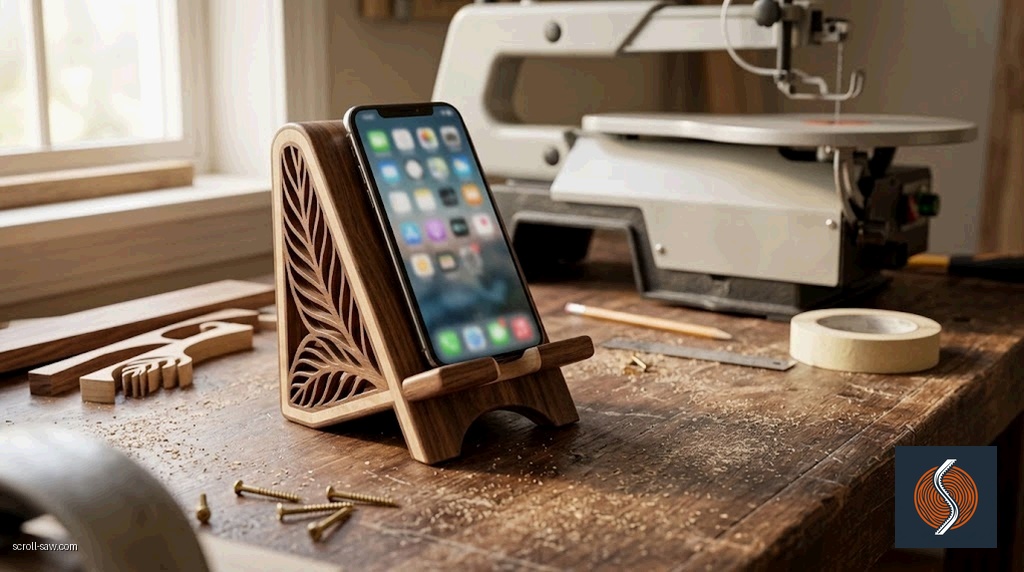
Scroll Saw Cell Phone Holder: Design Guide
A cell phone holder is one of the most useful small scroll saw projects going right now. Every desk, kitchen counter, and workshop bench needs a place to prop a phone for hands-free viewing. Cut from a single piece of hardwood in an afternoon, it costs a couple dollars in material and sells for $15 to $40 at craft shows.
Getting the specifications right matters more than for a decorative piece. The phone has to sit stable at the right viewing angle, the charging cable has to fit, and the holder has to accommodate phones of different sizes without wobbling.
Here is how to specify a scroll saw cell phone holder correctly.
Key specifications
Phone slot width
Measure across the phone’s thickness including any case. Common ranges:
Naked phones: 7 to 9 mm thick (0.28 to 0.35 inches)
Phones with slim case: 10 to 12 mm (0.4 to 0.47 inches)
Phones with rugged case: 15 to 20 mm (0.6 to 0.8 inches)
Universal design: 15 to 18 mm slot accommodates most naked and cased phones with slight give.
Allow 1 to 2 mm of clearance in the slot. Too tight and the phone won’t fit. Too loose and it wobbles.
Phone slot depth
Deep enough to hold the phone stable. Standard:
Standard depth: 15 to 20 mm (0.6 to 0.8 inches). Enough to grip the phone bottom without covering the screen.
Shallow depth: 10 to 12 mm. For small phones or when a slim look matters. Less stable.
Deep depth: 25 to 30 mm. For rugged cases or landscape orientation. May cover speaker openings.
Phone slot angle
Back angle from vertical:
Standard: 15 to 20 degrees. Comfortable viewing angle for most desk and counter positions.
Steep: 25 to 30 degrees. Nearly reclining. Good for video watching from below.
Shallow: 5 to 10 degrees. Nearly vertical. Good for FaceTime or webcam angle.
Common compromise: 15 degrees. Works for most use cases.
Base dimensions
Must be stable enough that the phone does not tip the holder:
Depth (front to back): At least 2 inches. Longer for taller phones.
Width: At least 4 inches. Wide enough for a phone in landscape orientation if desired.
Thickness: 3/4 inch minimum for stability. Thicker for larger phones.
Cable clearance
Most people charge their phone while it sits in the holder. Design for cable access:
Cutout at the bottom of the slot. A small notch or hole that lets a charging cable pass through.
Position: Center of the slot bottom for center-charging phones; adjust for side-charging.
Size: 15 to 20 mm wide by 8 to 10 mm tall. Fits most USB-C and Lightning cables with connectors.
Angle: Straight through, or angled slightly to guide the cable to one side.
Speaker clearance
Some phones have bottom-firing speakers. Consider:
Cutout under phone position to allow sound to pass through the base.
Position: Bottom center of the phone position.
Size: 20 to 30 mm wide by 5 to 8 mm deep.
For phones with side or front speakers, skip this. For phones with bottom speakers, the sound quality difference is noticeable.
Design variations
Single-piece design
Cut from one piece of thick hardwood. Slot cut with scroll saw or router.
Pro: Fewer parts, no glue joints. Clean look.
Con: Requires thick stock (3/4 inch or more). More material waste.
Two-piece design
Base piece plus vertical back piece with slot for phone.
Pro: Uses less material. Easier to cut with a scroll saw.
Con: Glue joint between pieces.
Three-piece design
Base plus two side supports that create the phone slot between them.
Pro: Adjustable slot width. Easy to accommodate different phones.
Con: More parts, more complex assembly.
Folding travel design
Collapses flat for portability.
Pro: Portable.
Con: More parts, more complex. Requires hinges or slot mechanism.
Blade selection
For 3/4 inch hardwood base:
Skip-tooth #7 or #9. Standard for thick outline cuts.
For 1/2 inch back panel (if two-piece design):
Skip-tooth #5 or #7.
For the phone slot cut:
Scroll saw with #5 skip-tooth for a rectangular slot.
Router table with 1/4 or 3/8 inch straight bit for a cleaner slot.
Router cuts cleaner slots; scroll saw slots require sanding.
Cutting sequence
Single-piece design
-
Cut the outline of the holder profile.
-
Cut the phone slot through the top edge into the body.
-
Cut cable clearance notch at the bottom of the slot.
-
Cut speaker clearance opening below the phone position.
-
Sand all surfaces thoroughly.
Two-piece design
-
Cut base outline. 3/4 inch stock.
-
Cut back panel outline. 1/2 inch stock, with the phone slot.
-
Cut mortise in base for back panel to fit into (or use a groove).
-
Test fit back panel in base.
-
Glue and clamp assembly at correct angle.
-
Sand and finish after glue dries.
Material selection
Cherry. Classic warm look. Easy to cut. Finishes beautifully.
Walnut. Rich dark color. Slightly harder to cut. Premium look.
Maple. Very hard. Clean cuts. Contrasts with darker phones.
Oak. Prominent grain. Good for larger designs.
Baltic birch plywood. Cheapest. Very flat. Good for beginners.
Bamboo. Sustainable. Contemporary look.
For sale pieces, cherry or walnut are the most requested. For personal use, whatever hardwood you have handy.
Finishing
Wipe-on polyurethane. Durable, easy to apply.
Tung oil. Warm, natural look. Requires periodic reapplication.
Shellac. Fast-drying, easy to touch up.
Lacquer. Very durable; requires spray application.
Two to three coats minimum. Sand lightly between coats with 320 grit.
Felt on the base. Cut felt slightly smaller than the outline; adhere with contact cement. Protects the surface the holder sits on.
Common design mistakes
Slot too narrow for cased phones. Users will remove case to fit; annoying. Design for 15 to 18 mm slot width.
Base too small or too light. Holder tips forward under phone weight. Make base 2+ inches deep and 3/4+ inches thick.
No cable clearance. Cable pinches against the slot bottom. Add a notch or hole.
Slot angle too vertical. Phone falls forward. Use 15+ degrees back angle.
Slot angle too steep. Phone screen faces the ceiling; hard to see. Stay under 30 degrees.
No speaker clearance for bottom-speaker phones. Sound muffled. Add a small cutout.
Sharp edges around the slot. Scratches phone case over time. Round or chamfer edges.
Testing the design
Before finalizing a design for production:
-
Prototype in scrap. Cut a version from cheap plywood first.
-
Test with multiple phones. iPhone SE (small), iPhone Pro Max (large), various cases.
-
Test with common cables. USB-C, Lightning, wireless charging pad.
-
Test on multiple surfaces. Desk, counter, table.
-
Adjust dimensions based on what actually works.
A prototype takes an hour; a bad design in production takes a day and creates unsold inventory.
Pricing for sale
Craft show pricing:
Simple design in Baltic birch: $10 to $18
Standard design in cherry or walnut: $18 to $30
Personalized with monogram: $25 to $40
Custom design for specific phone or case: $35 to $60
Material cost is $2 to $5 per holder. Labor time is 30 to 60 minutes plus finishing.
Bottom line
A scroll saw cell phone holder should have a slot 15 to 18 mm wide, 15 to 20 mm deep, angled 15 degrees back. Base at least 2 inches deep and 3/4 inch thick for stability. Include cable clearance and consider speaker clearance for bottom-speaker phones. Use hardwood for premium pieces; Baltic birch for budget or first attempts. Prototype and test with real phones before committing to production runs.
FAQ
How wide should a cell phone holder slot be? 15 to 18 mm accommodates most phones with or without slim cases.
What angle should the phone slot be? 15 to 20 degrees back from vertical for standard viewing.
Do I need a cable cutout? Yes if the phone will charge while in the holder. A small notch at the bottom of the slot.
What wood for cell phone holders? Cherry, walnut, or maple for premium pieces. Baltic birch for budget or beginners.
Should the base include speaker clearance? Useful for phones with bottom-firing speakers. Add a small cutout under the phone position.
How thick should the base be? 3/4 inch minimum for stability with typical phones.
How much can I sell one for? $10 to $60 depending on wood, complexity, and personalization.
References
-
Steve Good, Scroll Saw Workshop patterns, scrollsawworkshop.blogspot.com
-
Pegas Scroll Saw project catalog, pegas-swiss.com
-
Bear Woods scroll saw patterns, bearwood.com
-
Common phone dimension references from manufacturer spec sheets


