
Scroll Saw Motor: What to Measure Before Ordering
Scroll Saw Motor: What to Measure Before Ordering
Most scrollers never touch the motor on their saw. It hums along quietly for years until, one day, it does not: the saw runs slower than it used to, or refuses to start, or emits a burning smell mid-cut. That is when you learn scroll saw motors are surprisingly simple parts, and replacement is often less expensive than you would expect.
Here is what to measure and confirm before ordering a replacement scroll saw motor.
Why motors fail
Scroll saw motors typically fail from:
Bearing wear. After 500 to 1,000 hours of use, bearings develop play or noise. Sometimes replaceable; often the whole motor gets swapped.
Overheating. Extended runs at high speed, poor ventilation, or sawdust accumulation cause winding damage.
Voltage issues. Power surges or under-voltage can damage windings.
Age. Motors slowly lose torque over decades even without a specific failure event.
Debris in the motor. Sawdust in the fan or between windings causes overheating.
Most home-shop scroll saws see less than 100 hours per year, so motor life measured in decades is normal. Heavy production users see failures faster.
What to measure and confirm
1. Saw model and serial number
Where to find it: Nameplate on the motor housing or saw base.
Why it matters: Motors are saw-specific. Some manufacturers changed motors mid-production.
How to record: Photograph the nameplate with model and serial number.
2. Voltage and phase
Common home-shop saws: 120V AC single-phase. Standard outlet.
Some larger saws: 240V AC single-phase.
Industrial or European: 220 to 240V AC. Sometimes three-phase.
Check: Nameplate on the motor. If it says “120V,” the replacement must be 120V. Wrong voltage motor will burn out immediately or fail to run.
3. Motor horsepower or wattage
Small scroll saws: 1/8 HP (approximately 95 watts).
Standard scroll saws: 1/6 HP to 1/4 HP (125 to 190 watts).
Premium scroll saws: 1/3 HP or larger (250+ watts).
Check: Nameplate rating. Match or exceed for replacement.
4. RPM
Variable speed saws: Motor rated for the top speed; controller adjusts.
Fixed speed saws: Motor RPM matches saw speed.
Typical range: 400 to 1,725 RPM at motor shaft.
Match the RPM of the original motor. A different RPM changes cutting speed and can damage the drive mechanism.
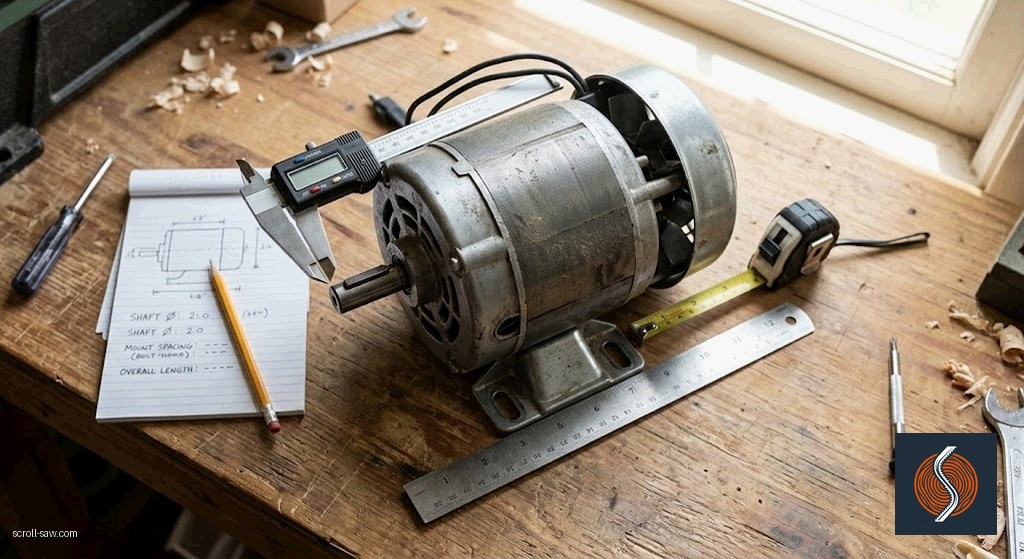
5. Motor mount and shaft
Mount pattern. Bolt holes and spacing must match the saw’s motor mounting bracket.
Shaft diameter. Common: 1/2 inch. Verify with calipers.
Shaft length. Measures from face of motor to end of shaft. Must match for pulley or eccentric fit.
Shaft keyway or flat. If the pulley uses a keyway or set screw against a flat, the shaft must have the same feature.
6. Rotation direction
Some motors are reversible; some are single-direction. Confirm which:
Check original motor. Look for arrow on housing or connection diagram.
Match the replacement. Wrong rotation direction damages the saw drive mechanism.
7. Duty cycle
Continuous duty (S1). Runs indefinitely at rated load. Standard for scroll saws.
Intermittent duty (S2 or S3). Rated for short runs with cooling breaks. Not appropriate for scroll saws.
Confirm the replacement is continuous duty rated.
8. Cooling method
Fan-cooled. Motor has an internal fan drawing air across windings. Standard for scroll saw motors.
Convection cooled. Passive; less common on scroll saws.
Match the original’s cooling method. Fan-cooled motors need airflow; a fully enclosed replacement may overheat.
9. Electrical connections
Wire count. Two-wire (single voltage) or three-wire (with ground). Match the original.
Terminal style. Screw terminals, spade lugs, or pigtail leads. Match or adapt.
Capacitor. Some single-phase motors use a start capacitor. Confirm capacitor is included with the replacement or transfer the original.
Where to find part numbers
Saw owner’s manual. Usually has motor part number.
Manufacturer website. Some list current part numbers.
Authorized dealers. Can cross-reference by saw model and serial number.
Motor manufacturer. If the motor has its own nameplate, order by that number.
Aftermarket motor suppliers. Grainger, McMaster-Carr, Amazon list motors by spec.
Common motor replacement scenarios
Direct factory replacement
Cost: $80 to $300 depending on saw model.
Compatibility: Guaranteed if you order the correct part number.
Availability: Depends on saw age and manufacturer support.
Cross-referenced generic replacement
Cost: $50 to $200.
Compatibility: Matches specs but may have slightly different mount or shaft. Confirm before ordering.
Source: Grainger, McMaster-Carr, Motor Superstore.
Rebuilt motor
Cost: $60 to $200.
Compatibility: Same as original.
Availability: Local motor rewind shops. Rare for very small motors; more common for larger saws.
Motor upgrade
Cost: $150 to $400.
Purpose: Higher torque, quieter operation, or better duty cycle.
Compatibility: Must match mount and shaft. Verify carefully.
Installation checks
Before installation
-
Unplug the saw and confirm no power.
-
Photograph existing wiring before disconnecting.
-
Note wire colors and terminal positions.
-
Have tools ready: Socket set, screwdriver, wire strippers if needed.
-
Verify replacement motor matches specs.
During installation
-
Disconnect wiring. Remove wire nuts or terminals.
-
Remove motor mount bolts. Support motor weight as final bolt comes out.
-
Remove old motor.
-
Transfer any accessories (pulley, fan, capacitor) if not included with replacement.
-
Install new motor. Align mount holes; install bolts finger-tight first, then torque.
-
Reconnect wiring matching the original diagram.
-
Verify all connections are secure.
-
Double-check nothing is loose or in the path of moving parts.
After installation
-
Plug in the saw.
-
Test at lowest speed first. Listen for unusual noise or vibration.
-
Gradually increase speed. Verify smooth operation.
-
Cut a scrap. Confirm cutting performance matches original.
-
Run for 15 to 30 minutes to break in bearings and verify no overheating.
Common installation problems
Motor does not start. Check wiring; verify voltage at motor; check start capacitor if applicable.
Motor runs backwards. Reverse leads on capacitor start motors; check wiring diagram.
Motor vibrates. Mount not tight, pulley not aligned, or motor bearing damaged. Check each.
Motor overheats. Wrong duty cycle, blocked cooling airflow, or wrong voltage. Diagnose carefully.
Saw runs slower than before. Wrong RPM motor or worn drive mechanism.
Pulley does not fit shaft. Wrong shaft diameter or missing keyway.
When to hire a professional
Call an electrician or motor shop if:
Wiring is unclear. Old motors sometimes have non-standard wiring.
Capacitor connections are unclear. Wrong capacitor wiring damages motors.
Motor upgrade requires new wiring. May exceed circuit capacity.
Saw is high-value. For expensive premium saws, professional installation ensures no accidental damage.
Preventing motor failure
Clean motor housing regularly. Blow out sawdust with compressed air (not high pressure).
Ensure adequate ventilation. Do not block the fan intake.
Do not overload the saw. Feed pressure should not stall the motor.
Use appropriate speed for the material. Extended high-speed runs on hard material stress the motor.
Let the motor cool between long sessions. 15-minute break every hour prevents winding damage.
Check voltage stability. In areas with poor power quality, use a surge protector or voltage regulator.
Bottom line
Scroll saw motors are simple, replaceable parts. Before ordering: record saw model and serial number, confirm voltage and phase, match horsepower and RPM, verify mount and shaft dimensions, and check rotation direction and duty cycle. Order from the manufacturer, authorized dealer, or aftermarket supplier that lists compatibility. Install with power off; verify wiring; test at low speed first. For expensive or complex installations, consult a motor shop or electrician.
FAQ
How long does a scroll saw motor last? Home use: decades. Heavy production: 500 to 1,000 hours.
What voltage do scroll saws use? Most US home saws: 120V AC. Some larger or European saws: 240V.
How much horsepower does a scroll saw need? 1/6 to 1/3 HP for most scroll saws. Match the original spec.
Can I upgrade to a higher-horsepower motor? Sometimes. Must match mount, shaft, RPM, and duty cycle.
Where do I buy scroll saw motor replacements? Manufacturer parts department, authorized dealer, Grainger, McMaster-Carr, Amazon.
How much does a replacement motor cost? $50 to $300 depending on saw model and motor spec.
When should I replace vs repair? Small motors are usually cheaper to replace than repair. Larger motors may be worth rebuilding.
References
-
DeWalt DW788 parts catalog, dewalt.com
-
Delta scroll saw parts documentation
-
Grainger motor selection guide, grainger.com
-
McMaster-Carr electric motors, mcmaster.com
-
Steve Good, Scroll Saw Workshop on saw maintenance, scrollsawworkshop.blogspot.com


