
Scroll Saw Throat Plate: Failure and Replacement
Scroll Saw Throat Plate: Failure and Replacement
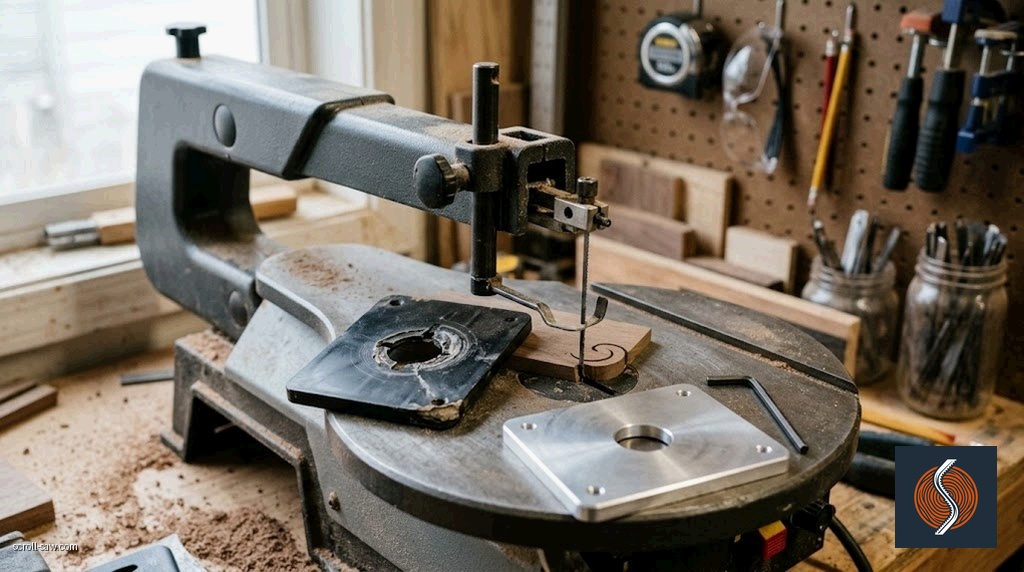
The throat plate is the small removable panel that fills the opening around the blade at the scroll saw’s table surface. Also called an insert. Unlike the cast-iron table, the throat plate is meant to wear and be replaced. Here is when to replace it and what to watch for as it ages.
What a throat plate does
Provides support close to the blade. Small workpieces stay flat instead of dipping into the throat opening.
Provides zero-clearance around the blade. Reduces tear-out and chatter on fine detail.
Allows access under the table. Removes for sawdust cleanup and blade inspection.
Wears predictably. Replacement is cheap and easy compared to replacing the table.
Common failure modes
1. Slot enlarged
Cause. Blade oscillation wears the slot edges over hundreds of hours of use.
Symptom. Slot noticeably wider than a new insert. Small pieces dip into the gap. Fine detail loses support.
Replacement criteria. When workpiece support degrades noticeably. Usually 100 to 500 hours of use.
2. Cracked around the slot
Cause. Repeated stress from blade contact, or the slot was cut too close to a plywood layer edge.
Symptom. Visible crack extending from the slot outward.
Replacement criteria. Any crack. Cracks propagate; broken pieces can jam the blade or fly out.
3. Warped
Cause. Humidity exposure (for wood or plywood inserts), or one-sided heat/moisture exposure.
Symptom. Insert no longer sits flat. Rocks in pocket; cannot be leveled properly.
Replacement criteria. Warping affects support and safety. Replace.
4. Leveling screws stripped
Cause. Overtightening leveling screws, or aluminum insert thread wear.
Symptom. Cannot adjust leveling. Insert sits at an inconsistent height.
Replacement criteria. Cannot maintain flush fit. Replace insert or repair threads with helicoil (rare for scroll saw inserts).
5. Chipped or splintered edges
Cause. Wood or plywood insert dropped or hit during cleaning; workpiece caught on edge.
Symptom. Chipped or splintered around the perimeter.
Replacement criteria. Cosmetic if minor. Replace if chips affect fit or workpiece movement.
6. Blade contact marks
Cause. Slot too narrow or misaligned; blade wanders during cutting; blade not vertical.
Symptom. Marks along the slot from blade contact. Heat discoloration in severe cases.
Replacement criteria. Cosmetic if minor; replace with a wider slot or realign blade if the problem persists.
7. Sawdust ingress
Cause. Insert not seated flat; leveling screws loose.
Symptom. Sawdust accumulates on top of insert edges. Workpiece slides less smoothly.
Replacement criteria. Not usually a replacement issue; readjust leveling and clean.
8. Insert flies out during cutting
Cause. Insert not secured; vibration; missing fasteners.
Symptom. Insert lifts out of pocket during cutting.
Replacement criteria. Not a replacement issue; add clips or fasteners.
Insert materials and their failure patterns
Cast metal (aluminum or zinc). Fails slowly; slot wears over years of use. Rarely cracks. Threads can strip.
Baltic birch plywood (DIY). Fails from moisture warping, wear, or edge splintering. Cheap to replace.
Hardwood (DIY). Similar to plywood but more stable. Wears at the slot.
Phenolic. Very durable. Rarely fails.
Plastic (HDPE, UHMW). Wears at the slot; can crack.
For high-volume users, phenolic is the longest-lasting. For casual users, factory aluminum or DIY plywood is adequate.
Replacement decision matrix
| Symptom | Try first | Replace if… |
|---|---|---|
| Slot enlarged | Nothing; wear is one-way | Support noticeably degraded |
| Cracked | Nothing; cracks propagate | Any visible crack |
| Warped | Adjust leveling if possible | Cannot level flat |
| Leveling screws stripped | Repair threads if possible | Cannot adjust |
| Chipped edges | Sand smooth if minor | Fit or safety compromised |
| Blade contact marks | Widen slot or realign blade | Marks persist after adjustment |
| Sawdust ingress | Readjust leveling; clean | Not a replacement issue |
| Insert flies out | Add clips or fasteners | Not a replacement issue |
Preventive maintenance
Clean the pocket regularly. Vacuum or brush after each session. Sawdust prevents flat seating.
Check leveling monthly. Vibration can loosen screws over time.
Inspect for cracks periodically. Especially around the slot where wear is highest.
Rotate DIY inserts. Keep a set for different blade sizes; label them.
Replace before catastrophic failure. A worn but functional insert is easier to replace during a planned maintenance session than during a project.
When to replace vs. when to make a new zero-clearance
Replace with same type when. The factory insert is worn but the design is still working for you.
Make a new zero-clearance when. You want better support for fine detail, or you have switched to a new blade size.
Keep a set of zero-clearance inserts when. You switch blade sizes often (e.g., #3 for detail, #7 for outline). Make one for each common blade size.
DIY replacement guide
DIY plywood or hardwood inserts are cheap and take 15 to 30 minutes:
-
Trace factory insert onto 1/4 to 1/2 inch Baltic birch plywood.
-
Cut outline slightly oversized with scroll saw or band saw.
-
Sand to exact fit with disc sander or belt sander.
-
Drill 1/16 inch starter hole for the blade slot.
-
Cut blade slot with scroll saw. Slot width: 1/16 inch wider than the blade for zero-clearance; wider for a universal slot.
-
Test fit in table pocket.
-
Adjust leveling screws for flush fit with table.
-
Optional: apply finish (wipe-on polyurethane) for moisture protection.
Cost: under $2 per insert. Time: 15 to 30 minutes.
Factory replacement guide
-
Verify part number from saw manual or manufacturer.
-
Order from manufacturer or authorized dealer.
-
Unplug saw.
-
Remove old insert.
-
Clean pocket.
-
Install new insert.
-
Adjust leveling screws for flush fit.
-
Test with straight edge.
Cost: $10 to $30 depending on saw model.
When to consider a different approach
Repeatedly warping DIY inserts. Switch to phenolic material or accept more frequent replacement.
Cracking around slot repeatedly. Try thicker stock (1/2 inch instead of 1/4) or hardwood instead of plywood.
Factory inserts wear out fast. Consider high-volume phenolic aftermarket inserts.
Cannot maintain zero-clearance across multiple blade sizes. Make and label a set of DIY inserts for each common blade size.
Signals it is time to replace
Fine detail work loses definition. Slot wear reducing support.
Workpiece dips visibly into the throat. Enlarged slot or worn edge.
Insert wobbles or rocks. Warping or worn screws.
Blade contact marks appear. Misalignment or slot wear.
Cracks appear. Structural failure imminent.
Sawdust builds up in pocket faster than usual. Insert not seating flat.
Cost of not replacing
Reduced cut quality. Tear-out, chatter, wandering.
Broken workpieces. Small pieces dip into the throat and break.
Blade damage. Blade contact with insert edge wears the blade faster.
Safety risk. Cracked insert can shatter under vibration; broken pieces are eye hazards.
Time lost troubleshooting. Fixing other things when the insert is the actual problem.
Bottom line
Scroll saw throat plates fail predictably from slot wear, cracking, warping, and screw damage. Replace when workpiece support degrades noticeably, when cracks appear, when warping cannot be corrected, or when threads strip. DIY replacements from Baltic birch cost under $2 each; factory replacements are $10 to $30. Keep a set of zero-clearance inserts labeled by blade size for fine detail work. Inspect and clean regularly; replace before catastrophic failure.
FAQ
What is a scroll saw throat plate? The removable panel around the blade at the table surface. Also called an insert.
When should I replace the throat plate? When the slot enlarges, cracks appear, warping cannot be corrected, or threads strip.
How long does a throat plate last? Factory metal inserts: years. DIY plywood inserts: months to years depending on use.
Can I make my own throat plate? Yes. 1/4 to 1/2 inch Baltic birch plywood. Under $2 each.
Why does my slot keep wearing wider? Blade oscillation over hundreds of hours. Normal wear. Replace when support degrades.
What causes throat plate cracks? Stress at the slot edge, wrong material, or accumulated wear.
How much do throat plates cost? $10 to $30 for factory; under $2 for DIY.
References
-
DeWalt DW788 owner’s manual, dewalt.com
-
Pegas Scroll Saw accessories, pegas-swiss.com
-
Sloan’s Woodshop parts, sloanswoodshop.com
-
Steve Good, Scroll Saw Workshop on saw maintenance, scrollsawworkshop.blogspot.com


