
Sharktooth Scroll Saw Blades: Selection Guide
Sharktooth Scroll Saw Blades: Selection Guide
Sharktooth (sometimes written shark tooth) scroll saw blades are the aggressive fast-cut option in the scroll saw blade lineup. Where skip-tooth blades produce clean cuts at moderate speed and precision ground blades produce clean cuts at slow speed, sharktooth blades produce rougher cuts at high speed. For the right application, that speed advantage matters.
Here is a practical selection guide covering when to choose sharktooth blades, which sizes to use for which materials, and how to pair sharktooth with other blade types in a workflow.
What sharktooth blades are
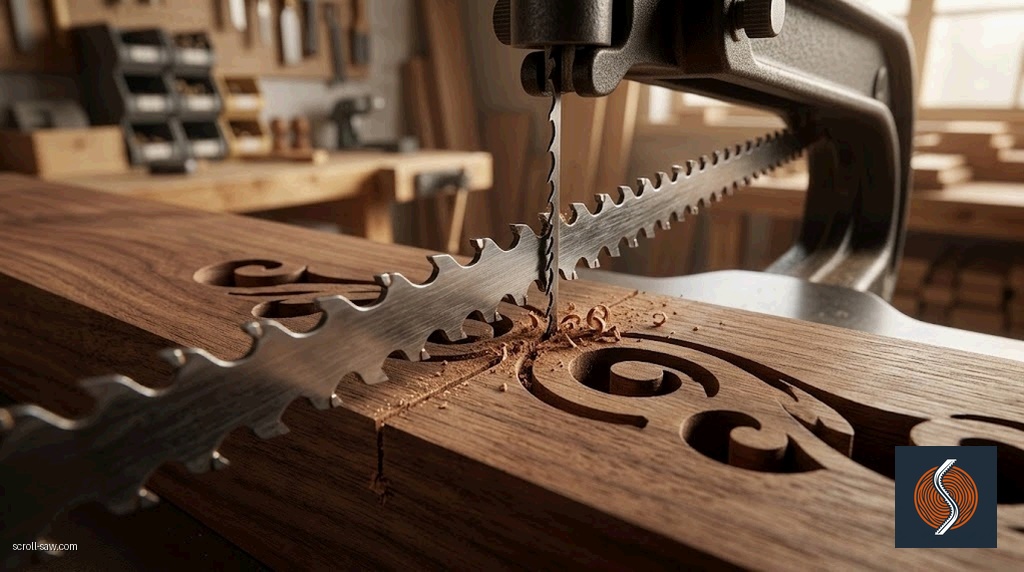
Sharktooth blades have teeth clustered in groups (usually two or three teeth together) separated by wide gullets. The clustered teeth cut aggressively; the wide gullets clear sawdust before it packs the blade.
Compared to standard skip-tooth blades:
-
Faster feed rate
-
Better dust clearing
-
Less blade loading on thick stock
-
Rougher cut finish
-
Similar blade thickness (kerf) and minimum turning radius
When to choose sharktooth
Thick hardwood cutting
At 3/4 inch or thicker, standard skip-tooth blades slow down noticeably. Sharktooth maintains cutting speed even in thick oak, maple, or walnut. Ideal for cutting scroll saw art from thicker slabs, or for cutting 3D scroll saw pieces from stacked material.
Rough sizing before detail work
Many scroll projects begin with an outside outline cut before the fret detail. Sharktooth handles the outline fast; switch to reverse-tooth or skip-tooth for the fret work.
Production runs
Cutting 50 wooden ornaments from cherry stock? Sharktooth cuts each faster than skip-tooth, and the finish sanding is the same either way.
Thick softwood
Pine and poplar in 1 to 2 inch thickness. Sharktooth clears the softer waste efficiently.
Rough bandsaw-style work
When you want to use the scroll saw for freehand curved cuts on thicker stock than the scroll saw normally handles well.
When to skip sharktooth
Fine detail work
Rough cut finish requires too much sanding cleanup. Reverse-tooth or precision ground blades work better.
Portrait scrolling
Cut quality matters more than speed. Spiral blades cut in all directions; precision ground leaves cleaner edges.
Fretwork on visible faces
The underside splintering typical of sharktooth is a problem when both faces show. Use reverse-tooth instead.
Very thin stock (under 1/8 inch)
Standard blades cut thin stock plenty fast. Sharktooth aggressive geometry can cause tear-out.
Learning to scroll
Sharktooth is less forgiving of heavy feed than skip-tooth. Beginners often push too hard and get wandering cuts.
Size selection by material
1/4 inch hardwood or plywood
Rough outline: Sharktooth #5.
Fine work: Not recommended; use reverse-tooth #3.
1/2 inch hardwood
Rough outline: Sharktooth #5 or #7.
Rough freehand curves: Sharktooth #7.
3/4 inch hardwood
Rough outline: Sharktooth #7.
Freehand shaping: Sharktooth #9.
1 inch hardwood
Rough outline: Sharktooth #9.
Very rough cuts: Sharktooth #12.
1.5 to 2 inch hardwood
Rough cutting: Sharktooth #12.
Or use band saw: Beyond typical scroll saw capacity; consider band saw if available.
Softwood (pine, poplar, cedar)
Drop one size from hardwood recommendations. Softer wood cuts easier.
Softwood 2+ inches
Sharktooth #12. Full-thickness scroll cutting.
MDF
Not ideal. Sharktooth teeth wear fast on MDF adhesive layers. Use skip-tooth if you must; consider bandsaw for large MDF outlines.
Workflow examples
Wooden ornament production
Materials: 3/4 inch cherry.
Batch size: 20 ornaments.
Sequence:
-
Rough outline all 20 blanks with sharktooth #9. Fast batch outline cutting.
-
Cut fretwork detail in each with reverse-tooth #3. Clean edges.
-
Sand each ornament.
-
Finish with wipe-on polyurethane.
Sharktooth handles the volume; reverse-tooth handles the finish quality.
Thick wall art
Materials: 2 inch maple slab.
Design: Silhouette with some interior cutouts.
Sequence:
-
Rough outline with sharktooth #12. Slowly and steadily.
-
Interior cutouts with sharktooth #9. Threading through starter holes.
-
Sanding to refine edges.
-
Router chamfer or bevel on edges.
Standard blades would struggle with 2 inch stock; sharktooth handles it.
Multi-piece 3D scroll
Materials: Multiple layers of 3/4 inch hardwood glued temporarily for cutting.
Design: 3D scroll like a stylized bird or fish.
Sequence:
-
Stack and temporary-glue three 3/4 inch pieces.
-
Cut front-view outline with sharktooth #12 (through 2.25 inches of stock).
-
Separate layers; restack for side-view cut.
-
Cut side-view outline with sharktooth #12.
-
Refine and sand.
3D scroll cutting requires cutting through stacked layers; sharktooth handles the thickness.
Brand comparison
Pegas Modified Geometry. Premium sharktooth-style; consistent quality; smooth cutting.
Flying Dutchman Ultra Reverse. Aggressive geometry with reverse-tooth underside; hybrid approach.
Olson Precision Ground sharktooth. Standard commercial option; widely available.
Niqua Puma. European premium; excellent for thick stock.
PS Wood Ultra Reverse. Aggressive with reverse-tooth; good hybrid.
Hardware store house brands. Adequate for casual use; less consistent than premium brands.
For serious production, premium brands (Pegas, Niqua, PS Wood) pay back in longer blade life and more consistent cuts.
Cost expectations
Generic sharktooth #5: $6 to $10 per dozen.
Premium sharktooth #5: $10 to $18 per dozen.
Sharktooth #9 or larger: $10 to $20 per dozen.
Assortment packs: $15 to $40 for multiple sizes.
Buy in dozens rather than singles. Test one dozen before ordering multiples.
Setup tips for sharktooth
Tension
Standard scroll saw tension. Firm; blade barely deflects when plucked.
Speed
Hardwood: 800 to 1,200 SPM.
Softwood: 1,000 to 1,500 SPM.
Thick stock: Lower end for control.
Feed pressure
Light to medium. Sharktooth teeth cut fast on their own; heavy feed causes wandering and burn marks.
Dust management
Sharktooth clears its own dust well. Standard dust blower and shop vac work fine.
Blade change frequency
Sharktooth blades dull faster than skip-tooth on abrasive materials (MDF, plywood adhesive layers). Change blades when cut quality degrades noticeably.
Common problems
Excessive splintering on underside. Sharktooth is not usually reverse-tooth. Use reverse-tooth for jobs where underside matters.
Rough cut edge. Expected. Sand more before finishing.
Blade wanders. Feed too heavy or tension too low. Adjust.
Blade burns wood. Feed too heavy or speed too fast. Reduce both.
Blade breaks quickly. Over-tension or excessive feed. Adjust.
Dust piles despite dust blower. Feed too heavy for the blade’s clearing rate. Reduce feed.
Comparison table
| Requirement | Sharktooth | Skip-tooth | Reverse-tooth | Precision ground | Spiral |
|---|---|---|---|---|---|
| Speed | Fast | Medium | Medium | Slow | Medium |
| Cut finish | Rough | Good | Very good | Best | Fair |
| Underside quality | Poor | Fair | Very good | Very good | Fair |
| Blade life | Fair | Good | Good | Excellent | Fair |
| Cost per blade | Medium | Low | Medium | High | Medium |
| Best for | Rough outline, thick stock | General use | Plywood, fretwork | Finish work | Portrait, tight curves |
Bottom line
Choose sharktooth scroll saw blades when speed matters more than finish: thick hardwood, production runs, rough outline cuts, and freehand curved cutting on stock too thick for standard blades. Size selection matches standard scroll saw blade numbering. Set light feed pressure and standard tension. Follow rough sharktooth cuts with reverse-tooth or precision ground blades for finish detail. Sand more before finishing than you would with cleaner-cutting blades.
FAQ
When should I use sharktooth scroll saw blades? Thick hardwood, production runs, rough outline cuts, freehand curved cutting on thick stock.
What size sharktooth for 3/4 inch cherry? #7 for detail; #9 for rough outline.
Are sharktooth blades reverse-tooth? Some hybrid versions (like Flying Dutchman Ultra Reverse) combine aggressive teeth with reverse-tooth underside. Standard sharktooth is not reverse.
How do sharktooth blades compare to skip-tooth? Faster cutting; rougher finish. Same size numbering and kerf.
What brand of sharktooth blade is best? Pegas Modified Geometry, Niqua Puma, PS Wood Ultra Reverse are premium options.
How much do sharktooth blades cost? $6 to $20 per dozen depending on brand and size.
Can I use sharktooth for fine detail? Not recommended. Cut finish is too rough. Use reverse-tooth or precision ground instead.
References
-
Pegas Scroll Saw blade catalog, pegas-swiss.com
-
Olson Saw Company product line, olsonsaw.com
-
Niqua GmbH blade line, niqua.de
-
Flying Dutchman blades from Mike’s Workshop, mikesworkshop.com
-
PS Wood scroll saw supplies, pswood.com
-
Steve Good, Scroll Saw Workshop on blade selection, scrollsawworkshop.blogspot.com


