
Skil Scroll Saw Blade Change: Complete Guide
Skil Scroll Saw Blade Change: Complete Guide
Skil scroll saws are the entry point for many first-time scrollers. Priced under $200, available at big-box hardware stores, and easy to set up out of the box, they get people into scroll cutting without a serious investment. The blade change process on a Skil scroll saw is one of the first things you learn, and it is one of the areas where the entry-level design shows.
Here is what to know about changing blades on a Skil scroll saw, plus the size, tooth geometry, and material considerations that make cuts turn out better.
Blade compatibility
Skil scroll saws (models like the 3335, 3320) typically accept:
Pinned-end blades: Standard for many Skil models. Cross-pin at each end drops into slots.
Plain-end blades with adapter: Some models include or accept plain-end adapters.
Check your specific model manual. Pinned-end blades are simpler for beginners; plain-end offer more size and type options.
Blade sizes for Skil scroll saws
Standard scroll saw numbering:
#3. Fine detail work.
#5. Standard general use.
#7. Heavier cuts.
#9. Thick stock.
Most Skil scroll saws handle #3 through #9 well. #12 may be beyond the machine’s capability.
Blade change procedure
For pinned-end blades
-
Turn off and unplug the saw.
-
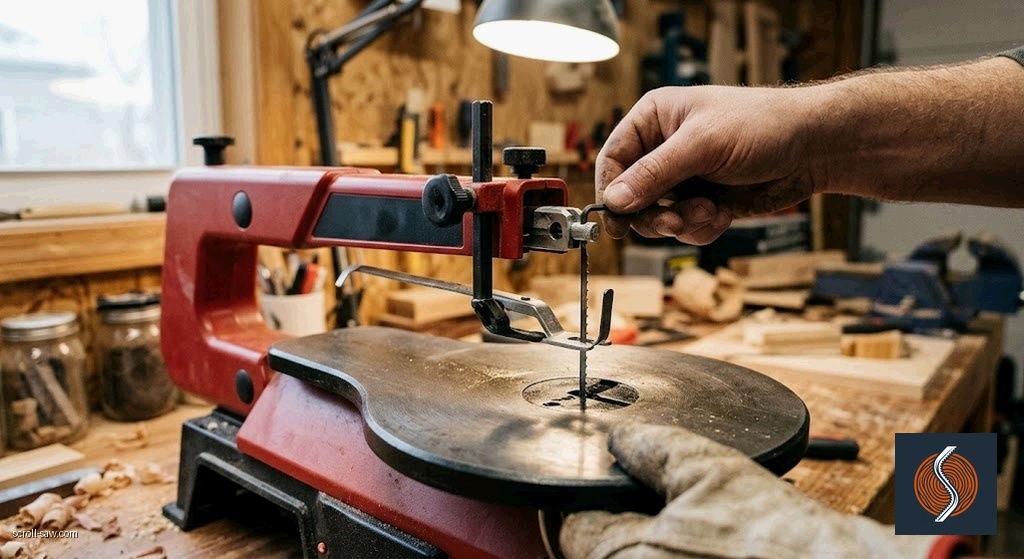
Release blade tension. Usually a lever or knob on the top of the arm.
-
Lift the blade guard if applicable.
-
Remove the old blade by lifting the top pin out of the upper clamp slot, then lifting the bottom pin out of the lower slot.
-
Insert the new blade. Bottom pin into the lower slot first, then top pin into the upper slot.
-
Verify blade orientation. Teeth face down for standard cutting.
-
Reapply tension.
-
Verify blade alignment is vertical.
-
Plug in and test with a scrap cut.
Time: 30 to 60 seconds with practice.
For plain-end blades with adapter
-
Turn off and unplug the saw.
-
Release tension.
-
Remove the old blade by loosening the upper adapter and lifting the blade out.
-
Insert the new blade into the lower adapter first, then upper.
-
Verify insertion depth matches the reference mark.
-
Tighten adapters.
-
Reapply tension.
-
Verify blade alignment.
-
Test cut.
Time: 45 to 90 seconds with practice.
Tooth geometry
Skip-tooth
Most common Skil-compatible blade. Alternating teeth and gullets. Good general-purpose cutting.
Best for: Standard cutting, outlines, moderate curves.
Reverse-tooth
Bottom-third teeth face upward. Reduces underside splintering.
Best for: Plywood, veneers, cases where both sides show.
Precision ground
Ground teeth for finer finish. Less common in pinned-end format.
Best for: Finish quality cuts. Rare for Skil users.
Spiral
Twisted blade cuts in any direction. Less common in pinned-end format.
Best for: Portrait scrolling; not usually available for Skil.
For Skil scroll saws, skip-tooth and reverse-tooth in pinned-end format cover most needs.
Material recommendations
1/8 inch plywood
Standard cutting: Pinned skip-tooth #3.
Fine detail: Pinned skip-tooth #3, slow feed.
Reduce splintering: Reverse-tooth #3 if available.
1/4 inch plywood or hardwood
Standard cutting: Pinned skip-tooth #5.
Fretwork: Pinned skip-tooth #3.
Reduce splintering: Reverse-tooth #5 if available.
1/2 inch hardwood
Standard cutting: Pinned skip-tooth #7.
Detail: Pinned skip-tooth #5.
3/4 inch hardwood
Standard cutting: Pinned skip-tooth #9.
At the machine’s capability limit. Some Skil models struggle here.
1 inch hardwood
Generally beyond Skil scroll saw capability. Feed slowly if attempted. Use band saw for thick stock.
Softwood (pine, poplar)
Drop one size from hardwood recommendation.
MDF
Pinned skip-tooth in size for thickness. MDF dulls blades quickly; expect more frequent blade changes.
Non-ferrous metal (thin aluminum, brass)
Special metal-cutting blades if available in pinned format. Slow speed with lubricant. Not all Skil models are ideal for metal.
Speed settings
Skil variable-speed models offer a range of speeds:
Slow speed. Fine detail, hardwood, metal.
Medium speed. Standard cutting, most work.
Fast speed. Softwood, rough cutting.
Most Skil scroll saws use 550 to 1,600 SPM range. Start at medium and adjust.
Feed pressure
Light. Let the blade cut at its own pace.
Steady. Consistent feed produces smoother cuts.
Adjust for material. Softwood accepts more feed; hardwood needs less.
Heavy feed on a Skil scroll saw stalls the motor and causes wandering cuts. Light and patient produces better results.
Cut quality tips
1. Use fresh blades
Dull blades ruin otherwise perfectly good cuts. Change blades when cut quality degrades or when you feel the blade slowing.
2. Match blade to material thickness
Oversized blades cannot follow tight curves. Undersized blades take too long and burn.
3. Use reverse-tooth for plywood
Splintering on the underside is the most common complaint from beginners. Reverse-tooth solves it.
4. Slow speed for hardwood
High speed on hardwood burns the wood and stresses the motor.
5. Keep the blade tension firm
Under-tensioned blades wander. Blade should barely deflect when plucked in the middle.
6. Support the workpiece
Hold flat against the table. Small pieces dip into the throat opening; use zero-clearance insert if possible.
7. Cut slowly on curves
Rush a curve, wander off the line. Slow down for accuracy.
Common Skil scroll saw problems
Motor bogs down. Feed too heavy or blade too small for stock. Reduce feed; use larger blade.
Blade breaks quickly. Over-tension, excessive feed, or wrong blade size. Adjust.
Blade slips out of pin socket. Pin damaged or slot worn. Replace blade or clamp.
Excessive vibration. Stand unstable, or saw not properly mounted. Verify installation.
Blade wanders. Under-tension, dull blade, or heavy feed. Adjust.
Rough cut finish. Wrong blade or dull blade. Change to appropriate blade.
Splintering on underside. Use reverse-tooth blade.
Blade cannot cut tight curves. Blade too large. Use smaller blade.
Where to buy Skil-compatible blades
Home Depot, Lowe’s, Ace Hardware. Where you likely bought the saw. Skil brand and Olson-brand pinned blades usually available.
Amazon. Wide selection of pinned-end blades from multiple brands.
Skil direct. skil.com sometimes has blades listed under accessories.
Scroll saw specialty retailers. Bear Woods, Sloan’s Woodshop, PS Wood, Seyco carry pinned-end options.
Olson pinned scroll saw blades. Standard pinned-end blade line; widely available.
Blade quality
Entry-level and hardware-store pinned blades vary widely in quality. Premium options:
Olson pinned: Standard quality; widely available.
Skil brand: OK for beginners; not premium.
Delta pinned: Similar quality to Olson.
Generic bulk packs: Cheapest per blade; quality varies.
For better cuts from a Skil scroll saw, invest in Olson or similar quality blades rather than generic bulk packs.
When to upgrade from Skil
Frequent blade breakage. Machine may be past its useful life.
Excessive vibration. Machine wearing out or design limitation.
Need for finer detail than machine allows. Dedicated scroll saws (DeWalt DW788 and up) have better precision.
Serious scroll work. Premium saws pay back in workflow and quality.
Fretwork specialization. Quick-release blade clamps matter; Skil models generally do not have them.
When Skil scroll saw is right
Learning scroll work. Adequate to develop skills.
Casual use. Occasional projects; no need for premium.
Budget-limited. Best scroll saw for under $200.
Space-limited. Compact; portable.
Backup saw. Useful when the main saw is in use for another project.
Bottom line
Skil scroll saws use standard pinned-end blades (mostly) in sizes #3 through #9. Blade change is straightforward: release tension, lift out old blade, insert new blade with correct orientation, retension. Match blade to material thickness. Use skip-tooth for standard cutting and reverse-tooth for plywood to reduce splintering. Feed lightly; let the blade cut at its own pace. Invest in Olson or similar quality pinned blades rather than generic bulk packs. When ready for more, upgrade to a dedicated scroll saw with quick-release clamps.
FAQ
What blades fit Skil scroll saws? Pinned-end scroll saw blades in sizes #3 through #9. Some models accept plain-end with adapter.
How do I change a blade on a Skil scroll saw? Release tension, lift blade pins out of clamps, insert new blade pins in reverse order, retension.
What size blade for 1/4 inch plywood? Pinned skip-tooth #5 for standard cutting; reverse-tooth #5 to reduce underside splintering.
Where do I buy Skil scroll saw blades? Hardware stores, Amazon, scroll saw specialty retailers.
Why does my blade break so quickly? Over-tension, excessive feed, or wrong blade for material. Adjust.
Can Skil scroll saws cut hardwood? Yes, up to about 3/4 inch. Thicker stock is at the machine’s limit.
Should I upgrade from a Skil scroll saw? For serious scrolling, yes. For casual use, Skil is capable.
References
-
Skil scroll saw owner’s manual, skil.com
-
Olson Saw Company pinned blades, olsonsaw.com
-
Bear Woods scroll saw supplies, bearwood.com
-
Steve Good, Scroll Saw Workshop for beginners, scrollsawworkshop.blogspot.com


