
Skil Scroll Saw Blades: Selection Guide
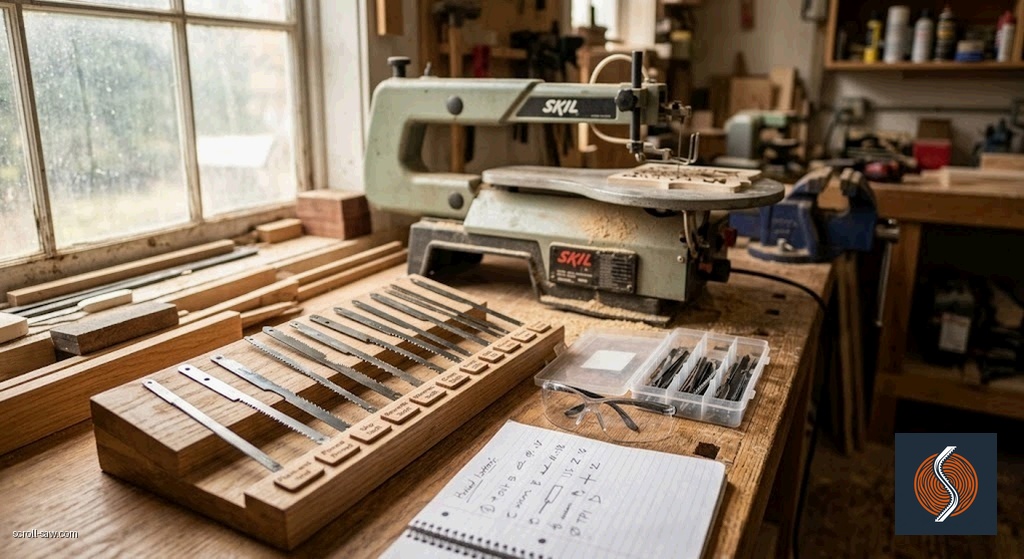
Skil Scroll Saw Blades: Selection Guide
Skil scroll saws are common first saws. Priced under $200, sold at big-box hardware stores, they get many people into scroll cutting without a serious investment. What separates a Skil owner who makes clean detailed cuts from one who fights the saw is not the machine. It is the blades and the technique.
Here is how to choose Skil-compatible blades for clean curves and controlled cuts.
What blades fit Skil scroll saws
Most Skil scroll saw models (3335, 3320, and similar) accept:
Pinned-end blades: Standard. Cross-pin at each end drops into slots in the blade clamps.
Plain-end blades with adapter: Some models include adapters; others accept aftermarket adapters.
Pinned-end blades are simpler to install (no adjustment beyond dropping into slots), but plain-end blades come in a wider range of types and quality.
Blade sizes
Skil scroll saws typically handle:
#3. 0.012 inch thick, 20 TPI. Fine detail.
#5. 0.015 inch, 16 TPI. Workhorse.
#7. 0.017 inch, 12 TPI. Heavier work.
#9. 0.020 inch, 10 TPI. Thicker stock at machine’s limit.
#12. Beyond most Skil models’ capability. Not recommended.
Most cutting happens with #5 for general work; #3 for fine detail; #7 for outline on thicker stock.
Blade types available in pinned format
Skip-tooth (most common)
Standard alternating teeth. General purpose. Available in all sizes.
Best for: Standard cutting, straight lines, moderate curves.
Reverse-tooth
Bottom-third teeth face upward. Reduces splintering on the underside.
Best for: Plywood, veneers, dual-face visibility work.
Precision ground
Ground teeth for cleaner cuts. Less commonly available in pinned format.
Best for: Finish quality where available.
Spiral
Rarely available in pinned format. Buy plain-end with adapter if needed.
Best for: Portrait scrolling; not typical Skil use.
For most Skil users, skip-tooth and reverse-tooth in sizes #3 through #7 cover most work.
Choosing by material
1/8 inch plywood or thin hardwood
Standard: Pinned skip-tooth #3.
Reduce splintering: Reverse-tooth #3.
1/4 inch plywood or hardwood
Standard: Pinned skip-tooth #5.
Fretwork: Pinned skip-tooth #3.
Reduce splintering: Reverse-tooth #5.
1/2 inch hardwood
Standard: Pinned skip-tooth #7.
Detail: Pinned skip-tooth #5.
3/4 inch hardwood
Standard: Pinned skip-tooth #9.
At the machine’s limit. Feed slowly.
Softwood (pine, poplar)
One size smaller than hardwood recommendations.
MDF
Skip-tooth in size for thickness. MDF dulls blades faster.
Non-ferrous metal (thin aluminum, brass)
Special metal-cutting pinned blades if available. Slow speed with lubricant.
Setup for clean cuts
Blade tension
Firm. Blade should barely deflect when plucked in the middle. Under-tension causes wandering; over-tension breaks blades.
Blade speed
Hardwood: Slow to medium speed (600 to 1,000 SPM on typical Skil models).
Softwood: Medium to fast (1,000 to 1,500 SPM).
Plywood: Medium (800 to 1,200 SPM).
Fine detail: Slow for control.
Metal: Slow with lubricant.
Feed pressure
Light. Push the workpiece gently against the blade; do not force. Skil saws bog down with heavy feed; light and steady produces cleaner cuts.
Blade orientation
Teeth face down for standard cutting. Verify before starting.
Workpiece support
Hold flat against the table. Zero-clearance table insert helps with small pieces and reduces underside splintering.
Cut technique for clean curves
Line-of-sight
Keep the pattern line in view. Do not let your hand block visibility.
Smooth feed
Continuous steady feed produces smoother curves than variable feed with pauses.
Follow the line, do not force it
Gently steer the workpiece to follow the pattern. Do not push the wood into the blade.
Turn workpiece for tight curves
Rotate the workpiece around the blade for tight radius turns. Do not force the blade to bend.
Back the blade off at sharp corners
For 90-degree or sharper corners, back off the workpiece, rotate to the new direction, then re-enter.
Cut interior curves before exterior
Support for interior detail cuts is better when the exterior outline is still intact.
Cut symmetrically when possible
Fold-and-cut for symmetric patterns saves time and produces matching sides.
Where to buy Skil-compatible blades
Home Depot, Lowe’s, Ace Hardware. Skil brand and Olson pinned blades usually available.
Amazon. Wide selection.
Scroll saw specialty retailers. Bear Woods, Sloan’s Woodshop, PS Wood, Seyco.
Manufacturer direct. Olson (olsonsaw.com) sells pinned blades directly.
Brand recommendations
Quality of pinned blades varies widely:
Olson Standard Skip Tooth. Reliable; widely available. Solid choice for most Skil users.
Olson Precision Ground. Higher quality; better finish. Where available in pinned format.
Delta pinned scroll saw blades. Similar quality to Olson.
Skil brand. Adequate for beginners; not premium quality.
Generic hardware-store bulk packs. Cheapest per blade; quality varies significantly. Some are excellent value; some are barely usable.
For consistent cut quality, invest in named-brand pinned blades (Olson, Delta) rather than generic bulk. Save $2 to $5 per dozen; get consistent cuts.
Common cut quality problems
Blade wanders. Under-tension, dull blade, or heavy feed. Adjust each.
Rough cut edge. Wrong blade size, dull blade, or wrong blade type. Change blade.
Excessive splintering on underside. Use reverse-tooth blade.
Burn marks. Feed too heavy or wrong speed. Reduce feed; adjust speed.
Blade breaks quickly. Over-tension or excessive feed. Adjust.
Motor bogs down. Feed too heavy or blade too small for stock. Reduce feed; use larger blade.
Blade slips out of pin socket. Pin damaged or clamp worn. Replace blade or check clamp.
Cuts do not follow pattern line. Feed too fast; slow down.
Extending blade life
Use fresh blades for critical work. Save partially worn blades for practice.
Do not overheat blades. Excessive speed or feed dulls fast.
Store blades dry. Humidity rusts blades.
Use appropriate blade for material. Cutting oak with a #3 blade wears it out fast.
Change blades before quality degrades. Waiting until the blade is very dull produces bad cuts and stresses the saw.
When to upgrade to plain-end blades with adapter
Some Skil users add a plain-end adapter to access premium blade brands not available in pinned format:
Reasons to upgrade:
-
Wider selection of blade types (precision ground, spiral, specialty)
-
Better quality options (Pegas, Flying Dutchman, Niqua)
-
Lower cost per blade in some cases
-
Better cut quality on demanding materials
Reasons to stay with pinned:
-
Faster blade changes
-
Simpler installation
-
No adapter to lose or wear out
-
Adequate for most casual scroll work
Adapters cost $10 to $30 and install in minutes. Test the results before committing to plain-end blades exclusively.
When to upgrade the scroll saw
Skil scroll saws are adequate for learning and casual work. Consider upgrading if:
-
You scroll multiple hours per week
-
You want finer detail than the Skil supports
-
Vibration is affecting cut quality
-
You want quick-release blade clamps for faster changes
-
You are selling scroll work
Dedicated saws (DeWalt DW788, Excalibur, Hegner, Pegas Ultra) offer better cut quality, faster blade changes, and refined vibration control.
Bottom line
Skil scroll saws produce clean cuts with the right blade and technique. Use pinned skip-tooth #5 for general work; #3 for fine detail; #7 for outline on thicker stock. Reverse-tooth reduces splintering on plywood undersides. Set firm tension, moderate speed, and light feed pressure. Invest in Olson or Delta named-brand blades rather than generic bulk packs. Consider a plain-end adapter to access premium blade brands if you want more options. Upgrade to a dedicated scroll saw if you scroll frequently or need finer detail than the Skil supports.
FAQ
What blades fit Skil scroll saws? Pinned-end blades in sizes #3 through #9. Some models accept plain-end with adapter.
What size Skil blade for hardwood? #5 for 1/4 to 1/2 inch; #7 for 1/2 to 3/4 inch; #9 for 3/4 inch (machine’s limit).
Do I need reverse-tooth blades? Recommended for plywood or when both sides of the cut will show.
What brand of pinned blade is best for Skil? Olson is the standard recommendation. Delta is similar quality.
Why do my blades break so quickly? Over-tension, heavy feed, or wrong blade size. Adjust each.
Where do I buy Skil scroll saw blades? Hardware stores, Amazon, scroll saw specialty retailers.
Should I upgrade my Skil scroll saw? For serious use, yes. For casual scrolling, Skil is capable.
References
-
Skil scroll saw owner’s manual, skil.com
-
Olson Saw Company pinned blade line, olsonsaw.com
-
Bear Woods scroll saw supplies, bearwood.com
-
Steve Good, Scroll Saw Workshop for beginners, scrollsawworkshop.blogspot.com


