
Thin Scroll Saw Blades: Selection Guide
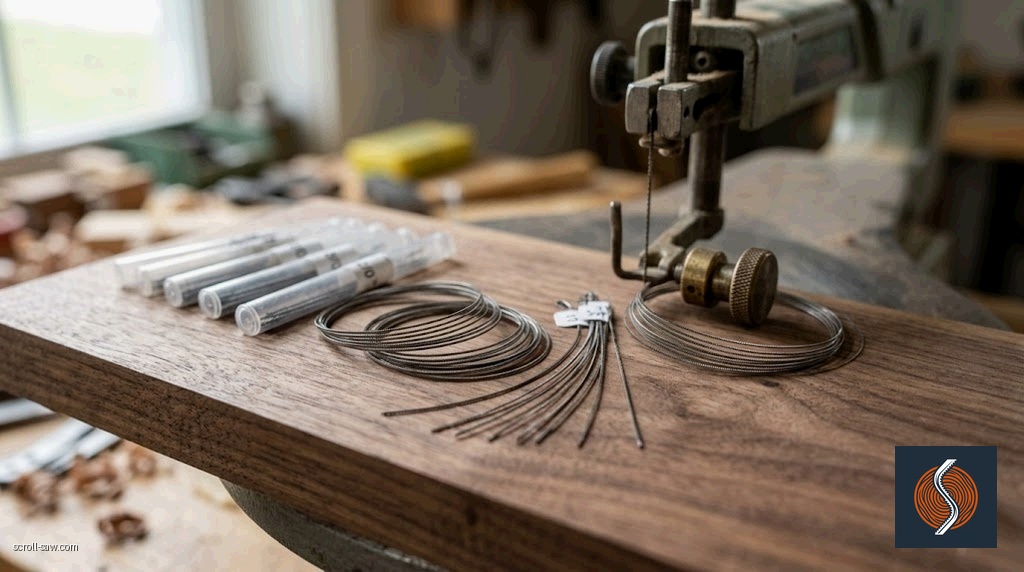
Thin Scroll Saw Blades: Selection Guide
The first time you break three #2/0 blades in a row, you understand what thin scroll saw blades really are. They are precision tools, they are unforgiving of technique errors, and they are the only way to cut certain kinds of detail. When you get them working right, you can cut hair-thin lines through 1/4 inch hardwood that no larger blade can approach.
Here is a practical guide to selecting and using thin scroll saw blades.
What thin means
Thin scroll saw blades are generally #2/0 (0.008 inch) through #3 (0.012 inch). Some manufacturers offer even smaller sizes:
#5/0. 0.006 inch. Extremely fine.
#4/0. 0.007 inch. Very fine.
#3/0. 0.007 inch. Very fine (slight variation).
#2/0. 0.008 inch. Fine.
#1. 0.010 inch. Fine.
#2. 0.011 inch. Detail.
#3. 0.012 inch. Standard detail.
At 0.008 inch thick or less, blades are considered thin. Below 0.006 inch enters specialty jeweler’s territory.
Why use thin blades
Fine detail
Some patterns require line widths so narrow that only thin blades can follow them. Portrait scrolling of faces, intricate calligraphy, complex fretwork all benefit.
Tight curves
Minimum turning radius scales with blade thickness. A #2/0 blade turns in about 1/16 inch radius. A #5 blade needs about 1/4 inch. If your pattern has 1/8 inch radius curves, you need a thin blade.
Thin kerf
Less material removed per cut. Important for jigsaw puzzles (pieces need to fit tightly) and inlay work (pieces need to fit their negative space).
Fine cuts through thin material
Puzzle blades, jewelry cutting, delicate scroll art all use thin blades on thin material.
Applications
Portrait scrolling
Face and hair detail requires thin blades. #2/0 to #3 for most portrait work; #1 or #3 for backgrounds.
Jigsaw puzzles
Wooden puzzles use very thin blades (#2/0 or thinner) for tight-fitting pieces.
Jewelry making
Brass, silver, and copper detail work uses thin blades (#5/0 or #4/0 in metal-cutting versions).
Fine fretwork
Lace-like patterns, intricate lettering, filigree work use thin blades throughout.
Inlay preparation
Matching positive and negative pieces requires thin kerf. #2/0 or #1 for good fit.
Model making
Scale models with fine detail benefit from thin blades.
Material thickness limits
Thin blades work only in thin material. Approximate limits:
#5/0. Up to 1/8 inch hardwood; 1/16 inch metal.
#4/0. Up to 1/8 inch hardwood; 1/16 inch metal.
#3/0. Up to 1/8 inch hardwood.
#2/0. Up to 1/4 inch hardwood; 1/8 inch metal.
#1. Up to 3/8 inch hardwood; 1/4 inch softwood.
#2. Up to 1/2 inch hardwood.
#3. Up to 3/4 inch hardwood.
Pushing thin blades through material thicker than the limit results in broken blades and rough cuts.
Setup for thin blades
Blade tension
Higher than standard. Blade must not deflect when plucked. Thin blades need higher tension to remain straight; premium scroll saws with fine tension adjustment help.
Blade speed
Hardwood: Slower speed for control (800 to 1,200 SPM).
Softwood: Slightly faster (1,000 to 1,500 SPM).
Metal: Slow with lubricant (400 to 800 SPM).
Too fast breaks thin blades. Too slow burns the wood.
Feed pressure
Very light. Thin blades cannot handle heavy feed. Push the workpiece gently; let the blade cut at its own pace.
Workpiece support
Zero-clearance table insert essential. The narrow blade slot on a standard insert lets small pieces dip and grab the blade, breaking it.
Blower position
Aim clear of the cut. Blast that disturbs the cut line disrupts fine work.
Handling thin blades
Handle by the ends only. Fingers on the blade body can cause bending.
Store separately. Keep thin blades separate from thicker blades to prevent damage.
Inspect before use. A thin blade with a slight bend will cut off-line.
Discard slightly damaged blades. They are not worth the frustration.
Change blades frequently. Dull thin blades break more easily than fresh ones.
Common problems with thin blades
Blade breaks quickly
Common causes: Over-tension, heavy feed, wrong material thickness, poor handling, damaged before use.
Fix: Reduce tension slightly (but keep firm); reduce feed to very light; verify material thickness is within blade limit; handle carefully.
Blade wanders off pattern
Common causes: Feed too fast, dull blade, under-tension.
Fix: Slow feed; change blade; increase tension.
Rough cut edge
Common causes: Dull blade, wrong blade for material, feed too fast.
Fix: Change blade; verify blade type; slow feed.
Blade slips out of clamp
Common causes: Clamp worn, debris in jaws, blade damaged at end.
Fix: Clean clamp; check for wear; use new blade.
Cannot see the cut line
Common causes: Dust blocking view, inadequate lighting.
Fix: Improve dust blower; add task light; use magnification.
Blade breaks at the clamp end
Common causes: Excessive vibration, clamp too tight, blade held too far into clamp.
Fix: Reduce vibration; ease clamp pressure; verify blade insertion depth.
Brand recommendations for thin blades
Pegas Modified Geometry #2/0. Premium; excellent quality; consistent.
Flying Dutchman Ultra Reverse #2/0. Aggressive fine cut; great for detail.
Olson Precision Ground #2/0. Standard quality; widely available.
Niqua Puma or Gold #2/0. European premium; excellent finish.
PS Wood Ultra Reverse #2/0. Aggressive fine cut; good for detail.
Seyco premium #2/0. Consistent quality; loyal following.
Herkules jeweler’s blades. Very fine sizes for metal work.
For thin blades, quality matters more than for thicker blades. Cheap thin blades break so often the savings vanish.
Cost
Standard #2/0 (generic): $6 to $12 per dozen.
Premium #2/0: $10 to $20 per dozen.
Jeweler’s #5/0 or #4/0: $15 to $30 per dozen.
Bulk packs of dozens: Better per-blade cost.
Buy in reasonable quantities. Thin blades break more often than thicker blades; expect to use several per project.
Where to buy
Scroll saw specialty retailers. Bear Woods, Sloan’s Woodshop, PS Wood, Seyco have wider thin blade selection than general hardware stores.
Amazon. Wide selection of premium brands.
Manufacturer direct. Pegas, Olson, Flying Dutchman, Niqua all sell online.
Jewelry supply houses. Rio Grande, Otto Frei carry very fine jeweler’s blades.
Workflow for thin blade projects
Preparation
-
Verify pattern requires thin blade. Do not use thin blade if #5 will work; you save time and blades.
-
Prepare workpiece. Sand, plane, verify flatness. Thin blades cannot compensate for uneven stock.
-
Drill starter holes. Use bit size matched to blade width plus 1/32 inch clearance.
-
Set up saw. Zero-clearance insert; verify tension mechanism works smoothly.
Cutting
-
Install fresh blade. Do not start critical work with a partly worn blade.
-
Verify blade orientation. Teeth face down; blade vertical.
-
Tension firmly. Higher than standard for thin blades.
-
Set slower speed.
-
Begin with light feed. Let the blade find its rhythm.
-
Follow the line carefully. Do not force curves.
-
Change blade when cut quality degrades. Do not push a dull thin blade.
Finish
-
Inspect cuts. Thin blade cuts often need minimal cleanup.
-
Light sanding if needed. 220 grit or finer.
-
Apply finish. Thin cuts hold detail if finish is applied carefully.
Comparing thin blades to alternatives
Thin blade vs standard skip-tooth same size. Thinner blade cuts tighter curves; may break more easily.
Thin blade vs spiral. Spiral cuts in any direction; thin blade cuts cleaner in one direction.
Thin blade vs jeweler’s blade. Jeweler’s blades are optimized for metal; wood scroll blades for wood.
Thin blade vs precision ground. Precision ground produces cleaner finish; thin blade cuts tighter radii.
Match blade type to the specific requirement.
Bottom line
Thin scroll saw blades (#2/0 through #3, or finer jeweler’s sizes) enable detail cutting no larger blade can approach. Use them for portrait scrolling, jigsaw puzzles, jewelry, fine fretwork, and inlay preparation. Match blade thickness to material thickness limits. Set higher tension than standard, slower speed, very light feed. Handle carefully; store separately. Invest in premium brands (Pegas, Flying Dutchman, Olson, Niqua) for consistent quality. Expect to break more blades than with thicker sizes; buy in reasonable quantities.
FAQ
What is a thin scroll saw blade? Blades of #2/0 (0.008 inch) or thinner. Some manufacturers offer #3/0, #4/0, #5/0.
When do I need a thin blade? For tight curves (1/8 inch radius or tighter), fine detail, jigsaw puzzles, jewelry work.
How thick material can a thin blade cut? #2/0 up to 1/4 inch hardwood; #1 up to 3/8 inch. Thinner blades handle less.
Why do my thin blades break so quickly? Over-tension, heavy feed, wrong material thickness, or handling damage. Adjust each.
What tension for thin blades? Higher than standard; blade must not deflect. Some scrollers describe it as “guitar tight.”
Where do I buy premium thin blades? Bear Woods, Sloan’s Woodshop, PS Wood, Seyco, Amazon, or manufacturer direct.
How much do thin blades cost? $6 to $20 per dozen depending on brand; $15 to $30 per dozen for jeweler’s sizes.
References
-
Pegas Scroll Saw blade catalog, pegas-swiss.com
-
Olson Saw Company product line, olsonsaw.com
-
Niqua GmbH blade line, niqua.de
-
Flying Dutchman blades from Mike’s Workshop, mikesworkshop.com
-
Steve Good, Scroll Saw Workshop on portrait scrolling, scrollsawworkshop.blogspot.com


