
Twisted Scroll Saw Blades: Better Cuts
Twisted Scroll Saw Blades: Better Cuts
Twisted scroll saw blades (usually called spiral blades) are the most misunderstood blade in the scroll saw lineup. Scrollers either love them or refuse to use them. Portrait scrollers rely on them. Traditional fretwork scrollers avoid them. Somewhere in the middle is a fair assessment: spiral blades do specific things very well and other things poorly. Knowing the difference is the key to getting better cuts with them.
Here is how to get the most from twisted (spiral) scroll saw blades.
What twisted blades are
A twisted scroll saw blade starts as a standard straight blade. During manufacture, the blade is twisted along its length, so that teeth point in every direction rather than only one direction. Looking at the blade end-on, teeth appear as a helical pattern.
This geometry has one key advantage: the blade cuts in any direction. Feed the workpiece toward the blade from any angle and the teeth engage.
Straight scroll saw blades cut only in the direction the teeth face. Turn a corner and the blade must be rotated (by turning the workpiece) so the teeth align with the new cut direction. Spiral blades skip this step.
When spiral blades shine
Portrait scrolling
Complex patterns with curves in every direction. Portraits of people, animals, or scenes with lots of small features. Spiral blades handle these without the constant workpiece rotation that straight blades require.
Complex fretwork with tight interior detail
When interior cuts have curves going every direction and rotating the workpiece is awkward.
Large workpieces
When the workpiece is too large or heavy to rotate freely, spiral blades let you cut in any direction without moving the wood.
Cutting inside a limited space
When the pattern is inside a larger workpiece that limits workpiece rotation.
Rapid prototyping
When you want to sketch shapes into wood without careful blade orientation.
When spiral blades fall short
Straight line cuts
Spiral blades wander on straight cuts. The multi-direction teeth grab in whatever direction is convenient, not always your intended line.
Fine detail requiring pattern-following accuracy
Spiral blades follow the pattern less precisely than straight blades. For pattern-critical work, straight blades are more accurate.
Thick hardwood
Spiral blades cut slower than straight blades of the same size. In thick hardwood, this can be frustrating.
Clean edge quality
Spiral blades leave rougher edges than straight blades. More sanding required.
Cuts requiring a specific angle
Bevel cuts or angled cuts benefit from straight blade precision.
Spiral blade sizes
Spiral blades follow the standard scroll saw numbering, but effective cutting characteristics differ from straight blades of the same number:
Spiral #2/0. Very fine; for delicate portrait detail.
Spiral #1. Fine; general portrait work.
Spiral #3. Standard; workhorse spiral.
Spiral #5. Heavier; thicker stock.
Spiral #3 or #5 handles most spiral scroll work. Very fine spirals (#2/0, #1) for delicate detail.
Material recommendations
1/8 to 1/4 inch hardwood or plywood
Portrait scrolling: Spiral #3.
Fine detail: Spiral #1.
Standard curves: Spiral #3.
1/2 inch hardwood
Portrait scrolling: Spiral #5.
Detail work: Spiral #3.
3/4 inch hardwood
Portrait scrolling: Spiral #5 or #7 (spiral #7 harder to find).
At the practical limit for spiral use. Straight blade is faster.
1 inch or thicker
Not recommended for spiral. Straight blade is better.
Spiral blades work best on thinner material (1/4 to 1/2 inch) where their multi-direction cutting shines.
Setup for better cuts with spiral blades
Tension
Slightly higher than for straight blades. Spiral blades tend to wander more; higher tension helps.
Speed
Medium speed. 800 to 1,200 SPM. Not as fast as some straight blade work.
Feed pressure
Very light. Spiral blades cut better with light feed than heavy. Push gently.
Workpiece support
Zero-clearance insert important. The multi-direction blade action causes underside splintering with standard inserts.
Blower
Standard dust blower. Direct clear of the cut.
Technique for better spiral cuts
1. Steer, do not force
Guide the workpiece; do not push. Spiral blades follow your steering more than your pressure.
2. Consistent feed
Steady continuous feed produces smoother cuts than variable feed.
3. Cut on the line, not toward it
Aim the cut so the pattern line falls at the blade’s cutting edge, not to one side.
4. Slow down on tight curves
Spiral blades handle tight curves easily but wander more at speed. Slow feed for accuracy.
5. Use fresh blades
Spiral blades dull noticeably. When cut quality degrades, change the blade.
6. Cut interior detail before exterior outline
With the outline intact, the workpiece has more rigidity for interior detail cuts.
7. Practice on scrap
Spiral blade technique is different from straight blade technique. Practice on scrap before critical work.
Common spiral blade problems
Blade wanders excessively. Feed too heavy or tension too low. Adjust each.
Rough cut edge. Expected; more than straight blade. Sand before finishing.
Excessive splintering. Use zero-clearance insert; use fresh blade.
Blade breaks quickly. Over-tension, excessive feed, or wrong blade for material. Adjust.
Cuts do not follow pattern line. Feed too fast; slow down. Or wrong blade choice.
Blade burns wood. Feed too heavy or wrong speed. Reduce feed; adjust speed.
Blade cannot cut through material. Blade too small for material thickness. Use larger spiral or switch to straight blade.
Brand recommendations
Flying Dutchman spiral blades. Popular among portrait scrollers; consistent quality.
Pegas spiral blades. Premium; excellent cut quality.
Olson spiral blades. Widely available; standard quality.
Niqua spiral blades. European premium.
Seyco spiral blades. Good quality; loyal following.
For spiral blade users, Flying Dutchman is a common favorite among portrait scrollers.
Cost
Standard spiral #3: $8 to $15 per dozen.
Premium spiral: $12 to $20 per dozen.
Assortment packs: $15 to $40 for multiple sizes.
Slightly more expensive than skip-tooth of the same size but offer capabilities skip-tooth cannot.
Where to buy
Amazon. Wide selection of spiral blades.
Scroll saw specialty retailers. Bear Woods, Sloan’s Woodshop, PS Wood, Seyco.
Manufacturer direct. Pegas, Olson, Flying Dutchman, Niqua all sell online.
Portrait scrolling communities. Facebook groups and forums sometimes have group buys or recommended sources.
Comparing spiral to alternatives
Spiral vs skip-tooth (same size). Spiral cuts any direction; skip-tooth cuts one direction cleaner.
Spiral vs reverse-tooth (same size). Spiral cuts any direction; reverse-tooth reduces underside splintering.
Spiral vs precision ground (same size). Precision ground cleaner finish; spiral more versatile direction.
Spiral vs sharktooth (same size). Sharktooth faster in one direction; spiral more flexible in direction.
Each blade type has its strengths. Match blade type to the specific cut requirements.
Portrait scrolling workflow with spiral blades
Many portrait scrollers use only spiral blades:
Preparation
-
Print pattern. Portrait pattern with dark shapes to cut.
-
Attach to blank. Spray adhesive or blue tape; sand smooth first.
-
Prepare saw. Zero-clearance insert; fresh spiral blade; proper tension.
Cutting
-
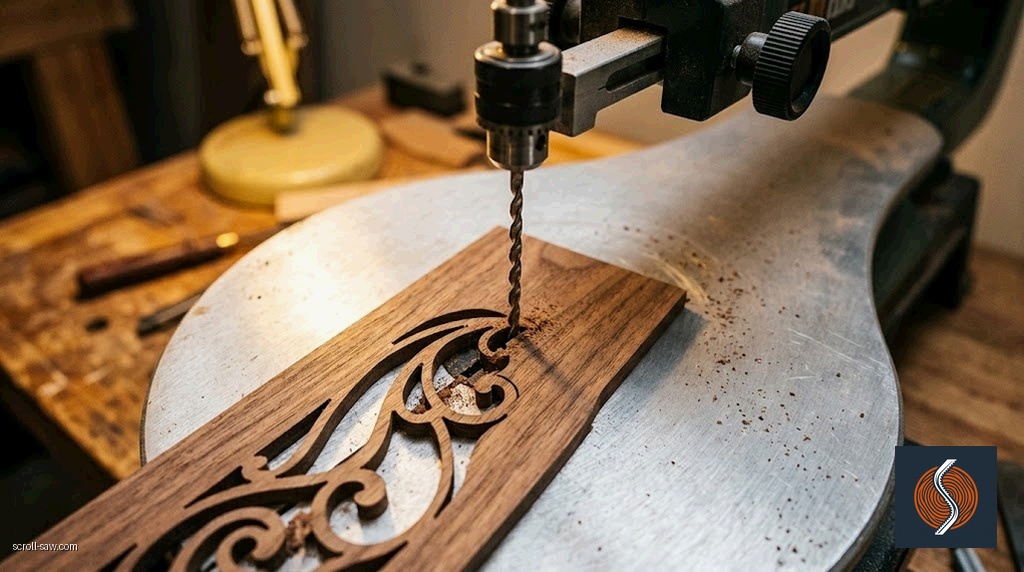
Drill starter holes in every shape to be cut.
-
Thread blade through hole.
-
Cut each shape. Follow the pattern outline with the spiral blade.
-
Refeed blade through next hole; repeat.
-
Continue until all interior shapes cut.
-
Cut exterior outline last if needed.
Finish
-
Remove pattern. Soak with adhesive remover if needed.
-
Sand any rough edges.
-
Apply finish. Wipe-on polyurethane or spray lacquer.
Spiral blades make portrait scrolling manageable. Straight blades would require constant workpiece rotation.
When to switch from spiral to straight
Even portrait scrollers sometimes switch blades:
-
Long straight cuts. Straight blade follows the line better.
-
Tight radius corners. Straight blade turns cleaner in tight corners.
-
Very thin material where cut quality is critical. Straight blade cleaner.
-
Cutting through thick sections. Straight blade cuts faster.
A portrait scroller might use spiral for 80 percent of the work and straight for 20 percent.
Bottom line
Twisted (spiral) scroll saw blades cut in any direction, making them ideal for portrait scrolling, complex fretwork, and large workpieces where rotation is awkward. Choose #3 or #5 for most work; finer sizes for delicate detail. Set higher tension than straight blades, medium speed, very light feed. Expect rougher cut edges than straight blades; sand more before finishing. Use zero-clearance table insert to reduce splintering. Flying Dutchman is a common favorite; Pegas, Olson, and Niqua also make quality spirals. Not the best choice for straight cuts, thick stock, or maximum cut quality; use straight blades for those.
FAQ
What is a twisted scroll saw blade? A blade twisted along its length so teeth face every direction. Also called spiral blade.
When should I use spiral blades? Portrait scrolling, complex fretwork, large workpieces, and any cut where rotating the workpiece is awkward.
Why do spiral blades wander? Multi-direction teeth grab wood in unintended directions. Higher tension, lighter feed, slower speed help.
What size spiral for portrait scrolling? #3 for standard portraits; #1 for very fine detail; #5 for thicker stock.
Where do I buy spiral blades? Amazon, scroll saw specialty retailers, or manufacturer direct.
How much do spiral blades cost? $8 to $20 per dozen depending on brand and size.
Are spiral blades better than straight blades? Better for portrait scrolling and complex direction cutting. Straight blades better for line-following and cut quality.
References
-
Flying Dutchman spiral blades from Mike’s Workshop, mikesworkshop.com
-
Pegas Scroll Saw spiral catalog, pegas-swiss.com
-
Olson Saw Company spiral line, olsonsaw.com
-
Steve Good, Scroll Saw Workshop on portrait scrolling, scrollsawworkshop.blogspot.com


