
Universal Scroll Saw Blade Chart: How to Actually Use It
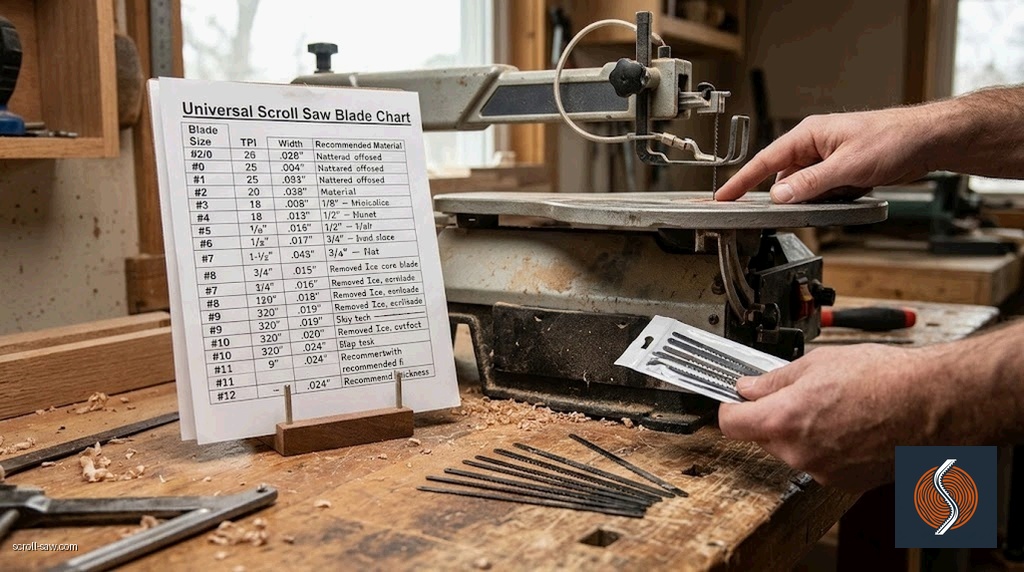
Universal Scroll Saw Blade Chart: How to Actually Use It
A universal blade chart is the piece of paper people pin above the saw and then argue with for the next five years. The reason it never quite matches the actual cut is simple: no chart can account for your wood, your feed rate, or how tight your blade tension really is. It gives you a starting point. The saw and the piece decide the rest.
Here’s what a working universal chart actually contains, why the ranges are ranges, and how to use one without believing it too much.
What a universal blade chart is really showing you
A scroll saw blade chart maps blade number to material, thickness, and rough teeth per inch. The number is the industry-wide sizing convention: bigger number, wider blade, coarser teeth, thicker material, faster cut, larger minimum radius. Smaller number, finer blade, thinner material, cleaner cut, tighter radius.
The short version:
-
#2/0 to #1: 1/16 to 1/8 inch stock. Veneer, thin plywood, marquetry. 25 to 30 TPI. Very fine, very fragile.
-
#3 to #5: 1/4 to 1/2 inch stock. Most portrait, fretwork, and pattern work. 12 to 20 TPI.
-
#7 to #9: 1/2 to 3/4 inch stock. Intarsia, thick softwood, larger patterns. 9 to 12 TPI.
-
#12: 3/4 inch and up. Stack cutting, long runs. 6 to 9 TPI.
That’s a chart. It’s also incomplete on its own.
Where the chart lies
Charts assume clean, straight-grained hardwood at a moderate feed. Your reality is knotty pine, damp poplar, or 1/4 inch Baltic birch with three grain layers running different directions. A #5 that eats through oak beautifully will burn through cherry at the same feed. A #3 that cuts a portrait cleanly in walnut will chatter in soft maple because the fibers tear rather than shear.
The honest use of a chart is to pick a starting blade, run one test cut on scrap of the same wood, and adjust. If the cut is clean but slow, move up a number. If the cut is fast but the blade wanders or scorches, move down.
The three variables the chart can’t cover
Blade tension matters more than blade choice for cut quality. A properly tensioned scroll saw blade pings when you pluck it. If it thuds, tighten. A #5 at proper tension out-cuts a #3 at low tension, and it’s not close.
Feed rate decides whether the chart works. Too fast and any blade burns or drifts. Too slow and the blade heats without progressing. You want the piece to move continuously through the cut with light forward pressure.
Blade brand and geometry shift the chart. A Flying Dutchman Ultra Reverse #3 cuts more aggressively than a generic #3 skip tooth. A Pégas Modified Geometry #12 cuts smoother than a stamped equivalent. Same number, different behavior.
Blades I actually keep on the bench
If you’re building a small library instead of hunting for one perfect blade, three assortments cover most work.
The Flying Dutchman 60-piece variety pack is the honest starter. Twelve blades in five styles, so you actually learn what your saw and wood want without buying five separate bulk packs.
The Olson FR49202 Reverse Tooth assortment is the practical everyday pack — three sizes, plain end, cleaner bottom face than a straight skip tooth for pattern work.
For pin-end saws, most premium blades won’t fit. Keep the chart, but shop the Delta #7 Super Sharps or a pin-adapter setup instead.
Who should skip a universal chart entirely: if you cut one material at one thickness for one project, buy the exact blade the pattern designer recommends and stop chart-hunting.
The takeaway
A universal blade chart is a first-cut suggestion, not a rulebook. Match the number to the material and thickness, tension the blade hard, run a scrap cut, and let the wood tell you what to adjust.
FAQ
What blade size should I use for 1/4 inch plywood? Start with a #3 skip tooth or reverse tooth. Move to a #5 if you’re cutting long, gentle curves. Drop to a #2 only for very intricate patterns and be prepared for slower feed.
Does the blade chart work the same for every brand? Roughly. The number system is universal, but a #5 from a premium maker cuts differently than a #5 from an entry-level pack. Use the chart to pick a starting number, then trust your test cut.
Can I use a pin-end blade in a pinless-end saw? With an adapter, sometimes. Without one, no. Most premium chart-listed blades are plain-end because pin-end limits the size range dramatically.
Why does my #5 blade burn cherry but not oak? Cherry’s fibers hold heat and its sap gums the gullets. Slow the feed and drop to a #3 with a fresh, sharp blade.
What’s the biggest mistake people make with blade charts? Believing them literally. Charts don’t know your wood, your tension, or your feed. They are starting points.
Do I need a different chart for hardwood versus softwood? Roughly the same numbers work, but softwood tolerates a coarser blade (higher number) at the same thickness because it cuts easier. Hardwood usually wants a finer blade with slow, patient feed.
How do I know if I’ve picked the wrong blade? If the blade wanders, burns, or breaks in normal use, the blade is wrong for the wood, the tension is wrong, or both. Change one variable at a time.
References
-
Olson Saw Company universal blade sizing reference
-
Pégas Swiss-made blade technical documentation
-
Flying Dutchman / Mike’s Workshop product size charts


