
Unpinned Scroll Saw Blades: Sizing and Wood Matching
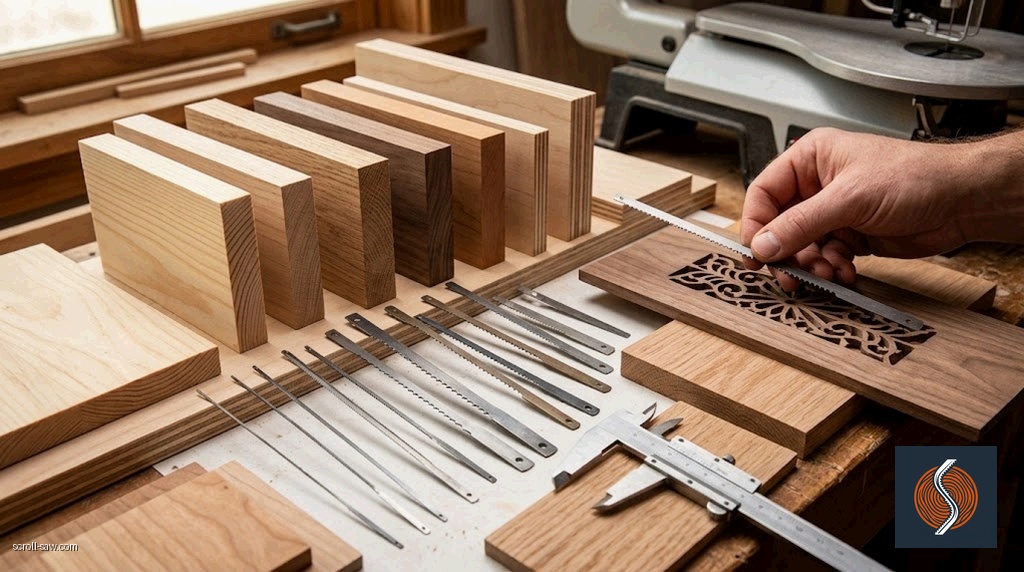
Unpinned Scroll Saw Blades: Sizing and Wood Matching
“Unpinned” and “pinless” and “plain-end” all describe the same thing: a scroll saw blade without the small crosswise pins at the top and bottom. Pinless blades are the standard on premium and mid-tier scroll saws because they open the door to the full blade range. If your saw is pinless-compatible, this is what to buy and how to size it.
Why pinless matters
Pinned blades exist for a reason: they drop into a slot and clamp without threading. Great for beginners on entry-level saws. The problem is that the pins limit the blade size to what will physically fit around them, which excludes almost every fine and specialty blade the pattern designers actually recommend. If you want ultra reverse, spiral, modified geometry, or anything below a #3 in fine work, you need pinless.
The fit is universal across most premium saws: 5 inches long, plain-end, held by a clamp screw at each end. DeWalt, WEN parallel-arm models, Hegner, Excalibur, most Delta parallel-arms.
Sizing an unpinned blade
The blade number is the same universal chart:
-
#2/0 to #1: 1/16 to 1/8 inch stock, veneer, thin plywood. Very fine, very slow, breaks under force.
-
#3 to #5: 1/4 to 1/2 inch stock. The workhorse range.
-
#7 to #9: 1/2 to 3/4 inch stock. Faster cutting, larger radius.
-
#12: 3/4 inch and thicker. Stack cutting, long runs.
The honest rule most beginners break: thickness dictates blade size before pattern detail does. A hair-fine pattern in 3/4 inch walnut is not a #2/0 job. It’s a #5 job with patient turns, because a #2/0 in that much wood will drift, heat up, and snap.
Match the blade to the wood, not just the pattern
Hardwood wants slower feed and finer blade at any given thickness. Cherry and maple burn easily; walnut cuts cleaner but scorches on a paused turn. Drop one number from the softwood recommendation, drop the speed to 800 to 1200 SPM, and keep the piece moving.
Softwood tolerates a coarser blade at the same thickness and takes higher speed happily. Pine and cedar clog fine blades; a #7 in 1/2 inch pine outperforms a #5.
Plywood varies wildly by construction. Baltic birch is dense and behaves like hardwood. Big-box construction plywood is glue-heavy and dulls blades fast. Use a reverse tooth or ultra reverse to control tearout on the bottom face.
Blades that hold up on pinless setups
Flying Dutchman Ultra Reverse #3 is my go-to for portrait work in 1/4 to 1/2 inch hardwood. Aggressive cut, clean bottom face, and long life. The tradeoff is real heat if you pause on a curve.
Flying Dutchman 60-piece variety pack is the honest first purchase for a new pinless setup. Twelve blades in five styles, so you learn what your saw wants before committing to a bulk pack.
Olson FR49202 Reverse Tooth three-size assortment is the practical everyday pack for pattern work.
Pégas Modified Geometry #12 is the smoothest cut I’ve had in 3/4 inch hardwood at speed. Slightly more expensive per blade and worth it for intarsia blanks or long straight runs.
Who should skip pinless: if your saw only accepts pinned blades and you cut mostly craft pine, the pinless range is over-engineered for your work. A pin-end blade set like the FOXBC is honest for that setup.
Setup: the boring stuff that decides your finish
Tension the blade until it pings. Set the speed to the wood. Use a hold-down foot low enough to prevent lift but not so tight the piece can’t pivot. Zero-clearance insert if your saw supports one. Change the blade the moment it starts to wander or burn, not three cuts later when you’re already frustrated.
The takeaway
Pinless blades unlock the whole scroll saw world. Match the number to the thickness of the wood, drop one number for hardwood, and buy from a maker whose geometry you can trust. The rest is tension and patience.
FAQ
Are unpinned and pinless the same thing? Yes. Both terms describe blades without the crosswise pins at top and bottom. Also called plain-end.
Can I use unpinned blades on my old pin-end saw? Only with an adapter, and adapters vary in how squarely they hold the blade. For serious work, either buy a pinless saw or buy pinned blades.
What blade size for a scrollsaw beginner? Start with a #5 reverse tooth for most 1/4 to 1/2 inch pattern work. It’s forgiving enough to learn on and honest enough to keep using.
Do unpinned blades break more often? Only if you force them. Fine unpinned blades (#2/0, #1) are fragile. Standard sizes in the #3 to #9 range last as long as any blade if you tension and feed properly.
Why does my unpinned blade drift left or right? Almost always tension. A blade at low tension follows the grain. Tighten until it pings.
How do I know if my saw is pinless-compatible? Check the clamp mechanism. If it uses a screw or lever to grip the flat end of the blade, it’s pinless. If it has a slot with two small notches for pins, it’s pinned.
Are premium pinless blades worth the price over generic? For pattern work, yes. Geometry consistency, sharpness, and life all improve noticeably with a Pégas or Flying Dutchman blade over a generic pack.
References
-
Flying Dutchman / Mike’s Workshop blade catalog
-
Olson Saw Company plain-end blade documentation
-
Pégas Sawblades technical specifications


