
Types of Scroll Saw Blades: Size, Geometry, and Material
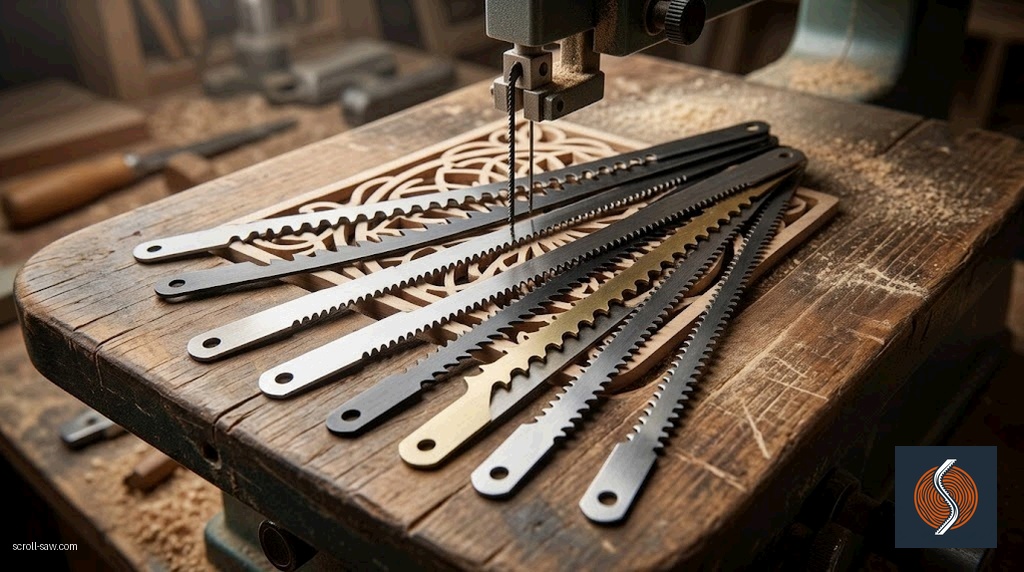
Types of Scroll Saw Blades: Size, Geometry, and Material
Open a scroll saw catalog for the first time and it looks like a wall of numbers. Skip tooth, double tooth, reverse tooth, ultra reverse, precision ground, modified geometry, spiral, crown, and the flying dutchman house names layered on top. Once you know what each type does, the wall becomes a short shelf: five or six blades cover almost every cut you’ll make.
Here’s the practical taxonomy.
The tooth patterns that matter
Skip tooth blades have a wide gap (a “skip”) between every tooth. That extra gullet space clears chips fast, so skip tooth cuts quickly and doesn’t clog in thick stock. Bottom face gets fuzzy. The standard workhorse for craft cutting.
Double tooth blades have two teeth then a skip, two teeth then a skip. The pair cuts cleaner than a single skip because the chip clears immediately after being sheared. Good middle ground for pattern work in medium hardwood.
Reverse tooth blades flip two or three teeth at the bottom of the blade upward. Those upward teeth cut the bottom face on the upstroke, giving you a cleaner underside than a straight skip tooth. The upgrade for any two-sided work.
Ultra reverse extends the upward-cutting section. More of the bottom of the blade cuts on the upstroke, so you get an even cleaner underside on portrait, fretwork, and intarsia. The tradeoff is more workpiece lift and slightly more heat.
Precision ground or modified geometry blades have milled teeth ground into the steel rather than stamped. Sharper out of the pack, longer sharp life, and a cleaner cut per tooth. More expensive and slightly more brittle at the tip.
Spiral blades are twisted so teeth face every direction. They cut in any direction without turning the workpiece, which is essential for tight interior fretwork and lettering. The tradeoff is a wide, rough kerf and a lot of practice to control feed.
Crown tooth blades have teeth in a symmetrical arrangement that cuts on both the up and down stroke without a reverse section. Less common, mostly for plastic and non-ferrous metal.
The size numbers
Blade size is a number, not a dimension:
-
#2/0 and #1: very fine, for veneer and 1/8 inch stock.
-
#3 to #5: the pattern-work workhorse for 1/4 to 1/2 inch stock.
-
#7 to #9: for 1/2 to 3/4 inch hardwood and intarsia.
-
#12: for thick stock, stack cuts, and long runs.
Bigger number equals wider blade, coarser teeth, faster cut, larger minimum radius. Smaller number equals finer blade, tighter radius, slower and cleaner cut.
The material choices
Most premium scroll saw blades are drawn from high-carbon steel. Within that category, the quality varies enormously. German and Swiss blades (most of the premium lines) cut predictably from first turn to last and break at the end of their life rather than randomly. Entry-level carbon steel dulls faster and behaves inconsistently.
Bimetal blades exist but are rare on the consumer side and usually not worth the price for wood work. If you cut a lot of non-ferrous metal, they earn their keep.
A small shelf that covers most work
Instead of buying one of each type, three assortments cover almost any pattern.
The Flying Dutchman 60-piece variety pack covers ultra reverse, super reverse, precision skip, and new spiral in one buy. It’s the best way to learn what your saw and your wood actually want.
The Olson FR49202 Reverse Tooth assortment covers three sizes of the everyday workhorse for pattern work.
The Olson FR49400 Skip Tooth assortment covers craft and softwood work at a lower per-blade cost.
For readers who cut a lot of 3/4 inch hardwood, the Pégas Modified Geometry #12 is a step up in finish quality worth the extra cost.
Who should skip most of this: if you cut one material at one thickness for one project, buy the exact blade the pattern designer recommends and stop the taxonomy hunt.
Setup matters more than blade choice
A properly tensioned #5 skip tooth out-cuts a poorly tensioned #3 ultra reverse every time. Pluck the blade after mounting; it should ping, not thud. Feed the piece continuously through the cut with light forward pressure. Change the blade the moment it starts to wander or burn.
The takeaway
Six tooth patterns and five size ranges cover essentially every scroll saw job. Skip tooth for speed, reverse for clean bottoms, ultra reverse for two-sided pattern work, precision or modified geometry for finish, and spiral for cuts that turn in place. Start with two assortments and one bulk pack of your everyday size.
FAQ
Which scroll saw blade is best for beginners? A #5 reverse tooth. Forgiving in the #3 to #5 range for most 1/4 to 1/2 inch stock, and the reverse teeth clean up the bottom face automatically.
What’s the difference between reverse and ultra reverse tooth? Reverse tooth flips a few teeth at the bottom to cut upward. Ultra reverse extends that upward-cutting section over a longer part of the blade, giving a cleaner underside on two-sided work.
When should I use a spiral blade? When you need to cut in any direction without turning the workpiece. Interior fretwork, lettering, and cuts where you can’t rotate the piece are the main uses.
Does the blade number mean TPI? No. The number is a manufacturer’s size code. Higher numbers correspond to wider blades and lower TPI. Check the package for the actual TPI.
Are precision ground blades worth the extra cost? For pattern work in hardwood, yes. They cut cleaner and last longer than stamped equivalents. For craft cutting in softwood, standard skip tooth is fine.
Can I use a wood blade to cut metal? No. Use a blade designed for non-ferrous metal, usually a much finer TPI and slower feed.
Why does my blade wander even at the right size? Almost always tension. Blades follow the grain when they’re under-tensioned. Tighten until the blade pings.
References
-
Olson Saw Company blade type documentation
-
Flying Dutchman / Mike’s Workshop blade catalog
-
Pégas Sawblades technical specifications


