
What Scroll Saw Blade to Use: A Working Framework
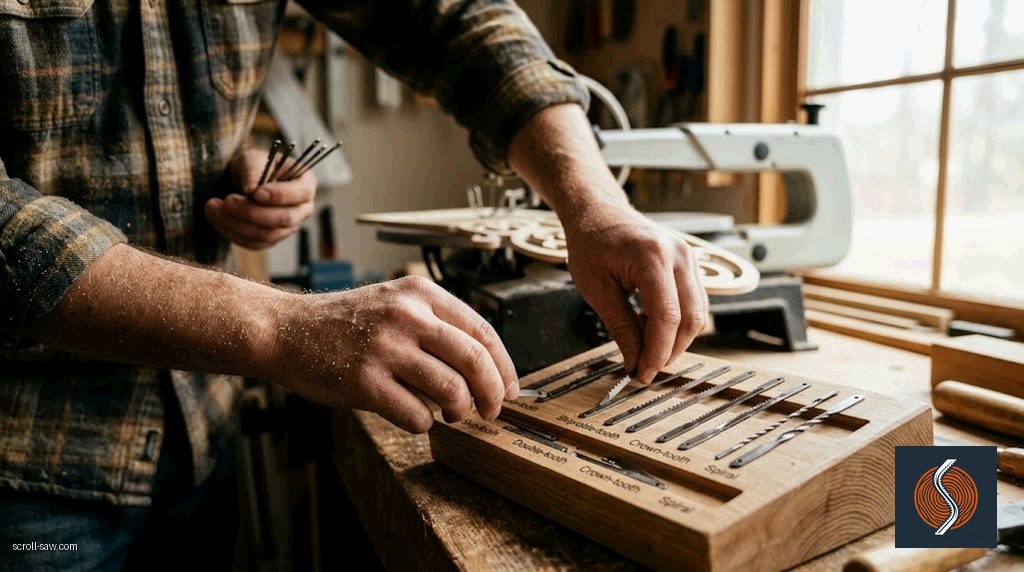
What Scroll Saw Blade to Use: A Working Framework
Every pattern designer suggests a blade, and every scroll saw owner ignores it at least once. Sometimes because the recommended blade isn’t on the bench. Sometimes because the wood is different than the pattern’s stock. Sometimes because you’re two hours in and don’t want to change. Here’s a working framework for picking a blade when the pattern doesn’t tell you or you don’t trust what it says.
Start with the wood, not the pattern
Thickness first. Thickness of the actual stock, not what the pattern was drawn for. A pattern designed for 1/4 inch Baltic birch might get cut in 1/2 inch cherry, and the blade that worked for the designer won’t work for you.
-
1/16 to 1/8 inch: #2/0 to #1
-
1/4 inch: #3
-
3/8 to 1/2 inch: #5
-
5/8 to 3/4 inch: #7 to #9
-
3/4 inch and up: #12
Then wood type. Hardwood, drop one number from softwood at the same thickness because hardwood cuts slower and needs the smaller kerf to stay cool. Softwood, stay on the chart. Plywood, treat as hardwood if it’s Baltic birch and as construction lumber if it’s big-box grade.
Then the finish requirement
One-sided craft cut, skip tooth. Fast, cheap, honest about its fuzzy bottom.
Two-sided work (both faces show), reverse tooth at minimum. Ultra reverse if the piece will be viewed from both sides at close range — portraits, intarsia, jewelry, marquetry.
Production speed on repetitive cuts, precision ground or modified geometry. Faster clean cuts per blade, longer sharp life.
Any cut that turns in place without pivoting the workpiece, spiral. Otherwise, straight tooth.
Then the pattern’s tightest radius
Measure the smallest turn in your pattern. If it’s under about 1/16 inch, you need a #2/0 or #1 to make it, and you’ll need to slow way down and probably use scroll pivots (backing up slightly and re-entering the curve). If it’s under 3/16 inch, a #3 works. Larger radii, size up.
Spiral blades pivot in place at any radius. But their kerf is rough and their tracking is poor for straight runs. Use them for the pivots and change to a straight blade for the runs.
Blades that hold up
The Flying Dutchman 60-piece variety pack is the honest first shelf: five styles, twelve blades each, enough to figure out what your saw wants. Ultra Reverse #5 and Precision Skip #5 come up most often in my rotation.
For everyday pattern work, the Olson FR49202 Reverse Tooth three-size pack covers most of the #3 to #7 range.
For thick hardwood at speed, Pégas Modified Geometry #12 is the smoothest cut I’ve had at that size.
For spiral work, Flying Dutchman New Spiral #1 is my default when I need pivot-in-place cutting.
Who should skip the framework: if your pattern designer specifies a blade you already own, use it. This framework is for when the pattern is silent or the stock has changed.
Controlled feed is what separates cuts
Blade choice is half the battle. The other half is feed rate. Too fast and any blade drifts and burns. Too slow and the blade heats without cutting. You want the piece moving continuously through the cut with light forward pressure. If the blade stops removing material, the wood starts absorbing heat, and you’ve traded a cut for a scorch.
Hardwood: 800 to 1200 SPM, slower feed, patient turns.
Softwood: 1200 to 1600 SPM, steady feed, don’t push.
Plywood: match to whichever species the plywood is made from.
The takeaway
Wood first, finish requirement second, tightest radius third. Then match to blade. Tension the blade hard, feed steady, and change the blade the moment it starts wandering. That framework works whether you’re new or fifty patterns in.
FAQ
What scroll saw blade should I use for 1/4 inch plywood? A #3 reverse tooth for pattern work, or a #3 skip tooth for craft cutting.
Which blade is best for portrait cutting? Ultra reverse in #3 or #5, depending on stock thickness. The extra upward-cutting length gives you a clean bottom face for two-sided display.
What blade for intricate letters and small holes? Spiral in #1 or #2/0 for pivots. Straight fine blade for the smooth runs. Many pattern cutters switch mid-pattern.
Do I need a different blade for hardwood versus softwood? Same numbering system, drop one size for hardwood at the same thickness, and slow the feed. Hardwood cuts slower and needs the tighter kerf to stay cool.
Why does my blade break on tight curves? Usually forcing the turn. A fine blade will turn tight; it won’t turn tight with sideways pressure. Pivot slowly and back up if needed.
Can one blade cover most projects? A #5 reverse tooth is the closest thing to a universal blade for pattern work in 1/4 to 1/2 inch stock. Not perfect for everything, but honest for most.
How often should I change the blade? When it starts to wander, burn, or drift. Trying to finish a pattern on a dulled blade wastes wood and pattern time.
References
-
Olson Saw Company blade selection guide
-
Flying Dutchman / Mike’s Workshop blade catalog
-
Pégas Sawblades technical documentation


