
What Size Scroll Saw Blade to Use: A Practical Chart
What Size Scroll Saw Blade to Use: A Practical Chart
Ask five scroll sawyers what size blade to use for 1/2 inch cherry and you’ll get five answers, all within a range of #3 to #7. That range is real, not sloppy. Blade size is a starting point that you adjust for your saw, your wood, and how tight the pattern’s curves are.
Here’s how to pick a size with confidence, and what to change when the first pick isn’t cutting the way you expect.
The base chart
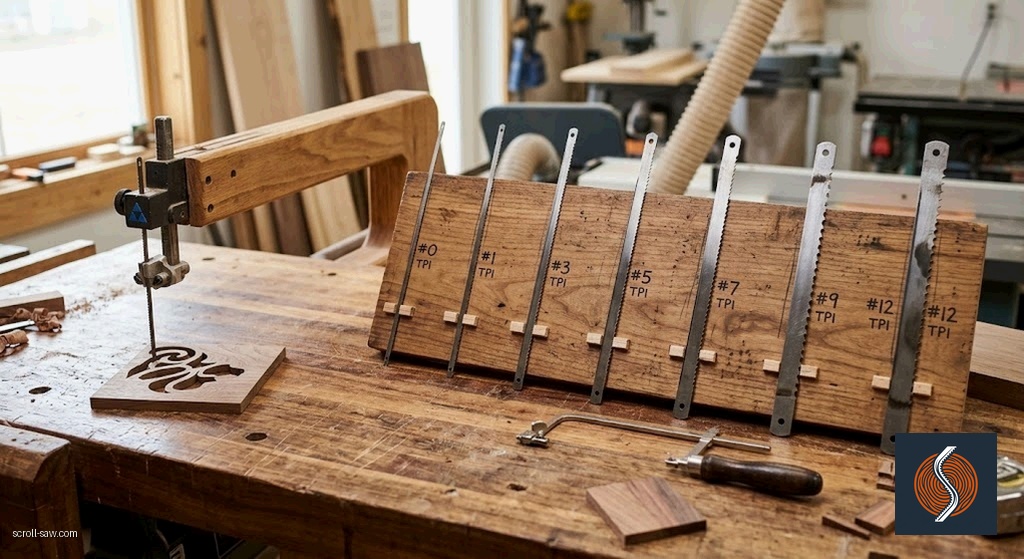
Blade number correlates to width, thickness, and teeth per inch. Bigger number, wider and coarser blade, faster cut, larger minimum radius. Smaller number, finer blade, tighter radius, slower and cleaner.
-
#2/0: 25 to 30 TPI. Veneer, 1/16 to 1/8 inch. Fragile.
-
#1: 22 to 25 TPI. Thin plywood, marquetry.
-
#3: 18 to 20 TPI. 1/4 inch stock, most portrait work.
-
#5: 12 to 15 TPI. 3/8 to 1/2 inch stock, the workhorse.
-
#7: 11 to 13 TPI. 1/2 to 5/8 inch hardwood.
-
#9: 10 to 12 TPI. 5/8 to 3/4 inch hardwood.
-
#12: 6 to 9 TPI. 3/4 inch and up, stack cutting.
Those ranges vary slightly by manufacturer. A Pégas #5 might list at 14 TPI while an Olson #5 lists at 12. Same size number, similar behavior.
What the size actually controls
Cutting speed. Bigger blades remove more material per stroke. A #12 chews through 1 inch pine at three or four times the rate of a #5. You pay for that speed in cut roughness and minimum turn radius.
Kerf width. Bigger blades cut a wider slot. That matters for inlay joints and precise fits, and it matters for chip clearance in thick stock.
Minimum radius. A #12 turns in a wide arc. A #2/0 pivots in a small one. The pattern’s tightest curve sets the maximum blade size you can use through that curve.
Blade life. Bigger blades last longer per cut because they distribute the work across more teeth. A fine blade in thick stock burns out fast.
Finish. Smaller blades leave cleaner edges, all else equal. The tradeoff is speed.
Match to the wood, then the pattern
Start with thickness. Move down one size for hardwood versus softwood at the same thickness. Then check the pattern’s tightest turn. If a #5 is right for the stock but the pattern has a 1/16 inch inside corner, either drop to a #3 for that section or plan to use a spiral blade for the pivot.
Example: 1/2 inch walnut portrait with fine facial details. Thickness says #5. Hardwood says drop to #3. Pattern detail says #3 is right. Load a #3 ultra reverse and cut.
Example: 3/4 inch pine plaque with a simple silhouette. Thickness says #9. Softwood keeps you at #9. No tight curves, so a #9 skip tooth is honest and fast.
Blades that hold up at each size
#3 range: Flying Dutchman Ultra Reverse #3 for two-sided pattern work in 1/4 to 1/2 inch stock.
#5 range: The Flying Dutchman 60-piece variety pack includes Ultra Reverse #5 among five useful styles at that size.
#7 to #9 range: The Olson FR49202 Reverse Tooth assortment covers this working range for pattern work.
#12 range: Pégas Modified Geometry #12 for smooth cuts in thick hardwood at speed.
Who should skip this framework: if your pattern designer specifies a blade and you have it, use it. This is for when the pattern is silent or you’re working with different stock than the design.
The size that looks right may still cut wrong
Three common reasons the right-size blade misbehaves:
-
Tension. Under-tensioned blades wander and burn regardless of size.
-
Speed. Hardwood at max SPM burns even with a fine blade.
-
Feed. Pausing on a curve heats the wood and scorches the edge.
Fix those before questioning the size.
The takeaway
Start with the wood’s thickness, drop one number for hardwood, and check the pattern’s tightest radius. That gets you the right blade size 90 percent of the time. The other 10 percent is tension, speed, and feed.
FAQ
What size scroll saw blade for 1/2 inch hardwood? #5 for most work. Drop to #3 if the pattern has tight curves.
What size for 3/4 inch pine? #9. Softwood cuts fast at that thickness and doesn’t need a smaller blade.
What size for marquetry? #2/0 to #1. Very fine, slow feed, gentle tension. Fragile blades that require patience.
Can I use a bigger blade than the chart says? Yes, if the pattern has no tight curves and you want speed. You’ll pay in roughness.
Can I use a smaller blade than the chart says? Sometimes for finish, but expect breakage and slow cuts. Only worth it for two-sided display work at close range.
Does blade size affect blade life? Yes. Bigger blades last longer per cut because more teeth share the work.
What size for a beginner? #5 reverse tooth for most 1/4 to 1/2 inch pattern work. The most forgiving working size.
References
-
Olson Saw Company blade sizing chart
-
Flying Dutchman / Mike’s Workshop blade specifications
-
Pégas Sawblades technical documentation


