
Which Scroll Saw Blade to Use: Match Number to Wood
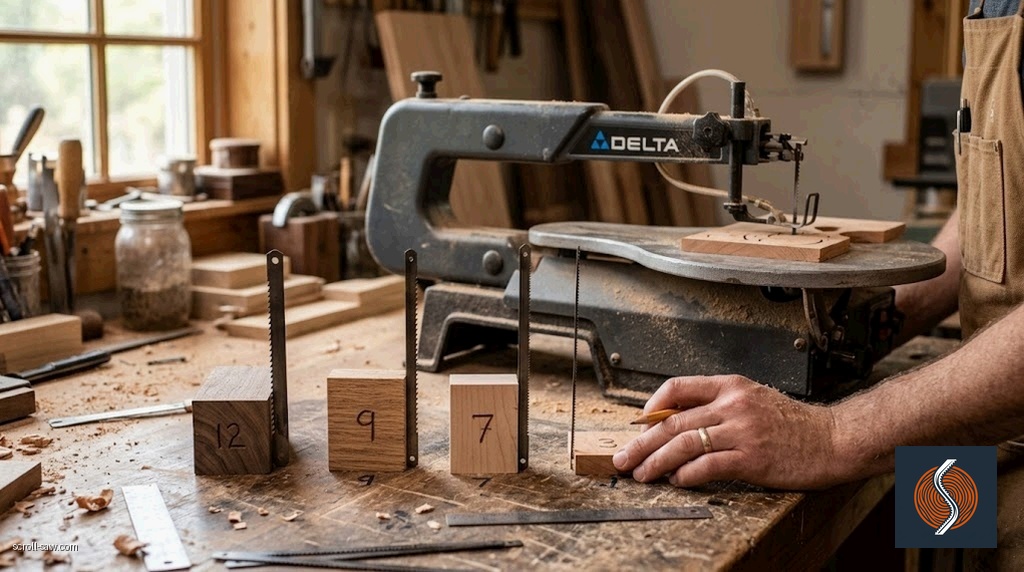
Which Scroll Saw Blade to Use: Match Number to Wood
The fastest way to pick a scroll saw blade is a three-step check: what’s the material, how thick is it, and how tight does the pattern turn. Get those three answers and the blade choice falls out.
The three-step check
Step one: material. Softwood (pine, cedar, poplar) tolerates coarser blades and higher speeds. Hardwood (oak, cherry, walnut, maple) wants finer blades and slower speeds. Plywood behaves like whichever species dominates the veneer; Baltic birch is dense and behaves like hardwood, big-box plywood is glue-heavy and dulls fast.
Step two: thickness.
-
1/8 inch: #2/0 to #1
-
1/4 inch: #3
-
3/8 to 1/2 inch: #5
-
5/8 to 3/4 inch: #7 to #9
-
3/4 inch and up: #12
For hardwood, drop one number from the softwood recommendation.
Step three: tightest curve. Measure the smallest turn in the pattern. If it’s under 3/16 inch inside radius, you need a #3 or smaller. Under 1/16 inch, you need a #2/0 or a spiral. If the pattern has one very tight section, switch blades for that part.
Two examples that show the framework
Example 1: 3/8 inch walnut portrait with fine facial detail. Material: hardwood. Thickness: #5. Drop one for hardwood: #3. Tight curves in the face: #3 confirms. Ultra reverse type for the two-sided display. Load a #3 ultra reverse and cut.
Example 2: 3/4 inch pine plaque with a simple silhouette. Material: softwood. Thickness: #9. No tight curves, no drop needed. Skip tooth type for speed. Load a #9 skip tooth and cut.
Blades that hold up for each case
For two-sided pattern work in 1/4 to 1/2 inch hardwood, Flying Dutchman Ultra Reverse #3 is the honest pick. Aggressive cut, clean bottom face, long life.
For a starter shelf, the Flying Dutchman 60-piece variety pack covers five useful styles in a single buy so you can learn what your saw wants.
For everyday pattern work, Olson FR49202 Reverse Tooth three-size assortment covers the #3 to #7 range.
For 3/4 inch hardwood at speed, Pégas Modified Geometry #12 is the smoothest cut in the thick range.
Who should skip the framework: if your pattern designer specifies a blade and you own it, use it. This is for when you’re on your own.
Setup that lets the right blade work
Tension the blade until it pings when plucked. Set the speed to the wood, not the pattern. Use a hold-down foot. Change the blade the moment it starts to wander or burn. All of these matter more than the last 5 percent of blade choice.
The takeaway
Material, thickness, tightest curve. Three inputs, one blade. The rest is tension, speed, and honest feed rate. Don’t overthink it.
FAQ
Which scroll saw blade for 1/2 inch cherry? #3 or #5 reverse tooth. Cherry burns easily, so slow the feed and use a fresh blade.
Which blade for 1/8 inch plywood? #2/0 or #1. Very fine, slow feed, gentle tension. Fragile.
Which blade for cutting animal silhouettes in pine? #5 to #7 skip tooth. Softwood, medium thickness, no tight curves.
Do I really need to drop a size for hardwood? Yes, in most cases. Hardwood cuts slower and a coarser blade builds heat instead of removing material.
Can I use one blade for a whole project? Often yes, if the pattern’s tightest curve fits your blade size. Complex patterns may need a mid-project blade change.
Why does my blade wander when I follow the chart? Almost always tension. Tighten until the blade pings when plucked.
What blade for spiral or in-place turns? Spiral blade in #1 or #2/0 for the turns, straight blade for the runs.
References
-
Olson Saw Company sizing chart
-
Flying Dutchman / Mike’s Workshop technical documentation
-
Pégas Sawblades product specifications


