
Which Way Do Scroll Saw Blades Go: Install Correctly
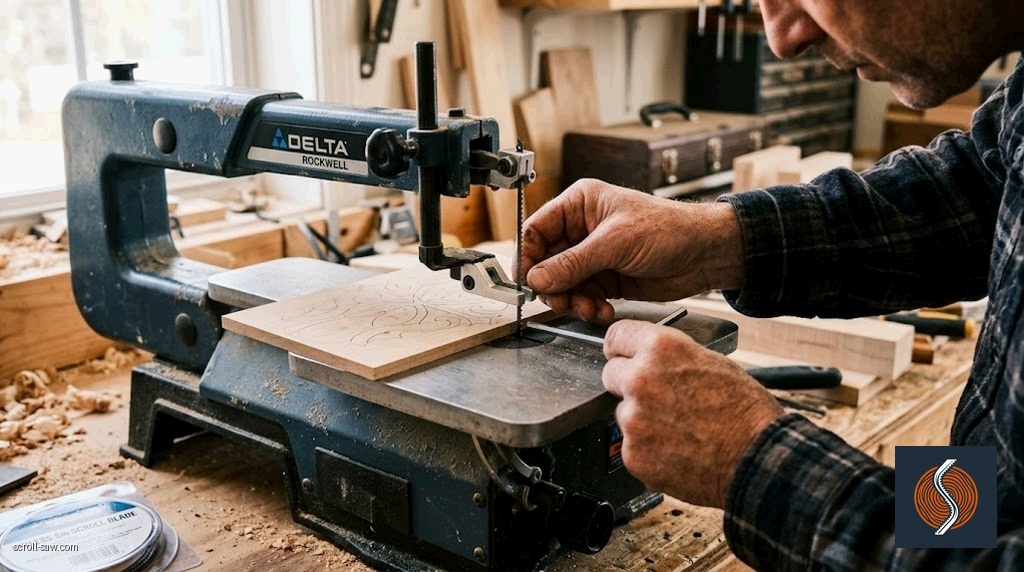
Which Way Do Scroll Saw Blades Go: Install Correctly
Somewhere between the first pack of blades and the first project, everyone stops and stares at a scroll saw blade for a good ten seconds trying to remember which end goes down and which way the teeth face. Get it wrong and the blade rides on top of the wood instead of cutting into it. Get it right and the saw feels twice as capable.
Here’s the rule, why it exists, and the small details that come after.
The rule
Scroll saw blades cut on the downstroke. The teeth face down and slightly toward you. When you install a blade, the pointed tips of the teeth should point down toward the table and the front of the saw.
A simple check: run a fingertip lightly along the front edge of the blade from top to bottom. It should feel smooth going down and catch going up. If it catches going down, the blade is upside down.
Why it matters
Scroll saw blades are precision-ground on one edge. That edge cuts. If the blade is installed upside down, the teeth ride on the wood on the downstroke and try to cut on the upstroke, which lifts the workpiece off the table with every cycle. You’ll feel it as violent chatter, and you’ll see it as a bouncing piece and a blade that refuses to feed forward.
Most pinless (plain-end) blades don’t have an obvious top or bottom stamped on the steel. The tooth direction is your only reliable clue.
Reverse tooth blades: the exception that’s not an exception
Reverse tooth and ultra reverse blades have a few teeth at the bottom flipped upward. Those upward teeth cut the bottom face of the workpiece on the upstroke to clean the tearout.
Installing a reverse tooth blade is exactly the same as any other: main teeth face down, the reversed section at the bottom takes care of itself. Don’t try to flip the blade to “use” the reverse section — you’ll defeat the whole point.
Loading the blade correctly
On a pinless saw with tool-free clamps:
-
Loosen the top and bottom clamps.
-
Feed the blade through the table’s blade hole from above.
-
Insert the bottom end into the bottom clamp and tighten. Teeth pointing down and forward.
-
Pull the top end up and insert into the top clamp. Do not over-stretch.
-
Apply tension with the tension lever. Pluck the blade; it should ping, not thud.
-
Check that the blade is square to the table with a small square.
On a pin-end saw:
-
Loosen the top and bottom clamps.
-
Feed the blade through the table’s blade hole.
-
Seat the bottom pin in the bottom clamp.
-
Seat the top pin in the top clamp.
-
Apply tension. Verify tooth direction.
A saw that arrives with a blade already installed is not guaranteed to be installed correctly. Check every blade every time.
Common installation mistakes
Blade upside down. Fixed by re-installing correctly. Costs you no wood if you catch it before the first cut.
Blade backward. Teeth face away from you instead of toward you. Cuts still happen but poorly, with the workpiece drifting away. Uncommon but possible on some clamp designs.
Blade twisted. The blade goes in with a slight twist. Cuts will drift left or right consistently. Loosen, straighten, retighten.
Blade under-tensioned. Even with correct orientation, a loose blade wanders and burns. Ping test after every install.
Blades that make the whole question easier
Premium blades from established makers have consistent tooth geometry, which means the visual and tactile cues are unmistakable. The Flying Dutchman 60-piece variety pack is a good place to develop the muscle memory of loading blades correctly across five different tooth patterns.
For everyday reverse tooth work, Olson FR49202 blades are clearly marked and consistently ground, so the tooth direction is easy to identify at a glance.
Who should skip a premium pack: if you’re brand new and going to install blades wrong a few times anyway, an Olson FR49400 skip tooth assortment is honest for learning.
The takeaway
Teeth down, teeth forward. That’s the rule. Every scroll saw blade goes in the same way, reverse tooth included. Check every install, tension until the blade pings, and you’ll never wonder mid-cut whether the blade is on right.
FAQ
Which way do scroll saw blades go, up or down? Teeth face down toward the table. The cutting happens on the downstroke.
Do reverse tooth blades install differently? No. Main teeth face down, reversed section at the bottom takes care of itself.
How do I know if my blade is installed upside down? The blade will chatter violently, the workpiece will bounce, and the cut will not advance. Stop, check, reinstall.
Which end of the blade goes in first? Bottom end into the bottom clamp first, then top end into the top clamp. Feed through the table hole from above.
Should the blade lean forward or backward? Straight up and down, perpendicular to the table. Check with a small square.
How tight should the blade be? Tight enough to ping when plucked. If it thuds, it’s under-tensioned.
Do pin-end and pinless blades install the same way? Same direction (teeth down, teeth forward). Different clamp mechanism.
References
-
Olson Saw Company blade installation guidance
-
Flying Dutchman / Mike’s Workshop blade documentation
-
DeWalt DW788 owner’s manual


