
DeWalt Scroll Saw Stand Assembly: The Right Sequence
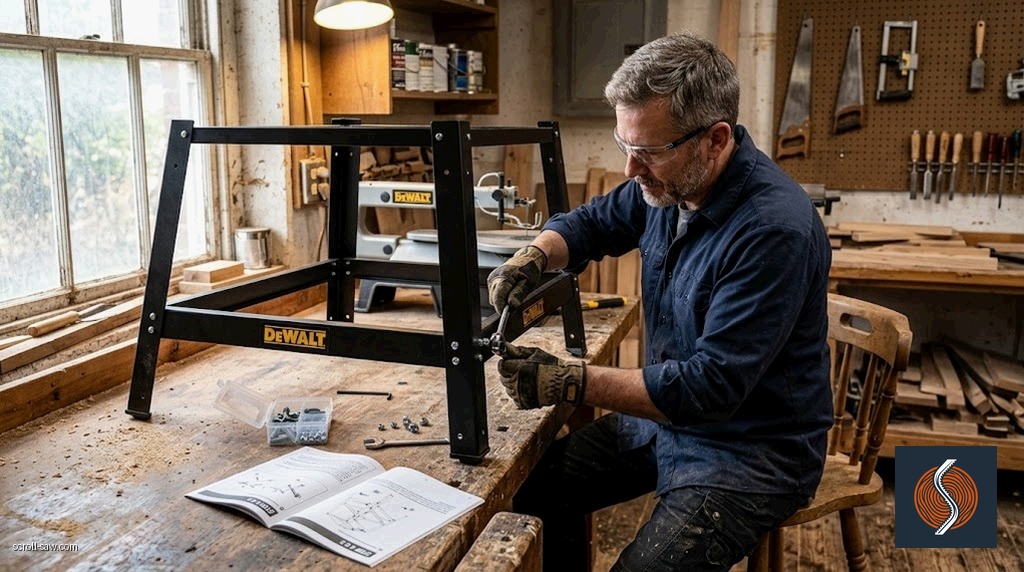
DeWalt Scroll Saw Stand Assembly: The Right Sequence
The DeWalt scroll saw stand is one of those parts nobody thinks about until they’re standing in front of it with an Allen key and a bag of bolts, wondering which leg goes where. The good news is the assembly is straightforward once you understand the sequence. Rushing it leaves you with a wobbly stand and a saw that walks across the floor.
Here’s the order that actually works, and the things worth checking after the last bolt is tight.
What you’re assembling
The DeWalt DW7880 scroll saw stand is a four-leg steel frame with an adjustable height range, a flat mounting plate that accepts the DW788 scroll saw, and rubber feet on the leg bottoms. The whole thing weighs about 25 pounds assembled.
Box contents typically: four legs, two upper cross braces, two lower cross braces, mounting plate, hardware bag with bolts, washers, and lock nuts, and an Allen key.
The assembly sequence
Step 1: Sort the hardware. Lay every bolt, washer, and nut out on a clean surface. Group by size. You’ll thank yourself when you’re not hunting for the right bolt at step 5.
Step 2: Attach the mounting plate to the two upper cross braces first. The mounting plate has bolt holes that match the DW788 saw’s mounting pattern. Get the plate square to the braces before tightening. Hand tight only at this stage.
Step 3: Attach the legs to the upper cross brace / mounting plate assembly. Slide each leg onto the corner brackets, secure with the bolt-and-nut hardware. Hand tight only.
Step 4: Attach the lower cross braces between the legs. These provide rigidity and prevent the frame from racking. Get the frame square by measuring diagonals — both should be equal when the frame is square.
Step 5: Tighten everything. Work in a cross pattern like tightening lug nuts on a car. Snug one bolt, then the opposite corner, then the other two. Repeat with progressively more torque until everything is firm. Don’t over-torque — the steel frames deform slightly if you crank the bolts too hard.
Step 6: Install the rubber feet on the leg bottoms.
Step 7: Set the stand upright and level. Use a small level on the mounting plate. If one leg is short, use a shim.
Step 8: Bolt the DW788 to the mounting plate. The mounting holes should align. Use lock washers on the mounting bolts — vibration will loosen plain washers over time.
What to check after assembly
Level. Torpedo level on the mounting plate. Adjust with shims under legs as needed.
Square. Measure the diagonals of the base frame. They should be equal within about 1/8 inch.
Torque. After a week of use, retighten every bolt. Vibration works loose the first hardware pass regardless of how tight you thought it was.
Vibration. Run the saw with a blade installed and a scrap piece on the table. If the stand walks or resonates strongly, add rubber pads under the feet or check for a loose bolt.
Height. Sit at the saw. Your forearm should be roughly parallel to the table when your hand is on the workpiece. Adjust stand height in the available range if needed.
Fit for saws other than the DW788
The DW7880 is designed for the DeWalt DW788. It may not fit other saws without drilling a new hole pattern in the mounting plate. If you have a WEN or other saw and want an adjustable stand that fits both, the WEN Adjustable Scroll Saw Stand is designed to fit the WEN family and the DW788.
Who should skip the DW7880: if you don’t own a DW788 and don’t plan to, a universal stand is a better buy.
Common assembly mistakes
Tightening in the wrong order. Frame racks and won’t sit square. Fix by loosening everything and retightening in cross pattern.
Skipping the diagonal check. Frame looks square but isn’t. Small out-of-square becomes visible walking on hardwood floors.
Not using lock washers on saw mount. Vibration loosens saw over time. Retighten monthly or use lock washers up front.
Wrong leg orientation. Some legs have specific left/right or front/back orientation. Check the instructions before bolting.
The takeaway
Sort the hardware, assemble the top first, add legs, add cross braces, tighten in cross pattern, level, and bolt the saw down with lock washers. The stand is not complicated. Rushing it is what causes vibration and walking problems.
FAQ
How long does DW7880 assembly take? About 30 to 45 minutes if you don’t rush and check squareness as you go.
Do I need special tools for the DW7880? An Allen key (usually included), a wrench for the lock nuts, a level, and a tape measure for the diagonal check.
Does the DW7880 fit any other scroll saw? Designed for the DW788. Other saws may fit with new holes drilled in the mounting plate.
Should I bolt the saw to the stand? Yes, with lock washers. A loose saw amplifies vibration and walks.
How high should the assembled stand sit? The DW7880 is height-adjustable within a modest range. Aim for the table just below your chest when seated so your forearms are roughly parallel to the workpiece.
Do I need rubber feet on the stand? Usually included. If missing, aftermarket rubber cabinet feet work. They damp vibration on hard floors.
Why does my stand wobble after assembly? Usually an out-of-square frame or a leg on an uneven floor. Check diagonals, level, and shim as needed.
References
-
DeWalt DW7880 product documentation
-
DeWalt DW788 scroll saw manual
-
Scroll Saw Association of the World ergonomics guidance


