
Olson Mach Speed Scroll Saw Blades: Speed and Trade-Offs
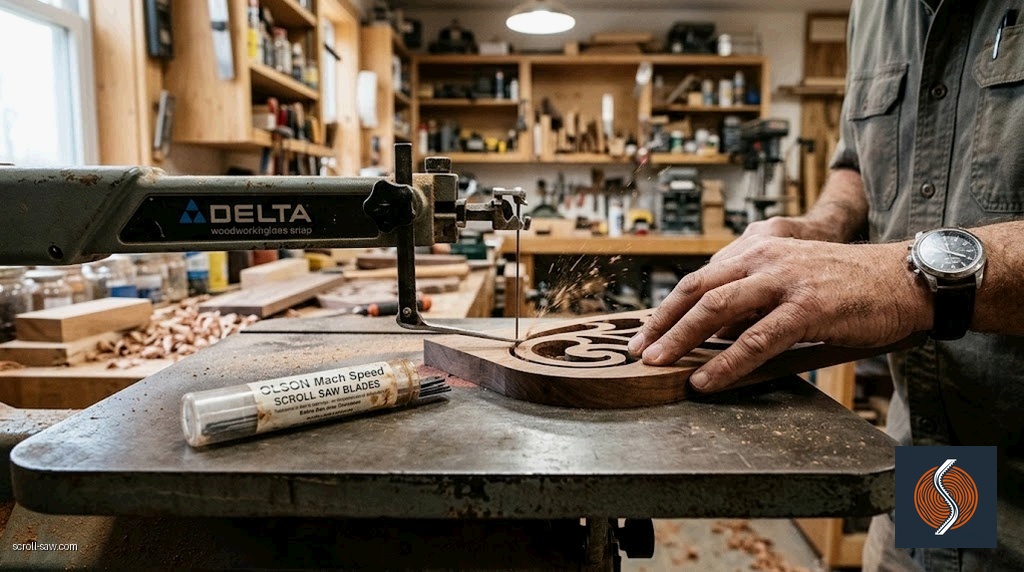
Olson Mach Speed Scroll Saw Blades: Speed and Trade-Offs
Olson’s Mach Speed line is the company’s answer to a real complaint: standard skip tooth blades are slow through thick hardwood. Mach Speed blades pack more aggressive tooth geometry into the standard 5-inch pinless format, so you get faster feed through 1/2 to 1 inch stock without stepping up to a huge blade number.
Here’s what actually changes on the cut and where the trade-off shows up.
What Mach Speed does differently
Mach Speed blades use a modified tooth profile with larger gullets and a slightly more aggressive rake than a standard skip tooth of the same number. The gullet difference is where the speed comes from — more chip room means the blade keeps cutting instead of packing and burning.
The TPI is roughly comparable to standard skip tooth at each size, but the effective cutting rate is noticeably higher, especially in thick hardwood where standard blades slow down.
Kerf and radius
Kerf is close to a standard skip tooth of the same number, so pattern precision is not sacrificed. Radius follows the same rules: bigger number, larger minimum turn. A Mach Speed #5 turns the same as a standard #5.
Finish
Rougher than a reverse tooth, similar to a standard skip tooth. Mach Speed is a speed blade, not a finish blade. Bottom face will need sanding.
If finish matters, use a reverse tooth for the visible portions and a Mach Speed for the interior stock removal.
Where Mach Speed earns its keep
Thick hardwood cuts where standard blades slow down. Stack cutting where the throughput matters. Rough cutting intarsia blanks. Long straight-ish runs where you want the piece off the saw and onto the sander fast.
Where it doesn’t: two-sided display work (use reverse tooth), fine detail (use a smaller blade), tight radius pivots (use spiral).
Comparable options
If you want a step up in finish for the same thick-stock work, Pégas Modified Geometry #12 cuts smoother through 3/4 inch hardwood, at a higher price per blade.
For everyday skip tooth work, the Olson FR49400 assortment covers the standard skip tooth line at a lower cost.
For a mixed-style variety, Flying Dutchman 60-piece variety pack covers five different tooth styles including super reverse and precision skip.
Who should skip Mach Speed: if you cut mostly 1/4 to 1/2 inch stock for pattern work, standard reverse tooth is the honest choice. Mach Speed is a thick-stock speed tool.
Setup
Tension until the blade pings. Speed moderate — the blade is already aggressive; high SPM builds heat fast. Firm hold-down, aggressive-cutting blades lift the workpiece harder.
The takeaway
Mach Speed is the Olson line for cutting thick hardwood faster without stepping to a huge blade. Rough finish, standard kerf, aggressive feed. Use it for stock removal and switch to a finer blade for the visible cuts.
FAQ
Are Olson Mach Speed blades pinless? Yes, 5-inch plain-end format, fits most modern pinless scroll saws.
How much faster do they cut than standard skip tooth? Noticeably faster in thick hardwood, roughly comparable in thin stock where standard blades don’t slow down much.
Do they leave a rougher finish? Similar to standard skip tooth. Not as clean as reverse tooth.
What size Mach Speed for 3/4 inch hardwood? #7 to #9 for most patterns, #12 for long runs and stack cuts.
Can I use Mach Speed for portrait cutting? Not ideal. Portrait work wants ultra reverse for the clean bottom face.
Do Mach Speed blades break easier because they’re aggressive? Only if you force them. Aggressive blades still need patient feed and correct tension.
Are Mach Speed blades more expensive than standard Olson? Slightly. The performance in thick stock justifies it for the right work.
References
-
Olson Saw Company Mach Speed product documentation
-
Pégas Sawblades technical specifications
-
Scroll Saw Association of the World blade guidance


