
AMT Scroll Saw: Vintage Identification and Maintenance
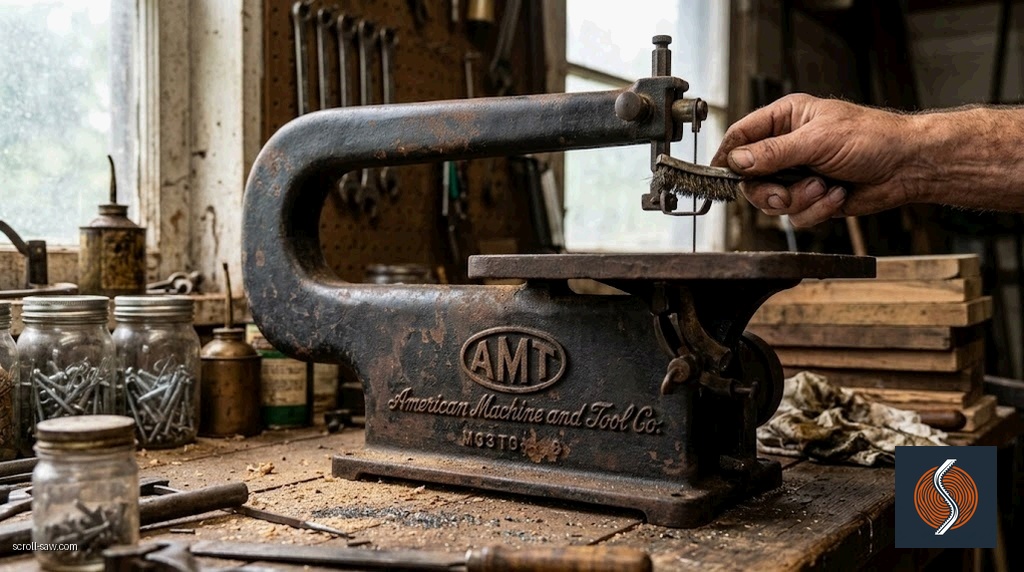
AMT Scroll Saw: Vintage Identification and Maintenance
AMT scroll saws show up in garages and estate sales more often than in current retailers. AMT (American Machine and Tool) was a mid-20th-century American manufacturer of woodworking tools, and their scroll saws were common in home shops from the 1950s through the 1970s. If you’ve inherited one or found one at a yard sale, here’s how to think about what you have.
What AMT scroll saws are
AMT scroll saws are typically:
-
Cast iron or steel body
-
Belt-driven from a separate motor (sometimes included, sometimes not)
-
Pin-end blade format
-
Simple mechanism with straightforward maintenance
-
Modest throat depth by modern standards (usually 14 to 18 inches)
Build quality was solid for the era. A well-maintained AMT will still cut cleanly today. The mechanisms are simple enough that basic maintenance is feasible without specialized parts.
Identification
Look for a nameplate on the saw body. AMT model numbers typically follow a format like 4600, 4650, or similar. The model number, combined with a photo, usually identifies the exact configuration.
Some AMT saws were sold with a motor; others were designed to accept a customer-supplied motor via belt drive. Verify what’s included before assessing complete functionality.
Parts availability
OEM parts are not available new. AMT has been out of business for decades. Options:
Vintage tool community. Forums and Facebook groups for old woodworking tools sometimes have members with donor parts.
Generic replacement. Blade clamps, screws, belts, and motor components can often be sourced generically. Measure carefully.
Fabrication. Some AMT parts (thin sheet-metal covers, small cast pieces) can be fabricated by owners with basic shop skills.
Cannibalization. Buying a second parts saw for a reasonable price is often the most efficient way to keep an AMT running.
Blade format
AMT scroll saws typically use pin-end 5-inch blades. Standard modern pin-end blades fit.
FOXBC pin-end 48-pack is the honest working blade.
Delta #7 Super Sharps for hardwood work.
For pinless conversion, aftermarket adapters exist but the old AMT clamp designs may not accept them cleanly. Verify fit before ordering.
Setup for a vintage AMT
Clean everything. Decades of wood dust, oil, and grime accumulate. Disassemble carefully, clean each component, and reassemble.
Lubricate arm pivots per any surviving manual, or use general woodworking machine oil sparingly.
Check motor brushes if the motor still runs. Worn brushes cause intermittent operation.
Check the drive belt. Old rubber cracks and slips. Generic V-belts often fit.
Check squareness with a small square. Adjust the table if needed.
Ping the blade after tensioning. Old spring mechanisms weaken; if the ping thuds, the tension spring may need replacement.
When to keep vs. replace
Keep the AMT if:
-
The mechanism runs smoothly after cleaning
-
You value the vintage character
-
Your work is craft-level, not precision pattern cutting
-
You enjoy maintaining old tools
Replace if:
-
Multiple critical parts are worn beyond serviceable condition
-
The motor is failed and replacement is uneconomical
-
Your work demands modern capabilities (variable speed, quick blade changes, deep throat)
Reasonable replacement options: WEN 3922 16-inch variable speed at entry-level, DeWalt DW788 at near-professional.
Safety
Inspect the power cord. Old cords crack and become electrical hazards. Replace if the insulation is damaged.
Inspect the switch. Old switches sometimes fail closed, meaning the saw won’t turn off. Test carefully before extended use.
Add a footprint of safety: dust mask, safety glasses, hearing protection. Old saws lack modern noise dampening.
The takeaway
AMT scroll saws are honest vintage American machines with straightforward mechanisms and no current parts support. Fine for craft-level use after cleaning and basic maintenance. Standard modern pin-end blades fit. When multiple critical parts fail, a modern entry-level saw is usually the honest replacement.
FAQ
Who was AMT? American Machine and Tool, a mid-20th-century American manufacturer of woodworking tools including scroll saws.
Are AMT scroll saws still made? No. AMT has been out of business for decades.
Can I get replacement parts for an AMT scroll saw? No OEM parts. Generic hardware (screws, belts, brushes) sometimes fits. Vintage tool communities have donor parts occasionally.
What blades fit an AMT scroll saw? Standard pin-end 5-inch blades. Any modern pin-end assortment works.
Is an AMT scroll saw worth restoring? Depends on the condition and your interest. Solid running examples are honest craft saws. Heavily worn units are not economically restorable.
Can I use pinless blades on an AMT? With an aftermarket adapter possibly, though old clamp designs may not accept modern adapters cleanly.
What’s a good replacement for an AMT? WEN 3922 for entry-level, DeWalt DW788 for serious pattern work.
References
-
Vintage scroll saw community resources
-
Original AMT product documentation (rare)
-
WEN and DeWalt scroll saw specifications


