
Atlas Scroll Saw: Vintage Identification and Parts
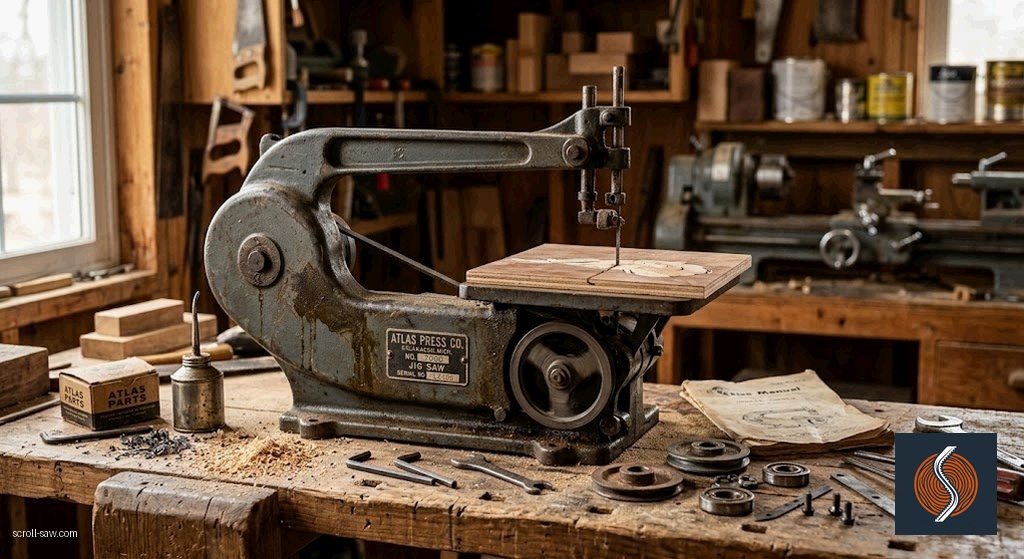
Atlas Scroll Saw: Vintage Identification and Parts
Atlas scroll saws show up in estate sales and vintage tool listings with real regularity. Atlas Press Company was a major American machine tool manufacturer through most of the 20th century, and their smaller woodworking tools — including scroll saws — turned up in home shops from the 1930s through the 1970s.
If you’ve found one at a barn sale or inherited one from a relative’s workshop, here’s the honest read.
What Atlas scroll saws are
Atlas scroll saws are typically:
-
Cast iron body, often with the classic Atlas green paint
-
Belt-driven from a separate 1/4 to 1/3 HP motor
-
Pin-end blade format
-
Modest throat depth (usually 14 to 18 inches)
-
Simple mechanical design that ages well
Build quality is genuinely solid for the era. Atlas built to last. A well-maintained Atlas from the 1950s or 1960s still cuts cleanly today.
Identification
Look for the Atlas Press Company nameplate, usually on the front or side of the saw body. Model numbers are stamped or cast into the frame. Common models include the 10-inch and 12-inch throat saws.
Some Atlas scroll saws were sold as complete units with motor and stand. Others were bare mechanisms designed to accept a customer-supplied motor.
Parts availability
OEM parts are not available. Atlas Press Company exited most consumer tool markets decades ago. Options for keeping an Atlas running:
Vintage tool communities. OWWM (Old Woodworking Machines) forum members occasionally have donor parts.
Generic hardware. Blade clamp screws, drive belts, motor brushes, power cords, and switches are universal sizes available at hardware and industrial supply stores.
Fabrication. Small parts can be fabricated by owners with basic machining skills.
Cannibalization. Buying a second parts saw is often the most efficient route.
Blades that fit
Atlas scroll saws use standard pin-end 5-inch blades on most models. Modern pin-end blades fit without modification.
FOXBC pin-end 48-pack is the honest working blade for vintage Atlas saws.
Delta #7 Super Sharps for hardwood pattern work.
Some very old Atlas models use non-standard blade lengths. Measure the blade path before ordering if you’re unsure.
Common failures
Stripped blade clamp screws. Universal machine screw replacement from any hardware store.
Cracked drive belts. Standard V-belts, measure length and width to spec a replacement.
Failed motor brushes. Generic brushes fit most motors of the era.
Worn arm pivots. May require bushing replacement or fabrication.
Failed switches. Universal toggle or paddle switches with minor bracket adaptation.
Setup for a vintage Atlas
Clean thoroughly. Decades of dust, oil, and grime accumulate in every crevice.
Lubricate the arm pivots and any moving joints per manual guidance, or use general woodworking machine oil sparingly.
Check squareness with a small square. Adjust the table if needed.
Ping test after tensioning. Old tension springs may have weakened.
Inspect the power cord and switch. Both age poorly. Replace if compromised.
When to keep, when to replace
Keep the Atlas if:
-
The mechanism runs smoothly after cleaning
-
The motor is healthy
-
You value the vintage character and enjoy maintaining old tools
-
Your work is craft-level, not high-precision pattern cutting
Move to a modern saw if:
-
Multiple critical parts need sourcing
-
The motor is failed and replacement is uneconomical
-
Your work demands variable speed, quick blade changes, or deep throat
Reasonable modern replacements: WEN 3922 for entry-level, DeWalt DW788 for near-professional.
Who should keep hunting Atlas parts: vintage tool enthusiasts who value the heritage and process of restoration.
The takeaway
Atlas scroll saws are solid vintage American machines with no current OEM parts support. Standard modern pin-end blades fit. Universal hardware handles most common failures. When multiple critical parts fail, a modern saw is the honest replacement.
FAQ
Are Atlas scroll saws still made? No. Atlas Press Company exited consumer tool markets decades ago.
Where can I get Atlas scroll saw parts? Vintage tool communities, generic hardware stores, industrial supply, and donor saws.
What blades fit an Atlas scroll saw? Most use standard pin-end 5-inch blades. Verify blade length on very old models.
Are Atlas scroll saws worth restoring? Depends on condition and interest. Solid running examples are honest craft saws.
Can I convert an Atlas to pinless blades? With an aftermarket adapter, possibly. Older clamp designs may not accept modern adapters cleanly.
What HP motor does an Atlas scroll saw need? Usually 1/4 to 1/3 HP at 1725 RPM. Standard sizes for replacement.
What’s a good modern replacement for an Atlas? WEN 3922 for entry-level, DeWalt DW788 for near-professional pattern work.
References
-
OWWM vintage tool community archives
-
Atlas Press Company historical documentation
-
WEN and DeWalt scroll saw specifications


