
Beaver Scroll Saw: Canadian Vintage Tool Guide
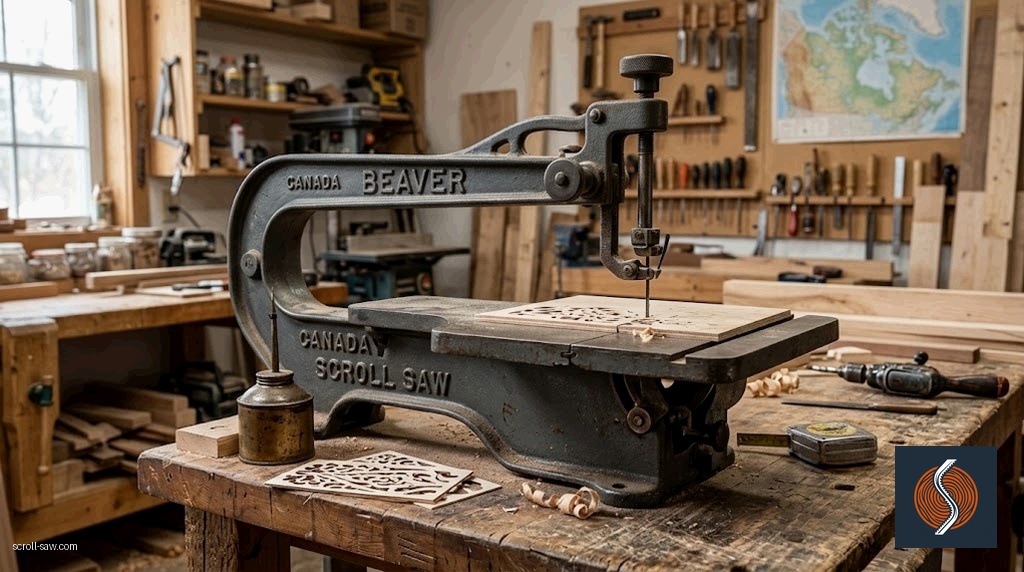
Beaver Scroll Saw: Canadian Vintage Tool Guide
Beaver was a well-known Canadian brand of woodworking machinery from the mid-20th century through the 1980s, and Beaver scroll saws show up regularly in Canadian garages and estate sales. If you’ve inherited one or found one at a farm auction, here’s the honest read.
What Beaver scroll saws were
Beaver Machinery, based in Guelph, Ontario, built solid mid-century woodworking tools including bandsaws, table saws, jointers, and scroll saws. The scroll saws are typically:
-
Cast iron body with the distinctive Beaver green paint
-
Belt-driven from a separate 1/4 to 1/3 HP motor
-
Pin-end blade format
-
Modest throat depth (usually 12 to 16 inches)
-
Simple, well-engineered mechanism
Build quality is solid. A well-maintained Beaver scroll saw from the 1960s or 1970s still cuts cleanly today. The mechanisms are simple enough that basic maintenance is feasible without specialized parts.
Identification
Look for the Beaver nameplate, usually on the front of the saw body. Model numbers are cast or stamped into the frame. Common Beaver scroll saw models include benchtop machines with 12 to 16 inch throat depths.
Beaver was acquired by other manufacturers over the years, so some later Beaver-branded tools may have been produced by different companies. Original 1960s–70s Beaver machines are the most sought-after by collectors.
Parts availability
OEM Beaver parts are essentially unavailable today. Beaver Machinery as an original manufacturer has been out of business for decades. Options for keeping a Beaver saw running:
Canadian vintage tool communities. Facebook groups and forums for Canadian woodworking tools sometimes have donor parts.
Universal hardware. Blade clamp screws, drive belts, motor brushes, and other consumables are generic sizes available anywhere.
Fabrication. Small parts can be fabricated with basic shop skills.
Donor saws. Buying a second parts saw is often the most efficient path.
Blade format
Most Beaver scroll saws use standard pin-end 5-inch blades. Modern pin-end blade assortments fit without modification.
Blades that fit
FOXBC pin-end 48-pack is the honest working blade for vintage Beaver saws.
Delta #7 Super Sharps for hardwood pattern work.
For pinless conversion, aftermarket adapters exist but older Beaver clamp designs may not accept them cleanly. Verify fit before ordering.
Common failures
Stripped blade clamp screws. Universal machine screw replacement.
Cracked drive belts. Measure and source V-belts from industrial supply.
Worn motor brushes. Generic brushes fit most motors of the era.
Weakened tension springs. May require sourcing through vintage tool communities or fabrication.
Failed switches. Universal switches with minor bracket modification.
Setup for a vintage Beaver
Clean thoroughly. Disassemble carefully, clean each component, lubricate pivots per any surviving manual guidance.
Check power cord and switch. Both age poorly. Replace if compromised.
Check squareness with a small square.
Ping test after tensioning.
Run the saw briefly with no blade to check for vibration and mechanical noise.
When to keep, when to replace
Keep the Beaver if the mechanism runs smoothly, the motor is healthy, and your work is craft-level.
Replace if multiple critical parts need sourcing, the motor is failed, or your work demands modern capabilities.
Reasonable modern replacements: WEN 3922 16-inch variable speed at entry-level, DeWalt DW788 at near-professional.
Who should keep hunting Beaver parts: Canadian vintage tool enthusiasts who value the heritage.
Historical note
Beaver Machinery was a significant Canadian tool manufacturer, and Beaver tools have real collectible value in Canadian vintage tool communities. A well-preserved Beaver scroll saw is worth restoring for both practical use and historical value.
The takeaway
Beaver scroll saws are solid vintage Canadian machines with no current OEM parts support. Standard pin-end blades fit. Universal hardware handles most common failures. When multiple critical parts fail, a modern saw is the honest replacement, but a healthy Beaver has real practical and historical value.
FAQ
Is Beaver Machinery still in business? The original Beaver Machinery Canadian company is no longer in business as an independent manufacturer. The brand may appear on other products under different ownership.
Where can I get Beaver scroll saw parts? Canadian vintage tool communities, generic hardware stores, industrial supply, and donor saws.
What blades fit a Beaver scroll saw? Standard pin-end 5-inch blades on most models.
Is a Beaver scroll saw worth restoring? Yes, for solid running examples. Beaver tools have real collectible value in Canadian vintage tool communities.
Can I convert a Beaver to pinless blades? With an aftermarket adapter, possibly. Verify fit with the specific clamp design.
What HP motor does a Beaver scroll saw need? Usually 1/4 to 1/3 HP at 1725 RPM.
What’s a good modern replacement? WEN 3922 for entry-level, DeWalt DW788 for serious pattern work.
References
-
Canadian vintage tool community archives
-
OWWM vintage tool documentation
-
WEN and DeWalt scroll saw specifications


