
Big Scroll Saw: When Throat Depth Actually Matters
Big Scroll Saw: When Throat Depth Actually Matters
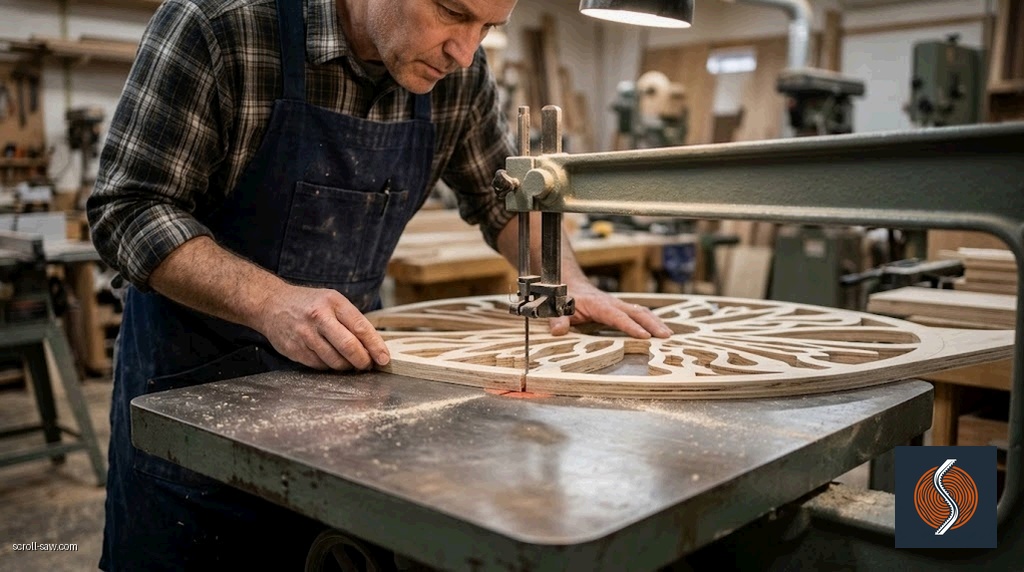
“Big scroll saw” usually means one with a large throat depth — the distance from the blade to the rear arm, which determines how big a workpiece you can maneuver around the blade. Throat depth is the single most important spec for serious pattern work, and it’s where entry-level saws start to hurt.
Here’s what changes when you have a big scroll saw and when the extra throat is worth the money.
What throat depth actually determines
The workpiece must fit between the blade and the rear arm. On a 16-inch saw, the workpiece can’t extend more than 16 inches from the blade in the direction of the arm. On a 20-inch saw, that jumps to 20 inches.
For small pattern work, 14 or 16 inches is fine. For larger projects — clock cases, wall art, intarsia panels, life-size portraits — you’ll bump the workpiece against the rear arm on smaller saws.
Common throat depths
-
14 inch: small hobby saws, budget entry-level
-
16 inch: the standard hobby size, WEN 3922 territory
-
18 to 20 inch: benchtop pro range, DeWalt DW788 at 20 inches
-
21 to 30 inch: premium and industrial, Excalibur EX30 and similar
When you need a big saw
Intarsia panels. A 24 by 18 inch intarsia landscape needs at least 18 inches of throat to maneuver.
Clock cases. Traditional fretwork clock cases run 12 to 18 inches tall and need throat depth to rotate.
Portrait cutting. Life-size or large-scale portrait cuts benefit from 20+ inches.
Wall art. Anything intended for wall display often exceeds 16 inches in one dimension.
Stack cutting. Multiple thin layers stacked for identical cuts require the same throat as a single large piece.
Custom sign work. Any sign longer than about 14 inches will bump the arm on entry-level saws.
When you don’t
Small ornaments. Puzzles. Keychains. Small compound-cut animals. Most beginner projects. Throat depth doesn’t limit you.
If your work is small and always will be, a 16-inch saw covers your range indefinitely.
Big saw picks
DeWalt DW788 20-inch is the near-universal big-saw pick for serious hobby work. Parallel arm, refined vibration, standard for pattern work.
Add DW7880 stand for ergonomics.
Add DW7881 work light for pattern visibility.
For 21 to 30 inch throat capacity, look at Excalibur EX21 or EX30 through specialty retailers.
Blades don’t change with throat depth
Big scroll saws use the same 5-inch pinless blades as smaller ones. Throat depth affects workpiece size, not blade selection.
Recommended blades for big saw work:
Flying Dutchman Ultra Reverse #3 for pattern work.
Pégas Modified Geometry #12 for thick hardwood.
Flying Dutchman variety pack for the range.
Table size scales with throat depth
Bigger throat depth usually pairs with a bigger table. A 20-inch saw has a larger table than a 16-inch, giving you more support for large workpieces.
Some saws support auxiliary table extensions for very large work.
Trade-offs of big scroll saws
Weight and size. A 20-inch saw takes more bench space than a 16-inch. Not a huge difference but noticeable.
Cost. Bigger saws generally cost more. The step from 16 to 20 inches often doubles the price.
Vibration considerations. Bigger machines with more mass often vibrate less, actually. Not a trade-off in that sense.
Overkill for small work. A 20-inch saw cutting a small ornament is fine but doesn’t earn its extra capability on that project.
Who should skip the big saw: hobbyists whose work is consistently small. A 16-inch WEN handles small work well and saves money for blades and wood.
The takeaway
Big scroll saws (20 inches and up) are essential for large pattern work: intarsia panels, portrait cuts, clock cases, wall art. For small hobby work, 16 inches is plenty. DeWalt DW788 at 20 inches is the near-standard for serious hobby big-saw work.
FAQ
What’s considered a big scroll saw? Generally 20 inches of throat depth or more.
Do I need a big scroll saw for hobby work? Depends on project size. Small ornaments and puzzles work on 16-inch saws. Large panels and intarsia need 20+ inches.
What’s the biggest hobby scroll saw? Excalibur EX30 at 30 inches is at the high end of hobby/prosumer capacity.
Does throat depth affect cut quality? Not directly. Cut quality depends on blade, tension, and technique. Throat determines what fits.
Is a 20-inch scroll saw worth the extra money? For serious pattern work, yes. For small hobby cutting, a 16-inch saves money without limiting output.
Can I add a throat extension to a smaller saw? No. Throat depth is fixed by the arm design.
What blade do I need for a big scroll saw? Same standard 5-inch blades as any scroll saw. Blade choice depends on stock and pattern, not saw size.
References
-
DeWalt DW788 specifications
-
Excalibur EX30 product documentation
-
Scroll Saw Association of the World tool guidance


