
Build a Scroll Saw: DIY Realities and Alternatives
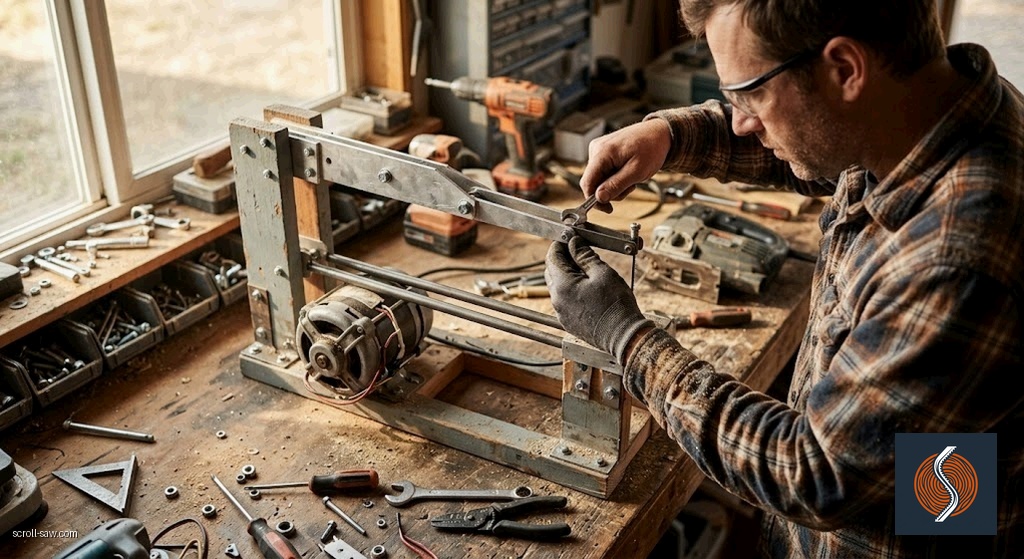
Build a Scroll Saw: DIY Realities and Alternatives
The idea of building a scroll saw from scratch shows up in maker forums and DIY tool communities regularly. The appeal is understandable — a custom-built machine tailored to your shop, the satisfaction of building your own tools, and potentially saving money.
The honest read: building a scroll saw is real DIY work that most people underestimate, and the result rarely matches a modern commercial saw at similar cost. Here’s when it makes sense and when it doesn’t.
What building a scroll saw actually involves
A scroll saw is deceptively complex. The core mechanism requires:
-
A frame with two arms tensioning a small reciprocating blade
-
A drive mechanism converting rotary motor motion to linear blade motion
-
Precise alignment of the blade path perpendicular to the table
-
A tension system that maintains blade tension through the stroke
-
Vibration control to prevent the saw from destroying itself
Each of these has real engineering challenges. Getting the blade to move straight up and down without wobble is not trivial. Maintaining tension consistently is not trivial. Damping vibration is not trivial.
A well-engineered scroll saw represents decades of design refinement across multiple manufacturers.
When DIY makes sense
Learning projects. Building a scroll saw as an engineering learning exercise is valuable regardless of the final quality.
Extreme customization. If you need capabilities no commercial saw offers (unusual throat depth, specific power source, special table configuration), DIY may be the only path.
Off-grid or remote contexts. In situations where commercial tools aren’t available, DIY makes sense.
Historical replication. Building a treadle scroll saw as a period-accurate reproduction has real value for demonstration and craft contexts.
When DIY doesn’t make sense
Cost savings. By the time you source a motor, machine linkage parts, and fabricate the frame, you’ve usually spent more than a commercial entry-level saw would cost.
Time efficiency. A commercial saw is ready to cut out of the box. A DIY saw is weeks or months of design, fabrication, and refinement.
Quality. A DIY saw made with basic shop tools usually can’t match the vibration control and precision of a well-engineered commercial saw.
Blade compatibility. Standard 5-inch blades require specific clamp designs. DIY clamp mechanisms often struggle with tension and squareness.
Common DIY scroll saw configurations
Jigsaw conversion. Mount a handheld jigsaw upside down under a table with a hole for the blade. Simple, functional, limited to jigsaw blade capabilities. Cuts moderately curved shapes but no interior cuts, no fine detail, no tight radius.
Sewing machine conversion. Historical DIY approach using an old sewing machine’s reciprocating mechanism to drive a scroll saw blade. Interesting but rarely practical.
Full ground-up build. A frame, motor, linkage, tension system, and table designed and fabricated from scratch. Most complex, best result if executed well.
Kit builds. Some plans and kits exist for scroll saw construction. Middle ground between full DIY and commercial purchase.
Practical alternative: buy commercial, then modify
For most people, the honest path is to buy a commercial scroll saw and modify it if needed:
WEN 3922 as an entry-level saw that can be modified with better blade holders, aftermarket dust collection, or ergonomic adjustments.
DeWalt DW788 as a near-professional platform that accepts aftermarket enhancements like Pégas chucks and third-party stands.
The result matches or exceeds most DIY builds at less total time and cost.
For those still committed to DIY
Start with clear plans. Ground-up designs from experienced builders (available in maker communities) are better starting points than winging it from scratch.
Use a real motor with variable speed control. Underpowered or inconsistent motors doom the project.
Invest in the frame. Vibration control comes from frame rigidity and mass.
Source commercial blade clamps if possible. Fabricated clamps are the hardest part to get right.
Plan for iteration. Your first build will teach you what your second build needs.
Blades for your DIY saw
Standard 5-inch scroll saw blades if your clamp design accepts them. Design your clamps to accept commercial blade formats rather than requiring custom blades.
Flying Dutchman variety pack gives you a range to test with.
The takeaway
Building a scroll saw is real engineering work, usually more expensive and time-consuming than buying commercial, and rarely produces a result matching a well-built commercial saw. DIY makes sense for learning, extreme customization, or historical replication. For most people, buying a commercial saw is the honest path.
FAQ
Can I build a scroll saw from a jigsaw? Yes, in a limited form. A jigsaw mounted upside down under a table gives you rough curve cutting. It’s not a scroll saw substitute.
Is it cheaper to build a scroll saw than buy one? Usually not, once you count motor, hardware, materials, and time. A commercial entry-level saw is often cheaper than a DIY build.
What plans are available for building a scroll saw? Maker community sites and vintage tool books have plans. Quality varies.
Can a DIY scroll saw match a commercial one? Rarely. Vibration control and blade path precision are hard to achieve with basic shop tools.
What’s the biggest challenge in building a scroll saw? Blade clamp design and blade path alignment. Both require precision.
Should I build a scroll saw as a learning project? Yes, if learning is the primary goal. Practical woodworking output is a bonus.
What’s the best commercial saw for someone who was considering DIY? WEN 3922 for entry-level, DeWalt DW788 for near-professional, both accept aftermarket modifications.
References
-
Maker community DIY tool project archives
-
WEN and DeWalt scroll saw specifications
-
Scroll Saw Association of the World engineering guidance


