
Chicago Electric Scroll Saw: Harbor Freight Entry-Level Guide
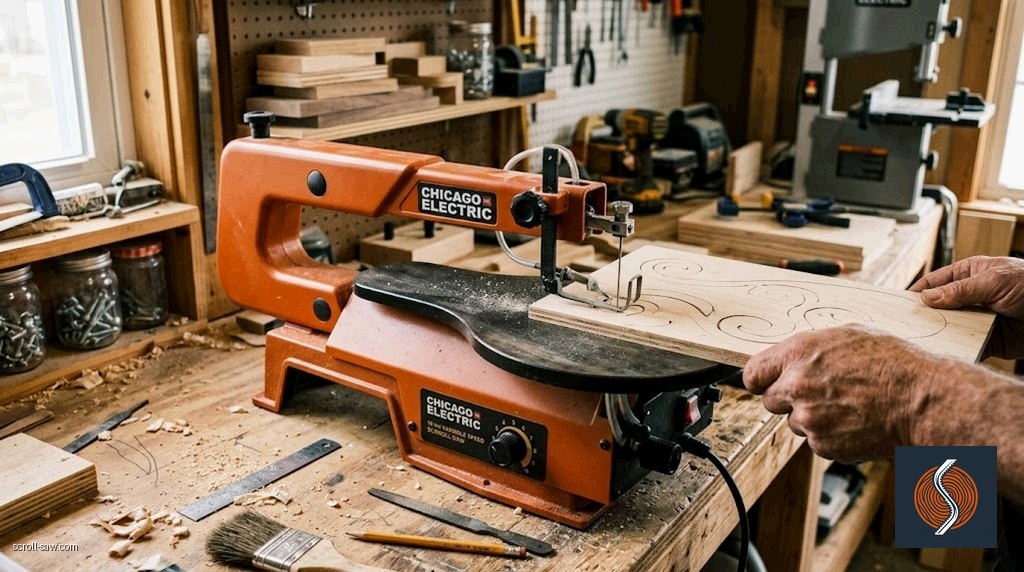
Chicago Electric Scroll Saw: Harbor Freight Entry-Level Guide
Chicago Electric is Harbor Freight’s house tool brand, and their scroll saws have been a common entry point for budget-conscious hobbyists for decades. If you own one or you’re considering buying, here’s the honest read on what Chicago Electric scroll saws offer, where they fall short, and how to work around the limitations.
What Chicago Electric scroll saws are
Entry-level benchtop machines with:
-
Small to medium throat depth (16 inches is common)
-
Pin-end blade format on most models
-
Single speed or basic variable speed
-
Fractional HP motor
-
Lightweight construction
These are the definition of budget scroll saws. Fine for occasional craft cutting; not built for serious pattern work over long hours.
What Chicago Electric does well
Price. Chicago Electric scroll saws are usually the cheapest entry point to scroll sawing. For someone unsure whether they’ll stick with the hobby, that’s a real advantage.
Immediate availability. Harbor Freight has stores nationwide. You can drive to one and walk out with a scroll saw the same day.
Coupon economy. Harbor Freight regularly offers coupons that further reduce the already low prices.
Return policy. Harbor Freight has a reasonable return policy for tools that don’t perform.
What Chicago Electric struggles with
Vibration. Lightweight construction amplifies vibration. Precision cuts are harder.
Tension consistency. Basic clamp mechanisms don’t hold tension as well as premium saws. Blades drift and break more often.
Blade selection. Pin-end format limits your blade choices significantly.
Long-run reliability. Motor and mechanism aren’t built for heavy use over years.
Fine detail work. Portraits, fretwork, and intarsia demand more precision than Chicago Electric consistently delivers.
When Chicago Electric is honestly the right choice
Testing whether you like scroll sawing. Buy a Chicago Electric, cut some patterns, decide if you want to invest more.
Craft-level cutting. Silhouette cutouts, painted signs, ornaments meant for craft fairs. The saw handles this fine.
Backup or shared saw. A workshop’s second scroll saw for occasional use by different people.
Teaching context. Introducing kids or students to scroll saw work. Low investment if they lose interest.
When to skip Chicago Electric
Serious pattern work. Portraits, intarsia, complex fretwork — the saw won’t deliver the precision you need.
Daily use. Long sessions will exhaust the mechanism faster than a better saw.
Premium blade users. Pin-end format limits access to the best blades.
Anyone comparing on capability. Even entry-level competitors like WEN 3922 outperform Chicago Electric at slightly higher prices.
Blades that fit Chicago Electric
Most Chicago Electric scroll saws use pin-end 5-inch blades. Standard pin-end blade assortments fit.
FOXBC pin-end 48-pack is the honest working blade.
Delta #7 Super Sharps for hardwood pattern work.
For pinless conversion, aftermarket adapters exist. Some loss of squareness with adapters.
The upgrade path
When you outgrow Chicago Electric, the natural next step is a real entry-level pinless saw:
WEN 3922 16-inch variable speed is a legitimate step up in tension consistency, vibration control, and blade options.
For a serious step up: DeWalt DW788 20-inch with DW7880 stand and DW7881 work light.
Setup for a Chicago Electric
Bolt the saw to a heavy bench. Chicago Electric’s lightweight construction really needs a stable mounting surface to control vibration.
Inspect the power cord and switch. Both are common failure points on entry-level tools.
Check squareness with a small square.
Ping test after tensioning. If the ping is weak, tension may not be sufficient.
Don’t over-drive the saw. Long sessions accelerate wear.
Parts and repair
Chicago Electric parts availability is inconsistent. Harbor Freight stocks some replacement parts for current models; older models often lack parts support.
When major parts fail on a Chicago Electric, the honest calculation is usually to replace the saw rather than repair it.
The takeaway
Chicago Electric scroll saws are the budget entry point to scroll sawing. Fine for craft-level cutting and testing whether you like the hobby. Not built for serious pattern work. When you’re ready to move up, WEN 3922 or DeWalt DW788 are honest upgrade paths.
FAQ
Are Chicago Electric scroll saws good? Entry-level value tools. Fine for occasional craft cutting. Not built for serious pattern work.
Where can I buy a Chicago Electric scroll saw? Harbor Freight stores and their website.
What blades fit a Chicago Electric scroll saw? Most use standard pin-end 5-inch blades. Verify clamp format on your specific model.
How long does a Chicago Electric scroll saw last? With light use, years. With daily heavy use, expect motor or mechanism failure sooner than a premium saw.
Can I use pinless blades on a Chicago Electric? With an aftermarket adapter, yes. Some loss of squareness.
Is a Chicago Electric worth upgrading from? If you’re doing serious pattern work or hitting the saw’s limits, yes. WEN 3922 or DeWalt DW788 are honest upgrades.
Does Harbor Freight have a return policy for scroll saws? Reasonable return window for tools that don’t perform. Verify current terms with Harbor Freight.
References
-
Harbor Freight Chicago Electric product documentation
-
WEN and DeWalt scroll saw specifications
-
Scroll Saw Association of the World tool guidance


