
Computer Controlled Scroll Saw: State of the Category
Computer Controlled Scroll Saw: State of the Category
A computer controlled scroll saw sounds like a natural extension of scroll saw technology, especially if you’ve watched a CNC router cut a pattern and thought “the same thing but with a scroll saw blade.” The reality is that this category barely exists in the hobby market, and the reasons why are worth understanding before you spend hours searching.
What exists
Custom-built projects. Ambitious makers have added CNC control to traditional scroll saws by mounting stepper-motor-driven X-Y tables under the blade. These work, but they’re one-off builds, not products.
Occasional industrial machines. Specialty CNC pattern-cutting machines exist in industrial contexts but aren’t sold at hobby prices.
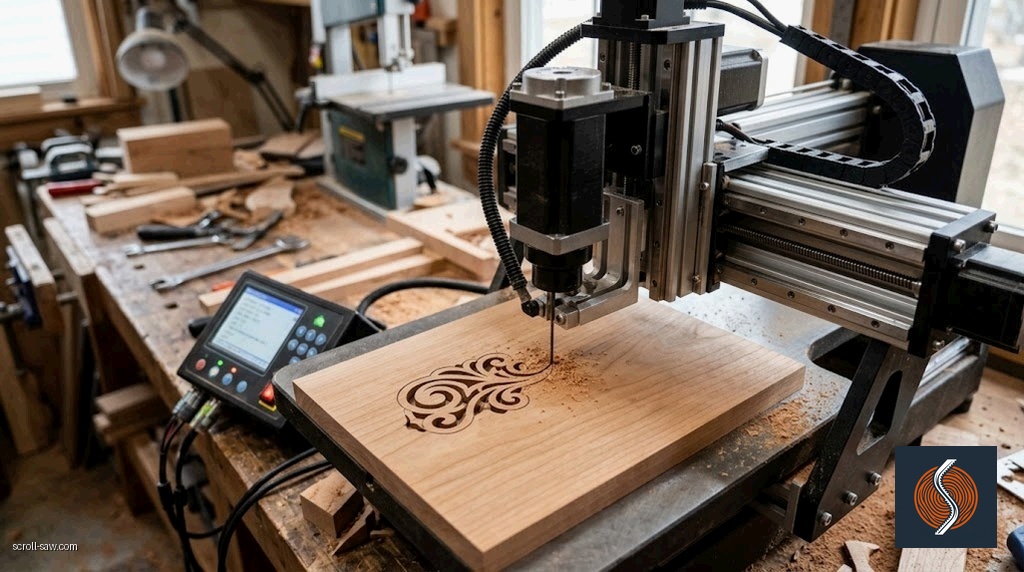
CNC routers doing pattern work. The closest hobby option. Not a scroll saw but produces similar pattern output.
Laser cutters doing pattern work. Different mechanism, similar output for wood and acrylic patterns.
Waterjet cutters. Industrial. Cuts anything but not hobby-priced.
Why the category is thin
Manufacturers have gravitated toward CNC routers for pattern work because:
-
Rotary cutters (router bits) are easier to CNC-control than reciprocating scroll saw blades
-
Router bit tooling is well-established
-
Chip clearance is simpler with rotary cutters
-
Router mechanics (spindle, moving gantry) map better to CNC design
A true CNC scroll saw is mechanically possible but has no clear advantage over a CNC router for the same output. Manufacturing follows the path of least engineering resistance.
What CNC control would offer for scroll saw work
If a hobby-priced CNC scroll saw existed:
-
Perfect pattern reproduction across many pieces
-
Complex CAD-designed patterns executed reliably
-
Reduced hand fatigue for long production runs
-
Precision beyond consistent hand cutting
These benefits are real. The market has just decided that CNC routers deliver them more cost-effectively.
Practical alternatives
For pattern production output: hobby CNC router. Shapeoko, Onefinity, X-Carve, various imports. Match to your work size and budget.
For fast wood and acrylic pattern cutting: laser cutter. Diode lasers at hobby prices, CO2 lasers at prosumer, fiber lasers at industrial.
For craft-level traditional scroll saw work: a good traditional scroll saw. Not CNC, but the pattern-work quality of hand cutting on a quality saw remains excellent.
For hybrid approach: own both. Traditional scroll saw for craft and compound cuts; CNC router for production.
The traditional scroll saw picks
DeWalt DW788 20-inch is the near-professional standard for hand pattern work.
WEN 3923 with two-direction blade capability at mid-tier.
WEN 3922 at entry-level.
DW7880 stand and DW7881 work light complete the DW788 setup.
Blades: Flying Dutchman variety pack, Pégas Modified Geometry, Olson FR49202 Reverse Tooth.
For CNC router evaluation
CNC router research areas:
-
Work area (size of pieces you’ll cut)
-
Materials (wood, plastic, aluminum, other)
-
Precision required
-
Budget
-
Software compatibility (Fusion 360, VCarve, Carbide Create)
-
Community support (helpful for troubleshooting)
Building a CNC scroll saw
For makers who want the project:
-
Start with a working traditional scroll saw as the cutting mechanism.
-
Design an X-Y table with linear rails or lead screws.
-
Add stepper motors and drivers.
-
Integrate with a CNC controller (Arduino + grbl, or dedicated boards).
-
Design workpiece fixturing.
-
Write or adapt software to convert patterns to motion.
Expect weeks to months of work. The result is functional but rarely more capable than a purchased CNC router at similar cost.
When to accept that CNC scroll saw isn’t the answer
If your primary goals are:
-
Production output
-
CAD pattern precision
-
Reduced hand labor
A CNC router meets those goals better than a hypothetical CNC scroll saw would.
If your primary goals are:
-
Craft satisfaction
-
Compound cuts
-
One-off pattern pieces
-
Low investment
A traditional scroll saw meets those better.
The intersection where a CNC scroll saw would be uniquely useful is small, which is why manufacturers haven’t built one.
The takeaway
Computer controlled scroll saws are essentially not commercially available at hobby prices. CNC routers and laser cutters cover the production and CAD pattern-work role. Traditional scroll saws cover the craft and compound cut role. For most people, one of those two familiar categories is the honest choice.
FAQ
Are computer controlled scroll saws available? Not commercially at hobby prices. Custom builds exist.
What does a computer controlled scroll saw do? Would automate pattern cutting on a reciprocating blade. In practice, CNC routers do the automation.
Can I get computer control on my existing scroll saw? Only through custom CNC conversion projects, which are significant engineering work.
Is a CNC router equivalent to a computer controlled scroll saw? For most pattern-work output, yes. Different mechanics, similar results.
What’s the cheapest computer controlled pattern cutting? Entry-level hobby CNC routers or diode laser cutters, depending on your material and precision needs.
Would a computer controlled scroll saw be worth it? For niche applications yes. For general pattern work, CNC routers cover the same need.
Should I build one myself? Only if the engineering project is the goal. For productive output, buy a CNC router.
References
-
CNC hobby machine manufacturer documentation
-
Maker community CNC conversion projects
-
Scroll Saw Association of the World tool overview


