
Convert a Jigsaw to a Scroll Saw: Realistic Options
Convert a Jigsaw to a Scroll Saw: Realistic Options
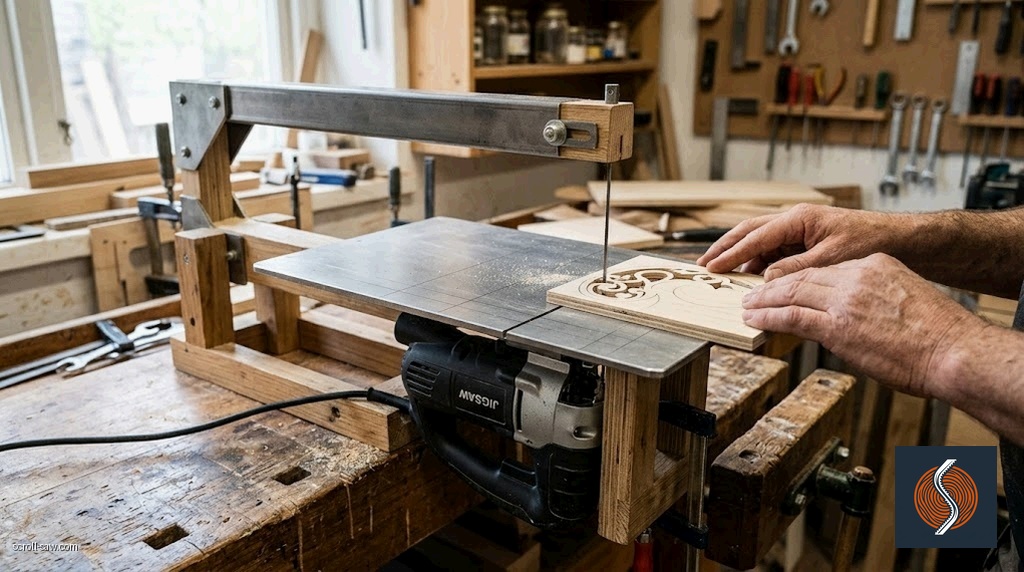
Converting a handheld jigsaw to a stationary scroll-saw-like tool is a classic DIY project. It’s not going to give you real scroll saw capability, but for some limited use cases it delivers a functional stationary curve-cutting station at almost no cost. Here’s the honest guide.
What conversion actually gets you
The standard conversion mounts the jigsaw upside down under a workbench with a hole for the blade to poke up through. You feed the workpiece against the blade instead of moving the blade against the workpiece.
What this gives you:
-
A stationary curve-cutting station in wood, thin plastic, and soft materials
-
Two-hand control of the workpiece (both hands free from the jigsaw)
-
Uses your existing jigsaw and jigsaw blades
What this doesn’t give you:
-
Fine pattern detail (jigsaw blades aren’t scroll saw blades)
-
Interior cuts through starter holes (blade profile prevents threading through small holes for many jigsaw blades)
-
Precise straight up-and-down blade motion (jigsaws often have orbital action that scroll saws don’t)
-
Vibration control (jigsaws vibrate more than scroll saws)
-
The refinement of a real scroll saw
When conversion makes sense
Very limited budget. You have a jigsaw already; scroll saws cost extra.
Occasional rough curve cutting. Signs, silhouettes, playhouse parts, rough craft cuts.
Short-term or project-based need. You need curve cutting for one project, not ongoing pattern work.
Learning experience. Understanding how the mechanism works before investing in a real scroll saw.
When to skip the conversion
You want fine pattern work. Portraits, fretwork, intarsia — the jigsaw conversion won’t cut it.
You want interior cuts. Threading a jigsaw blade through a small starter hole is nearly impossible.
You want precision. The jigsaw’s blade wander and vibration limit precision.
You’ll do this often. A used entry-level scroll saw beats the conversion for anything more than occasional use.
The basic conversion
-
Mount a work surface (thick plywood or MDF, at least 2 feet by 2 feet).
-
Cut a hole in the surface for the blade to poke through. Size depends on your jigsaw blade width; usually 1/2 to 1 inch is enough.
-
Mount the jigsaw upside down beneath the surface. The blade should extend through the hole with tooth-forward orientation.
-
Secure the jigsaw with clamps or a purpose-built bracket. The jigsaw’s own base plate becomes the mounting point.
-
Wire the jigsaw trigger to a switch you can operate from above (or set the trigger to always-on and control power with a switch).
-
Support the work surface on legs or clamp it to a bench.
Blades for the converted jigsaw
Use T-shank jigsaw blades appropriate to your material:
-
Fine T101AO or similar for scroll-work-approximate cutting in wood
-
Medium T101B for general wood cutting
-
T-shank plastic-cutting blades for plexiglass and acrylic
-
T-shank metal blades for thin non-ferrous metals
Standard scroll saw 5-inch blades do not fit a jigsaw. That’s a fundamental limitation of the conversion.
Setup for cutting
-
Turn on the jigsaw.
-
Set orbital action to zero if your jigsaw has it (orbital motion causes bumpy scroll-work).
-
Feed the workpiece slowly against the blade.
-
Keep steady continuous feed. The blade will wander less with continuous motion.
-
Use both hands on the workpiece.
-
Watch for the workpiece lifting; use a wooden hold-down if needed.
The Rockwell BladeRunner: purpose-built alternative
The Rockwell BladeRunner is essentially a factory-built version of the jigsaw-under-table concept. It uses T-shank jigsaw blades in a stationary table format with better ergonomics and safety than a DIY conversion.
See our Rockwell BladeRunner guides. Not a scroll saw replacement but a reasonable alternative to a DIY conversion.
When to buy a real scroll saw instead
Entry-level scroll saws are affordable and dramatically outperform any jigsaw conversion for pattern work:
WEN 3922 16-inch variable speed is a real scroll saw at entry pricing. Uses 5-inch scroll saw blades. Cleaner cuts, interior cut capability, better vibration control.
DeWalt DW788 20-inch for serious pattern work.
Use the freed-up jigsaw for the tasks jigsaws do well: rough curve cutting in framing and sheet goods.
Scroll saw blades once you upgrade
Flying Dutchman variety pack as the starter shelf.
Flying Dutchman Ultra Reverse #3 for pattern work.
Olson FR49202 Reverse Tooth as workhorse.
Pégas Modified Geometry for premium hardwood cutting.
Safety
Jigsaw blades under a table are more dangerous than scroll saw blades because they exit toward you (T-shank tip). Keep hands well clear of the blade area. Use pushsticks for narrow workpieces. Wear safety glasses.
Always power off the jigsaw before adjusting or clearing chips.
The takeaway
Converting a jigsaw to a stationary curve-cutting tool works for rough craft work at almost no cost. It’s not a scroll saw substitute for pattern work. Entry-level scroll saws (WEN 3922) are affordable enough that most people are better served buying one rather than converting.
FAQ
Can I really turn a jigsaw into a scroll saw? Into a stationary curve-cutting tool, yes. Not into a real scroll saw with fine pattern capability.
Do I need a special jigsaw for the conversion? Any jigsaw with a stable base works. Variable speed helps.
Can I use scroll saw blades in a converted jigsaw? No. Jigsaws use T-shank or U-shank blades, not 5-inch scroll saw blades.
How much does the conversion cost? Almost nothing if you have the jigsaw and scrap wood. Adds a switch and some hardware.
Is the conversion safe? With care, yes. Blade exit direction is different from scroll saws; keep hands clear.
Is a jigsaw conversion as good as a real scroll saw? No. For pattern work, buy a real scroll saw. For rough curve cutting, the conversion works.
What’s a purpose-built alternative to the conversion? The Rockwell BladeRunner uses T-shank jigsaw blades in a stationary factory design.
References
-
Maker community jigsaw conversion projects
-
Rockwell BladeRunner product documentation
-
WEN scroll saw specifications


