
Dunlap Scroll Saw Manual: Finding Vintage Documentation
Dunlap Scroll Saw Manual: Finding Vintage Documentation
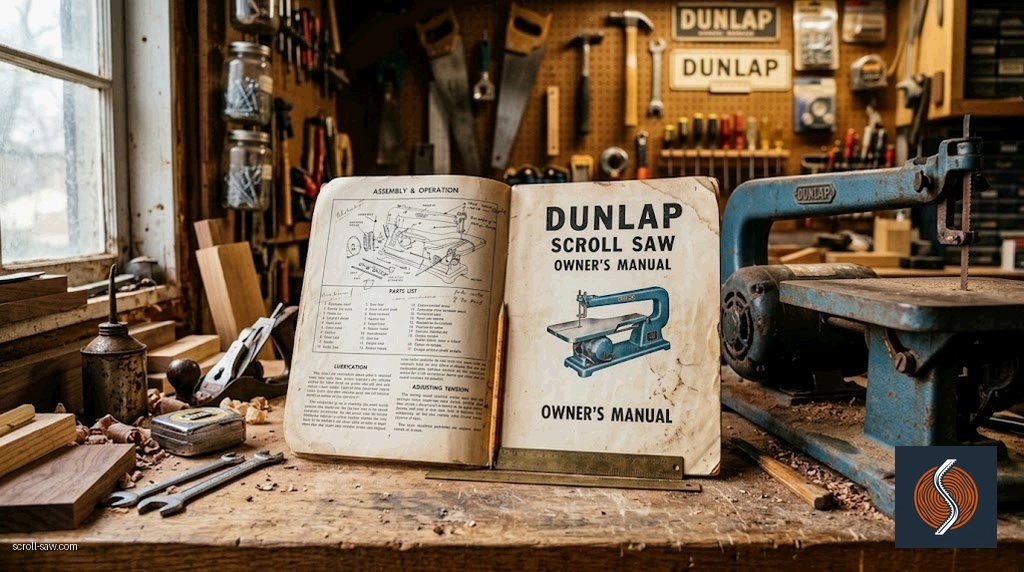
Dunlap was Sears’ entry-level house brand from the 1930s through the 1970s, and Dunlap scroll saws show up in estate sales, garage sales, and vintage tool auctions regularly. If you own one, you probably want the manual. Here’s the honest guide to sourcing documentation and running the tool.
About Dunlap scroll saws
Dunlap tools were made by various manufacturers on contract for Sears, most commonly:
-
King-Seeley (many Dunlap tools of the 1930s-60s)
-
Emerson
-
Various other American manufacturers under Sears contracts
Dunlap scroll saws are typically:
-
Cast iron or heavy-steel benchtop machines
-
Small to medium throat depth (12 to 16 inches was common)
-
Pin-end blade format
-
Single speed operation
-
Modest fractional HP motor
-
Solid vintage construction
Many Dunlap scroll saws are still operational decades after production because the mechanical simplicity holds up.
Finding the manual
Sears Parts Direct and archives. Sears (before store closures reduced its footprint) maintained parts archives. Some Dunlap manuals are still findable through remaining Sears service channels.
Vintage tool community sites. Old Woodworking Machines (OWWM.org), OWWM.com, and similar communities are the best sources for scanned vintage tool manuals. Members often have original copies and can share PDFs.
eBay and estate sales. Original printed manuals occasionally appear at auction.
General internet archives. Google searches for the specific model number sometimes turn up scanned manuals on personal sites or forum uploads.
Universal scroll saw principles. If the manual can’t be found, basic scroll saw operating principles apply universally. Setup, blade installation, tensioning, and speed are consistent across scroll saws regardless of brand.
Identifying your Dunlap
Check the nameplate for:
-
Specific model number
-
Manufacturing date (if legible)
-
Sears catalog number
The model number combined with photographs helps identification through vintage tool communities.
Basic operation of a Dunlap scroll saw
-
Bolt the saw to a heavy stable bench.
-
Install a pin-end blade with teeth pointing down and forward.
-
Tension per the mechanism (usually a knob or lever at the top arm).
-
Turn the saw on and let it settle to running speed.
-
Adjust hold-down foot to just contact the workpiece.
-
Test cut on scrap.
-
Feed the workpiece against the blade at a steady rate.
Blades for Dunlap saws
Most Dunlap scroll saws use pin-end 5-inch blades.
FOXBC pin-end 48-pack is the honest working blade.
Delta #7 Super Sharps for hardwood work.
For pinless conversion with an aftermarket adapter, premium blades open up:
Flying Dutchman Ultra Reverse #3.
Parts sourcing
Universal hardware. Blade clamp screws (M4 or M5), belts, brushes, cords, switches. Available at any hardware store.
Vintage tool communities. OWWM and similar sites sometimes have members with donor parts.
Sears Parts Direct. Some Sears/Craftsman/Dunlap parts remain available through the reduced Sears service network.
eBay and estate sales. Complete donor machines at reasonable prices.
Fabrication. Small parts can be shop-made with basic skills.
Common maintenance
Clean the mechanism. Decades of accumulated dust and grease reduce performance.
Inspect electrical. Old cords and switches are common failure points and safety hazards. Replace if in doubt.
Check blade clamps. Worn clamps affect tension and squareness.
Lubricate moving parts. Small amount of light machine oil on bearings and pivots. Don’t over-oil (attracts dust).
Bolt to a heavy bench. Vintage saws especially need stable mounting.
When to keep vs replace
Keep: if you value vintage character, do occasional craft cutting, and enjoy tool maintenance. A working Dunlap is a nice conversation piece and functional tool.
Replace: if you want fine detail work, variable speed, premium blade compatibility, or modern reliability. Modern entry-level saws exceed vintage capability at reasonable prices.
Modern alternatives
WEN 3922 16-inch variable speed is a modern entry-level saw with capabilities beyond vintage Dunlap.
DeWalt DW788 20-inch is the near-professional standard.
Add DW7880 stand and DW7881 work light.
Who should keep the Dunlap: vintage tool enthusiasts, casual craft cutters who value mechanical simplicity, or hobbyists who enjoy tool restoration.
Safety considerations
Old electrical components are the biggest safety concern. Replace worn cords and switches. Add a GFCI outlet for extra protection.
Blade guards may be absent or damaged on vintage saws. Reproduce or purchase aftermarket where possible.
Wear safety glasses when cutting. Vintage saws often lack modern eye protection features.
The takeaway
Dunlap scroll saw manuals are best sourced through vintage tool community sites (OWWM), remaining Sears parts channels, or eBay. Basic scroll saw operating principles apply universally if the manual is unavailable. Standard pin-end blades fit most Dunlap models. For fine pattern work, modern saws exceed vintage capability at reasonable prices.
FAQ
Where can I find a Dunlap scroll saw manual? Old Woodworking Machines (OWWM.org), remaining Sears service channels, eBay, or general internet archives.
What Dunlap model do I have? Check the nameplate for a model number. Vintage tool communities can help identify from photos.
What blades fit a Dunlap scroll saw? Most use pin-end 5-inch blades.
Are Dunlap scroll saws worth using? For occasional craft cutting, yes. Solid vintage construction. For fine pattern work, modern saws are better.
Where can I get Dunlap parts? Vintage tool communities, remaining Sears parts channels, eBay, or universal hardware for wear items.
Can I convert a Dunlap to pinless? With an aftermarket adapter, yes. Some loss of squareness.
What’s a modern alternative to a Dunlap scroll saw? WEN 3922 for entry-level, DeWalt DW788 for serious work.
References
-
Old Woodworking Machines forum (OWWM.org)
-
Sears vintage tool documentation
-
WEN and DeWalt scroll saw specifications


