
How a Fine Scroll Saw Fits Into a Scroll-Saw Workflow
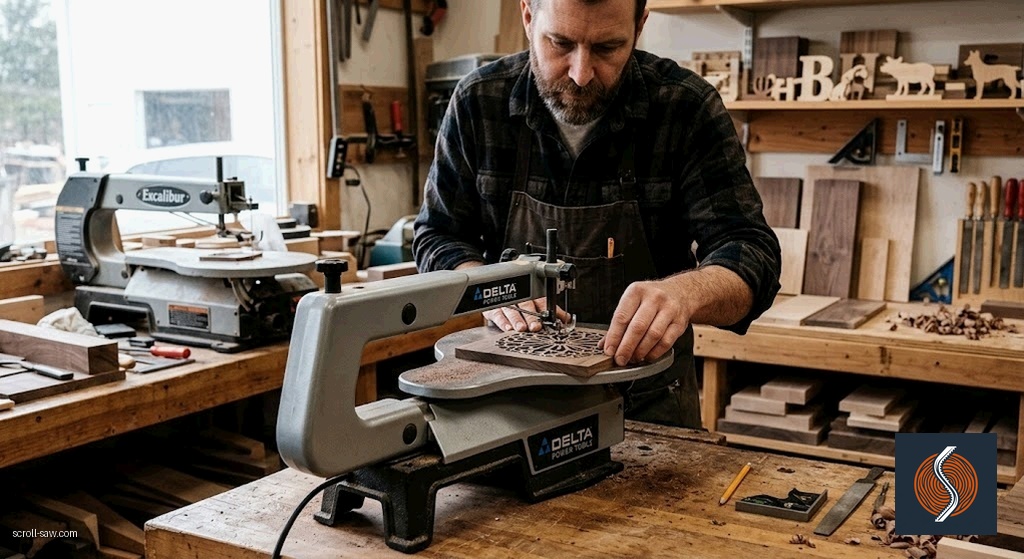
How a Fine Scroll Saw Fits Into a Scroll-Saw Workflow
The 2/0 blade is about as thick as a hair and roughly as forgiving. You clamp it in, spin the tension knob past what feels reasonable, feed a piece of quartersawn maple, and the blade wanders anyway. That is usually the moment a hobbyist figures out that a general-purpose scroll saw and a fine scroll saw are asking two different things of the same operator.
A “fine scroll saw” is not a category on any manufacturer’s site. It is shorthand for a machine that will hold delicate blades under real tension, run without a bounce that shows up in the cut line, and turn a tight interior curve without the blade twisting off vertical. Excalibur, Hegner, Pegas, and the better Dewalt runs get named in this conversation because they tend to do those three things well. Bench-top imports built to a low price point usually do not.
This article is about where a fine scroll saw earns bench space, where it does not, and how to fold one into a workflow that already includes a bandsaw, a router, and a few sanders.
What people actually mean by “fine scroll saw”
A fine scroll saw, in practical terms, is a scroll saw that can carry a #2/0, #1, or spiral blade at high, steady tension, hold vertical alignment for the full length of a stroke, and let you enter a 1/16-inch inside curve without deflecting.
If your saw does those things, you own a fine scroll saw for the work in front of you. If it does not, no blade choice or setup trick will get you there. The definition is behavioral, not brand-based.
The short answer to “do I need one?”
You need a fine scroll saw when your projects rely on tight interior cuts in hardwood, portrait or fretwork detail smaller than about 1/8 inch between lines, or thin veneers stacked for inlay. For beginner puzzles, holiday ornaments in soft pine, and rough curved cuts under an inch thick, a mid-range saw is usually enough.
That’s the rule. Everything below is how to actually use the fine saw well once you have one.
Where it fits in a real workflow
Most scroll-saw projects start on a different tool. A blank comes off the bandsaw or table saw already close to shape. A router or sander cleans an outside edge. The scroll saw only shows up when a cut has to go around a corner nothing else can reach.
A fine scroll saw takes over at the last stage of that sequence. Rough profile off the bandsaw, sand two faces flat, then move to the scroll saw for interior cuts, hard corners, and any joinery that has to stop dead at a line. Trying to use it earlier wastes its best quality, which is precision, and burns through blades doing work a bigger saw was built for.
Inside that hand-off, the fine saw handles:
-
Fret and portrait patterns where lines sit closer than 1/8 inch apart
-
Interior cutouts that need clean edges no sanding will fix (letters, keyhole shapes)
-
Segmentation and intarsia pieces that must butt tightly against neighbors
-
Thin stock and stacked veneers for inlay, where blade wander shows immediately
-
Puzzle work with tight kerf lines that need to slot back together
Outside that list, another tool is usually faster.
Setup that lets a fine saw behave like one
The machine only does as well as the setup. Four things matter more than everything else combined.
Tension. Pluck a mounted #2/0 blade like a guitar string. It should ring, not thud. If the note is dull, the blade will drift no matter how you feed. Under-tension is the single most common cause of drift on saws that are otherwise fine.
Blade square to the table. A small drafting square against the blade and the table catches this in ten seconds. If the top of the blade leans forward or back even a degree, interior cuts come out with a beveled edge you cannot sand out.
Table dead level side to side. Not just square to the blade. Level. A table that dips one way loads the blade sideways every stroke, and the cut walks.
Hold-down and blower. The hold-down keeps the workpiece from lifting on the upstroke, which is where most blade breakage starts on fine blades. The blower has to actually blow on the cut line, not into the corner of the shop.
Get these four right on a mid-range saw and it will out-cut an expensive machine set up badly.
Blade choice for detail work
Fine work runs on small blades. The general shape looks like this:
-
#2/0 and #1 skip-tooth: interior detail in hardwood under 1/4 inch
-
#3 to #5 skip-tooth: general fretwork, portrait cutting, thin stock
-
#5 to #7 spiral: cutting in any direction without turning the workpiece, useful for text and irregular shapes
-
#5 to #7 reverse-tooth: cleaner exit face on the bottom of the workpiece, worth having for anything showing both sides
Spiral blades tempt beginners because they seem to remove the need to steer. In practice they are harder to keep on a line and leave a wider, slightly furry kerf. They are the right choice for lettering and irregular direction changes, not for anything with a crisp outline.
A fine saw will run all of these. A cheaper saw will fight the smallest sizes because it cannot hold enough tension on such a thin cross-section.
Fine saw vs. general saw, in one comparison
Think of a general scroll saw as a car that handles fine on the highway and gets nervous on tight mountain switchbacks. A fine scroll saw is set up for the switchbacks. It might feel like overkill on straight cuts, but the moment the pattern demands a 1/16-inch inside pivot in figured walnut, the difference stops feeling academic.
A general saw will bounce, blur the cut line, and eventually snap the smallest blades because it cannot keep them under enough tension. A fine saw carries the load, and the cut comes off the table needing very little cleanup. That is what you are paying for: not more speed, less finishing.
Where a fine scroll saw is the wrong tool
A few honest limits worth naming.
Thick stock past about 2 inches slows any scroll saw badly, and even a top-end machine will not out-cut a bandsaw at that depth. Long, straight rip cuts belong on a table saw. Rough outside profile work belongs on a bandsaw or jigsaw, then the scroll saw takes over. And any repetitive production run of the same shape, where accuracy matters less than throughput, is CNC territory now. A fine scroll saw is a precision instrument for one-off and short-run detail work. Push it past that and you are punishing the tool.
Who should skip this whole conversation
If you are cutting 3/4-inch pine reindeer for a craft fair and sanding the edges anyway, a mid-price saw is going to do the job and leave money in your pocket for wood. Save the fine saw for the day you commit to a real fretwork project and find your current machine cannot hold a small enough blade.
A closing verdict
A fine scroll saw earns its bench space when the work in front of you is honestly small, honestly detailed, and honestly won’t tolerate sanding to fix a wandering cut. In that role it saves hours per project and produces work a general saw simply cannot. Anywhere else it is expensive overkill, and the honest move is to keep the mid-range saw and put the money into better blades, a better light, and a magnifier.
Before you buy, do the tension test on any saw you can put your hands on: mount a #2/0, tension it, pluck it, listen for that ring. That single test tells you more than any spec sheet.
FAQ
What does “fine scroll saw” actually mean? It describes a saw that holds very thin blades (#2/0 and up) at high, steady tension, cuts vertically for the full stroke, and lets you turn tight interior curves without deflection. It is a behavior, not a brand or model line.
Is a Dewalt DW788 a fine scroll saw? A well-set-up DW788 handles fine work for most hobby-level projects, especially fretwork and portrait patterns. Older, well-serviced units tend to run smoother than newer imports of the same design.
Do I need a parallel-arm saw for fine work? Parallel-arm and parallel-link designs are the usual choice because they keep the blade vertical through the stroke. C-arm saws work but tend to introduce a small forward tilt at the top of the stroke, which shows up in tight interior cuts.
How thin a blade can a fine scroll saw run? Most quality fine saws will hold a #2/0 blade under real tension. Some specialty saws step down to #3/0. Beyond that you are into jeweler’s saw territory.
Can I use spiral blades for portrait cutting? You can, and many people do for letters and irregular shapes. The tradeoff is a wider, slightly furry kerf and less crisp edges. For clean portrait work, most scrollers prefer a #2/0 or #1 skip-tooth and steer the workpiece.
Why does my new saw still drift with a fine blade? Usually one of four things: not enough tension, blade not perpendicular to the table, table not level side to side, or the blade is dull. Check those in that order before blaming the machine.
Is a fine scroll saw worth it for beginners? Probably not on day one. Learn on a mid-range saw. Once the work you want to do outgrows the machine, upgrading is easy and the used market for entry-level saws is active.


