
Getting Useful Results From Flying Dutchman Scroll Saw Blades
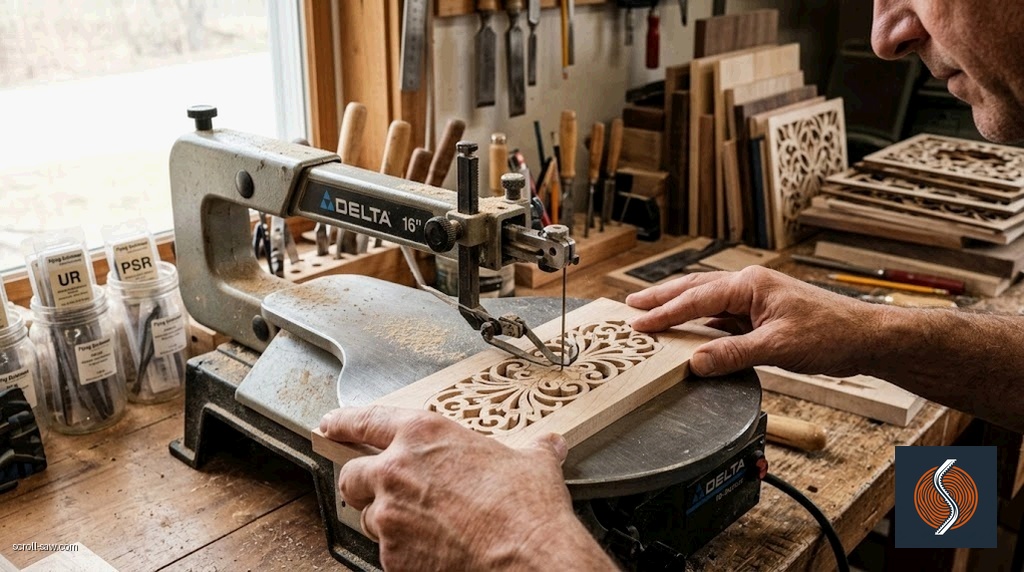
Getting Useful Results From Flying Dutchman Scroll Saw Blades
A lot of people type “Flying Dutchman scroll saw” into a search bar expecting to find a machine. There isn’t one. Flying Dutchman is a blade line, sold in the U.S. by Mike’s Workshop, and it has been quietly running under the tables of some of the best fretwork on the internet for two decades. The confusion is understandable. The name shows up in tutorials constantly, always as if it belongs on the machine itself.
What you actually want to know is this: which series fits your work, how to install them without pinching the ends, and why yours seem to break faster than the tutorial says they should.
Direct answer
Flying Dutchman blades are aftermarket scroll saw blades, sold by size and tooth pattern (Ultra Reverse, Two-Way Cut, Puzzle, Polar, Scroll Reverse, and Spiral among others). Any standard 5-inch pin-less scroll saw will hold them. Match the series to the cut you’re making, not the saw brand.
What the series names actually mean
The series names are the useful part. Once you know what each one is for, picking one is a two-second decision.
Ultra Reverse (UR). Reverse teeth on the bottom third of the blade. Leaves a cleaner exit face on the underside of the cut. Default choice for anything showing on both sides: ornaments, freestanding letters, layered art.
Two-Way Cut (2W). Aggressive reverse tooth pattern. Cuts almost as fast on the upstroke as the down. Fewer feathery bottoms, but a slightly wider kerf. Good for thicker stock where speed matters.
Scroll Reverse (SR). Milder reverse tooth version, closer to a conventional skip-tooth but with cleaner exits. A safe general-purpose blade.
Puzzle (Poly Puzzle, PP). Very fine kerf. Made for interlocking cuts where a wider blade would leave visible gaps. If you cut puzzles and the pieces feel loose, this is the fix.
Polar (P). Extra thin cross-section, meant for delicate fretwork in hardwood. Runs #2/0 and #1 well but needs a saw that can hold real tension.
Spiral. Teeth in all directions. Cuts in any direction without turning the workpiece. Slower and wider than a straight blade, useful for lettering and irregular shapes.
Beyond that, sizes run from #2/0 (thinnest, for tight interior detail) up to about #12 (thickest, for stock over an inch). The sweet spot for most hobby work is #3 to #7.
Getting them installed without pinching the ends
The most common Flying Dutchman complaint is blades snapping at the clamp. That is almost always installation, not the blade.
The blade end has to sit fully seated in the clamp jaw with the teeth pointing down and forward. If part of the shank is outside the clamp, or if the clamp is grabbing across the very tip of the blade, tension will concentrate at that pinch point and snap the blade within a few minutes of running.
Background rule: mount the blade so the working length between the upper and lower clamps is centered top to bottom in the stroke. If the blade is pushed too far up or down, one end wears out faster and the mounted blade behaves like it is dull long before it is.
Tension that actually works
Flying Dutchman blades want more tension than most beginners give them. Pluck a mounted blade like a guitar string. It should ring at a clear, high pitch. A dull thud means it will drift and eventually snap sideways rather than cleanly.
On a Dewalt DW788, the tension lever usually needs to sit in the higher two-thirds of its range for a #2/0 or #1. On an Excalibur or Pegas, use the same principle: tighten until the blade rings, back off a hair, and cut.
Feed rate: the second-most common breakage cause
You do not push a scroll saw blade through wood. You guide the wood into the blade and let the teeth do the work. The moment you have to lean on the piece, the blade is dull, the wrong series for the material, or the wrong size for the thickness.
A fresh Flying Dutchman UR #5 in 3/4-inch cherry should walk through the cut at a steady, unforced pace. If it is slowing down or bowing, stop, check the tension, and consider stepping up a blade size.
Matching series to project
A short workflow guide.
-
Christmas ornaments in 1/4-inch Baltic birch: UR #3 or SR #3. Clean both faces without sanding.
-
Portraits in 1/8-inch hardwood: UR #2/0 or Polar #1. Small kerf, clean lines, worth the slower pace.
-
Puzzle cutting in 3/4-inch pine: Poly Puzzle #5. Tight fit between pieces.
-
Freestanding letters in 3/4-inch walnut: UR #5 or 2W #5 depending on speed preference.
-
Layered art with stacked thin veneers: UR #3 with the stack taped and glued in stages.
-
Cutting shapes that need to go every direction (name signs, complex lettering): Spiral #3 or #5.
Common problems and what actually fixes them
Blades snap at the top clamp within minutes. Check that the blade is seated square in the jaw, teeth centered, and the clamp is not gripping the very tip. Also check that upper arm return spring is not pulling the arm past its natural resting height, which stretches the blade at rest.
Cut wanders even with correct tension. Verify the blade is perpendicular to the table with a small square. A blade tilted a degree forward will drift and no amount of feed correction fixes it.
Burn marks on the cut edge. Blade is dull, feed rate is too slow for the material, or the blade is too fine for the stock thickness. Step up one size or replace.
Fuzzy or feathered bottom face. Not using a reverse-tooth blade in stock where the bottom shows. Switch to UR or SR.
Blade dulls fast in “soft” wood. Often the wood is not what the label says. Import craft plywood frequently has glue lines that eat blades. Try genuine Baltic birch or the same design in domestic hardwood.
Are they worth the extra cost?
Compared to the generic hardware-store multi-packs, Flying Dutchman blades cost more per blade and cut noticeably longer between changes on hardwood. Compared to Pegas, they are roughly comparable in quality; the difference between the two is more about which series you prefer for a specific cut than any headline quality gap.
For a beginner working in pine and basswood, generic blades are fine. Once the projects move into hardwood, layered work, or anything with visible detail on both faces, the case for Flying Dutchman gets strong.
Verdict
Flying Dutchman is not a saw. It is a blade line that fits any standard pin-less scroll saw and rewards good setup with cleaner cuts and longer blade life. Learn the series names, mount them properly, tension them until they ring, and the difference from generic blades will be obvious within the first project.
If your saw cannot hold a #2/0 at full tension, the blade is not the problem. Upgrade the saw before you upgrade the blade any further.
FAQ
Is Flying Dutchman a scroll saw brand? No. It is a blade line sold by Mike’s Workshop in the United States. It fits any standard pin-less scroll saw.
Which Flying Dutchman blade is best for beginners? Ultra Reverse #5 in 3/4-inch pine or basswood, and Ultra Reverse #3 in 1/4-inch Baltic birch. Both handle a wide range of first projects.
Do Flying Dutchman blades fit a Dewalt DW788? Yes. The DW788 uses standard 5-inch pin-less blades, which is exactly what Flying Dutchman produces.
Why do my blades keep breaking near the clamp? Usually a mounting issue. The blade must be fully seated in the jaw with the teeth pointing down, not gripped across the very tip. Also confirm you are tensioning the blade after mounting, not before.
What is the difference between Ultra Reverse and Two-Way Cut? Ultra Reverse has reverse teeth on roughly the bottom third of the blade for a clean exit face. Two-Way Cut has aggressive reverse teeth for faster cutting on the upstroke. UR is better for detail; 2W is better for speed in thicker stock.
How long should a Flying Dutchman blade last? It varies with the material and how hard you feed, but a UR #5 in cherry commonly lasts two to four hours of active cutting before it starts to dull noticeably. Softer woods stretch that; anything with glue lines or knots shortens it.
Can I use Flying Dutchman spiral blades for straight cuts? You can, but you should not. Spirals leave a wider, less crisp kerf. Save them for lettering and shapes that require constant direction changes.


