
Fox Scroll Saw: Selection, Setup, and Common Problems
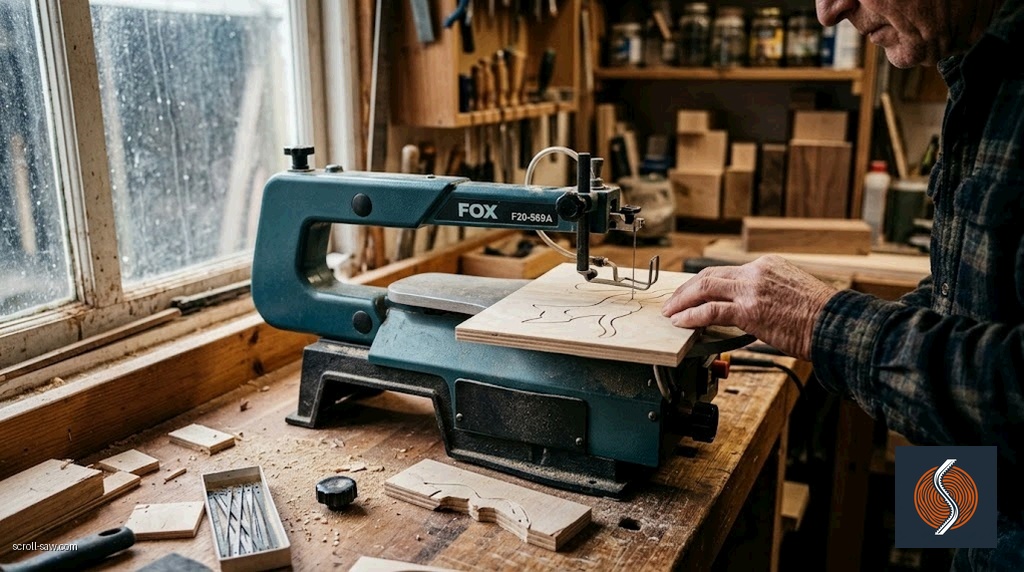
Fox Scroll Saw: Selection, Setup, and Common Problems
Somebody hands you a scroll saw with a red badge that says FOX and asks if it is any good. The honest first answer is: which Fox? The name has been used by more than one company across decades and importers, and the machine on your bench could be a rebadged Chinese import, a mid-century American cast-iron saw, or a European hobby saw sold under a distributor’s private label.
That’s the reason “Fox scroll saw” searches turn up conflicting reviews and confusing parts information. This article is about how to figure out what you actually have, decide whether it is worth putting into service, and avoid the two or three failure modes that come up on almost all of them.
Direct answer
A Fox scroll saw is any scroll saw sold under the Fox brand or badge, which is not one manufacturer’s brand but a name used by several importers and older tool companies. Identify the machine by casting details, motor plate, blade holder type, and any distributor markings before ordering parts or buying blades. Once you know what you have, setup follows the same rules as any similar-sized scroll saw.
Identifying what you actually have
Before you buy, sell, or fix a Fox scroll saw, the first task is identifying the actual manufacturer.
Check the motor plate. The motor is often the most identifiable component. A plate that lists a factory in China, Taiwan, or Italy is a starting point. The country of origin and voltage tell you what era and market the saw came from.
Look at the blade clamps. Modern pin-less clamps with a lever or knob release usually mean the saw is from the 1990s or later. Pin-only clamps that only accept pin-end blades point to an older or budget model. Some Fox-branded saws use both, with an adapter.
Measure the throat depth. Common sizes are 16 inches, 20 inches, and 22 inches. Match this against known scroll saw designs. A 16-inch Fox is likely a light-duty hobby saw. A 22-inch is more likely a semi-professional import.
Look at the arm design. C-arm (single curved arm) is the older, simpler design. Parallel-arm and parallel-link are common on saws marketed for detail work. The design affects how the blade behaves at the top of its stroke and, indirectly, how forgiving the saw is with fine blades.
Once you know the arm type, throat depth, and blade clamp style, the saw is 90 percent identified even without a nameplate. Parts and blade matching gets much easier from there.
Fit: where a Fox scroll saw belongs
Most Fox-branded scroll saws sold in the last twenty years fall in the light-to-mid hobby range. That means:
-
Occasional to regular use for household projects
-
Ornaments, small signs, thin-stock crafts, basic fretwork
-
Cutting 3/4-inch pine, 1/2-inch plywood, and occasional hardwood under half an inch
-
Learning the craft before deciding whether to upgrade
What they typically do not handle well:
-
Long production runs of the same detailed cut
-
Serious portrait or fretwork in hardwood over 3/4 inch
-
Sustained running for hours at a time (motors on the lightest saws overheat)
-
Very small blades (#2/0 and thinner) at real tension
If your work sits in the first list, a Fox saw in good condition is fine. If it sits in the second list, budget for an upgrade sooner rather than later.
Setup that keeps a light saw running well
A hobby-grade saw punches above its weight when the setup is right. Four checks before every session.
Level the table side to side. A cheap saw will still cut straight if the table is level. Put a small level across the table, adjust the trunnion or shims, and lock it down.
Square the blade to the table. Small square against the blade and the table. Adjust until you have a full-contact reading with no gap.
Tension the blade until it rings. Pluck a mounted blade. If it thuds, tension is low. If the tension mechanism will not get it to a clear pitch, the blade is too fine for what the saw can hold and you need to step up a size.
Check for arm play. With the saw off, lift the upper arm slightly and let it drop. A well-set-up saw returns to the same rest position every time. A saw with slop in the bearings or the arm pivot will drift and vibrate. If there is noticeable play, the machine needs a service before it is worth cutting anything precise on it.
Common problems specific to Fox and similar imports
A few failures show up over and over on rebadged hobby saws.
Vibration at higher speeds. Usually a combination of a lightweight cast base and rubber feet that have hardened or shifted. Mounting the saw to a heavier bench, or replacing the feet with fresh rubber pads, kills most of it.
Table tilt lock slips under load. The tilt mechanism on many light saws uses a small friction lock that wears. If your table drifts out of square during a cut, replace or shim the tilt lock, or add a secondary clamp to hold the table at zero for straight cuts.
Blade clamps refuse to hold thin blades. Common on saws designed primarily for pin-end blades. Cleaning the clamp jaws (there is often built-up sawdust and blade fragments trapped in there) usually restores grip. If it does not, the jaws themselves may be worn and need replacement, which can be difficult if the manufacturer is unclear.
Blower tube points the wrong way. The dust blower on almost every hobby saw arrives set slightly off. Reaim it so the air hits the cut line, not the wall of the saw.
Motor gets hot in long sessions. Light-duty motors on some Fox-badged saws are not rated for continuous heavy use. If yours runs hot after an hour, take a break rather than pushing through. Overheated motors on cheap saws fail permanently, and replacement motors for private-label brands are hard to source.
Buying used: what to check
Used Fox saws come up regularly on marketplace listings, estate sales, and garage sales. A ten-minute inspection avoids most bad purchases.
-
Ask to see it run under load. Not just powered on, but with a scrap piece being cut. Vibration and arm behavior tell you more than any words.
-
Check the table for cracks around the throat plate and the trunnion mounts. Cracks on cast-aluminum tables can be catastrophic.
-
Squeeze the upper arm gently. Any lateral play in the pivot is a red flag.
-
Look inside the blade clamps for dried blade fragments or rust. Clean clamps are a sign of a well-kept saw. Neglected clamps often mean everything else is neglected too.
-
Ask about the motor. If the owner cannot tell you the amperage or does not know if it has ever been serviced, factor a motor replacement into your offer.
A well-kept Fox scroll saw is worth a modest sum. A neglected one is often only worth its scrap steel and the parts you can strip off it.
Verdict
A Fox scroll saw is a category, not a single model. Once you have identified what yours actually is, treat it like any other hobby saw of the same class: level the table, tension the blades hard enough to ring, watch for arm play, and do not push it into work it was not designed for. Kept within its lane, a Fox saw can produce work indistinguishable from what comes off a name-brand hobby saw. Pushed past that lane, it will vibrate, drift, and eventually fail in ways that are hard to repair.
Before committing money to one, especially used, do the ten-minute inspection above. It is the single best predictor of whether the saw is worth your bench space.
FAQ
Who makes Fox scroll saws? The Fox brand has been applied by multiple importers and older tool companies. There is no single manufacturer. Identification depends on physical inspection.
Where can I find parts for a Fox scroll saw? Start by identifying the underlying manufacturer through the motor plate, casting marks, and design details. Parts for private-label saws are often available under the original manufacturer’s model, not the Fox badge.
Can a Fox scroll saw use standard 5-inch pin-less blades? Most modern Fox-branded scroll saws use standard 5-inch pin-less blades. Older or budget models may be pin-end only. Check the clamp style before ordering.
Is a Fox scroll saw good for fretwork? Lighter Fox saws can handle basic fretwork with the right blades, but serious fretwork demands a saw that holds real tension on very fine blades. Test with a #2/0 blade before committing to a fretwork project.
Why does my Fox scroll saw vibrate so much? Usually a combination of a lightweight base and worn rubber feet. Bolting the saw to a heavier bench or stand, and replacing the feet, resolves most vibration issues on hobby-grade saws.
Can I upgrade the motor on a Fox scroll saw? Sometimes, if the mounting pattern matches a common replacement motor. For private-label saws, motor replacement often requires machining a new mounting plate. It is often more economical to buy a different saw than to rebuild.
What blades work best in a Fox scroll saw? Any standard pin-less scroll saw blade from a reputable brand (Olson, Pegas, Flying Dutchman) will work as long as the clamp holds it under tension. Match blade size to material thickness as usual.


