
Getting Useful Results From a Genesis Scroll Saw: Setup and Technique
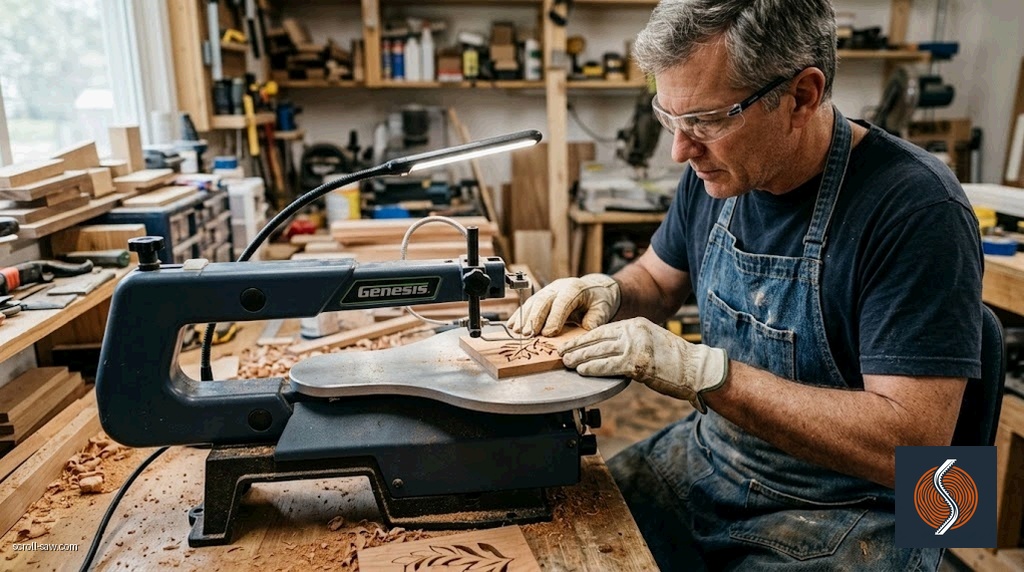
Getting Useful Results From a Genesis Scroll Saw: Setup and Technique
A Genesis scroll saw is the machine people buy when they want to try scrolling without committing to a Dewalt or an Excalibur. It sells at the price point where a hobby is easy to justify, ships from big-box retailers, and lives on the workbenches of a lot of first-year scrollers who are not sure yet whether the craft will stick.
That is a legitimate use case. And a Genesis scroll saw, set up correctly, will produce cleaner work than most first-time buyers expect. The problems most owners report (drift, vibration, blade breakage) are almost always fixable with three or four setup steps. This article walks through those steps, then names where the saw will always struggle no matter what you do.
Direct answer
A Genesis scroll saw is an entry-level machine typically featuring a 16-inch throat, variable speed, pin-less blade holders, and a light cast base. Setup that makes it perform: bolt it to a heavier bench, level and square the table, tension blades until they ring, and stay within its designed material range (up to about 3/4-inch soft wood or plywood).
First-day setup that changes everything
Out of the box, a Genesis needs about twenty minutes of work before it will cut clean. The steps do not appear in the manual as clearly as they should.
1. Mount it to a real bench. The stock base is light. Vibration is the top complaint about entry-level scroll saws, and 80 percent of it comes from the base moving. Bolt the saw to a heavy workbench through the mounting holes in the base, or to a piece of 3/4-inch plywood weighted with a paver or two, and the vibration drops immediately.
2. Level the table side to side. Small torpedo level across the table. Adjust the tilt trunnion until the bubble is centered. Lock it down. Do this before you cut anything.
3. Square the blade to the table. Small drafting square against a mounted blade. Adjust the table tilt until you have full contact top to bottom with no gap. This is what stops beveled edges on your finished pieces.
4. Tension the blade until it rings. Mount the blade, run the tension lever up until the blade pings at a clear high pitch when plucked. Under-tension is the leading cause of every beginner problem on a Genesis.
5. Aim the blower at the cut line. The blower tube arrives pointing wherever it happened to get shipped. Bend it so the air stream lands on the pattern in front of the blade, not on the wall of the saw.
That is the whole first-day list. It takes less time than most people spend fighting the saw in their first cut.
Blade choices that make a Genesis look good
A Genesis will run any standard 5-inch pin-less scroll saw blade. The blades that make it look good are not always the ones the store sells next to it.
-
#5 reverse-tooth for 1/4-inch to 1/2-inch plywood and pine. Clean bottom face, forgiving feed rate.
-
#7 reverse-tooth or skip-tooth for 3/4-inch pine and soft wood. Cuts faster, less burning.
-
#3 reverse-tooth for fine detail in 1/8-inch stock. This is near the lower limit of what a Genesis will hold well.
-
#9 skip-tooth for stock over 3/4 inch (occasionally, near the saw’s capacity limit).
Generic hardware-store blade multi-packs work for practice but dull fast. Once you know the craft is sticking, upgrading to Olson, Pegas, or Flying Dutchman blades noticeably improves cut quality on the same saw.
Technique that plays to the saw’s strengths
A Genesis is at its best on relatively light material with straightforward interior cuts. The technique that plays to that:
Feed slowly and let the blade cut. The lightest saws punish being pushed. If you feel yourself leaning on the workpiece, the blade is dull, too fine, or the wood is too thick. Fix the cause; don’t push through.
Turn the piece, not the blade. Scroll saws work by pivoting the workpiece around the blade, not by twisting the blade sideways. Small turning movements from the wrists, guided by the fingertips, produce the cleanest curves.
Rest between long cuts. The Genesis motor is not built for continuous production use. Give it a minute or two of rest every fifteen to twenty minutes of hard cutting. Overheated hobby motors fail permanently.
Change blades before they burn. A dull blade cuts hot, burns wood, and drifts. The moment cuts start to slow or leave burn marks, change the blade. A fresh blade cuts faster and cleaner, which more than pays for itself in blade cost.
What a Genesis will always struggle with
Honest limits.
Stock over 1 inch thick. The Genesis can technically cut thicker stock, but the arm speed and blade tension are not designed for it. Cuts get slow, blades burn out fast, and the motor works hard.
Very fine blades (#2/0 and thinner). The tension mechanism on entry-level saws does not consistently hold the thinnest blades. Real fretwork requires more machine.
Long production runs of the same piece. Even set up well, the light-duty design does not tolerate hours of continuous running. A weekend batch is fine; a full production week is not.
Hardwood past about 1/2 inch. Oak, maple, and other dense hardwoods stress the motor and dull blades quickly on a Genesis. It can be done, but it is slow and expensive in blade life.
Stay in the saw’s actual lane and it will work. Push past it and it will disappoint, not because it is a bad saw, but because it is being asked to be a different saw.
Common problems and fixes
Excessive vibration. Mount the saw to a heavier bench. Check that all base bolts are tight. Replace hardened rubber feet.
Blade wanders on cuts. Verify tension (should ring when plucked). Verify blade is perpendicular to the table. Verify feed rate is not pushing the blade.
Cuts have beveled edges. Blade is not square to the table. Recheck with a small square.
Burn marks on cuts. Dull blade, blade too fine for the material, or feed rate too slow. Replace blade, step up a size, or feed steadier.
Blade breaks near clamp. Blade not seated fully in the clamp jaw, or clamp is worn. Reseat the blade with teeth pointing down; inspect clamp for wear.
Motor bogs down under load. Wood too thick or blade too fine for the material. Step up a blade size or stop pushing the piece into the blade.
Verdict
A Genesis scroll saw is what it claims to be: a budget entry-level machine that will produce clean work on beginner projects if you set it up correctly. The setup is not obvious from the manual, but it takes twenty minutes and completely changes the saw’s behavior.
Use it for its designed range (up to 3/4-inch soft wood or plywood, standard-size blades, occasional-to-regular use) and it will keep up with a beginner’s ambitions for a year or two. Push it past that range or expect it to compete with mid-range saws in the same session, and it will disappoint quickly.
Before upgrading, exhaust the setup and technique fixes above. Most Genesis complaints go away when the saw is properly set up.
FAQ
Who makes Genesis scroll saws? Genesis is a brand line associated with Richpower Industries, which sells budget power tools under several brand names. Individual models may be manufactured overseas under private label.
What blades fit a Genesis scroll saw? Standard 5-inch pin-less scroll saw blades from any reputable brand (Olson, Pegas, Flying Dutchman, Skil). The blade clamps accept the same blades as most modern hobby scroll saws.
Can a Genesis scroll saw handle hardwood? Up to about 1/2 inch of medium-density hardwood, yes. Beyond that the motor and blade tension are being pushed past their comfort zone. Soft woods and plywood are its natural material.
How much can a Genesis scroll saw cut? Most Genesis models list a throat depth of around 16 inches and a maximum stock thickness of around 2 inches. Practical use is under 1 inch of soft wood for regular work.
Is a Genesis scroll saw worth the money? As a first saw for someone unsure whether scrolling will stick, yes. As a long-term saw for someone who is committed to the craft, most scrollers upgrade to a Dewalt DW788, Excalibur, or Pegas within a year or two.
How do I stop my Genesis scroll saw from vibrating? Bolt it to a heavy bench, check that base bolts are tight, and replace hardened rubber feet with fresh ones. That resolves most vibration complaints on light hobby saws.
Can I get replacement parts for a Genesis scroll saw? Some parts are available through the retailer that sold the saw. Deep parts availability is limited compared to name-brand saws. If long-term serviceability matters, this is a consideration.


