
German Made Scroll Saw Explained: Purpose, Fit, and Practical Setup
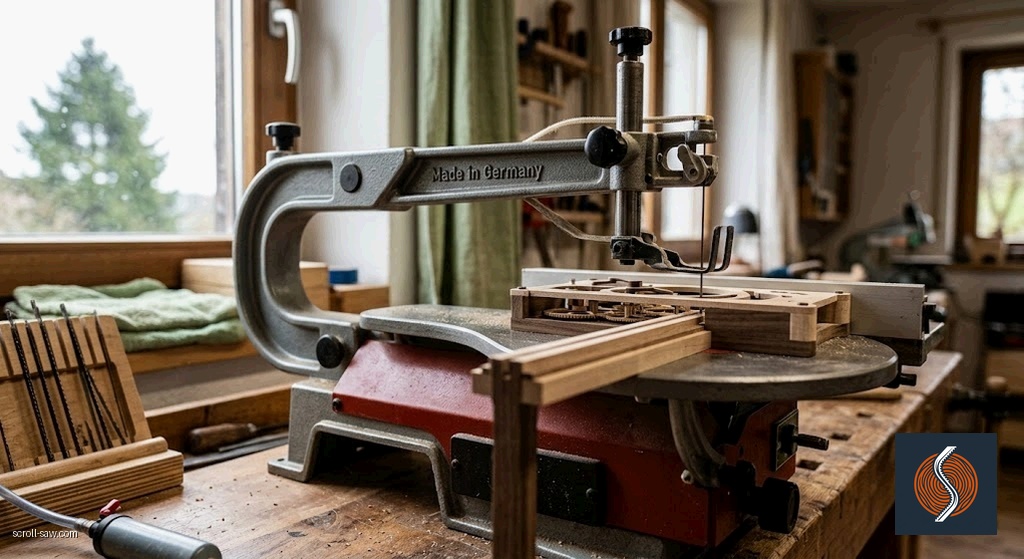
German Made Scroll Saw Explained: Purpose, Fit, and Practical Setup
A scrolling forum thread every year or two circles around the same question. Somebody in the U.S. inherits a saw with HEGNER cast into the arm and asks what they should do with it. The answers arrive fast and confident: keep it, service it, run it for the next thirty years. The same forums are more measured about almost every other brand.
That reputation is real, and it is the reason “German made scroll saw” turns up in search results at all. In practice, the term is nearly a synonym for Hegner, the machines built in Baden-Wurttemberg since the 1970s that set the reference point for parallel-arm scroll saw design.
This article is about what German scroll saw engineering actually gives you, where it fits, and where the extra money is not paying for anything you can use.
Direct answer
A German made scroll saw, in practical terms, is almost always a Hegner. The engineering focus is on rigidity, low vibration, and a blade holding system that keeps the blade dead vertical through the stroke. That translates into cleaner cuts on hardwood, longer blade life, and a machine that stays in service for decades. The tradeoffs are cost and weight.
What actually distinguishes German scroll saw design
Three things show up on every Hegner and on almost no import saw at any price.
Mass in the right places. The base and lower arm on a Hegner are heavy cast iron. That mass absorbs vibration rather than transmitting it into the workpiece. A blade that would chatter on a lightweight saw runs smooth on a Hegner, because there is nowhere for the vibration to go.
Blade clamps that hold their setting. The blade clamp mechanism on a Hegner is designed to grip a mounted blade at high tension without slipping, and to release the blade cleanly without deforming it. Beginners underestimate this; it is what lets Hegner blades last two to three times longer than the same blade in a lighter saw.
Parallel-arm geometry that stays true. The arm assembly is designed so the blade travels dead vertical through the entire stroke, with no forward tilt at the top. This is what makes clean interior cuts possible in fretwork, and it is why Hegner is the reference for portrait and detail work.
Combined, these give the saw a specific behavior: you can put a #2/0 blade in it, tension it hard, and cut a 1/16-inch inside curve in figured walnut without the blade drifting or breaking. That combination is rare, and it is what people are paying for.
Where a Hegner fits
Honest matches.
Serious fretwork and portrait cutting. A Hegner will hold the thinnest blades under real tension for hours without drift. If your work involves interior lines under 1/8 inch apart in hardwood, this is the class of saw that keeps the cut clean.
Intarsia in hardwood. Tight-fitting intarsia pieces need cuts that are vertical, clean, and dimensionally accurate. Hegner is the reference machine for professional intarsia.
Long production runs. The industrial-grade motor and drivetrain tolerate continuous running for hours. A Hegner running six hours a day for a decade is a normal expectation, not a stretch.
Teaching and shared use. The forgiving behavior (steady vibration, no arm slop, predictable blade holding) makes it easier for beginners to learn without fighting the machine.
Where the German saw is overkill
A few situations where the extra investment does not deliver.
Occasional weekend hobby use. If the saw runs a few hours a month on 1/4-inch plywood ornaments, a Dewalt DW788 or a Pegas will produce visually identical work and cost far less. The Hegner advantages are real but require a workload to show up.
Rough curved cutting. For work that could just as easily be done on a bandsaw, the Hegner adds no value. Save it for cuts that actually need a scroll saw.
Beginners still figuring out whether scrolling sticks. A first-year hobbyist rarely knows enough to appreciate what the Hegner does differently. Buy an entry-level saw, learn the craft, then upgrade if the work grows into it.
Extreme mobility needs. A Hegner is heavy. If you need to move the saw regularly, the mass that gives it its cutting quality also makes it difficult to relocate.
Setup: what changes on a serious saw
A Hegner rewards the same setup discipline as any other saw, but a few points are worth calling out.
Blade tension can go higher than you think. The tension mechanism will hold a #2/0 or #1 blade at a pitch a hobby saw cannot approach. Use that. High tension is what gives Hegner its edge in fine work.
Table trunnions stay square once locked. Unlike lighter saws where the table drifts, a Hegner locks square and stays there. Set it once and trust it until the next time you tilt it.
The blower is directional and effective. Position it once on the cut line and it stays put. Not something to fight with.
Break in a new saw with softer stock. Even a well-built saw benefits from a few hours of use on pine or plywood before tackling hardwood at full tension. Bearings seat, the belt settles, and the drive train evens out.
Service intervals are long but not zero. Hegner publishes service recommendations for their machines. Following them is what turns “good saw” into “lasts 30 years.”
Used market: what to check
Hegner saws hold value on the used market. A saw from the 1980s in decent shape is often still worth a meaningful fraction of a new one, because the design has not fundamentally changed and parts are still available.
Before buying used:
-
Run it under load. Listen for smooth, quiet operation without a knock or squeal.
-
Squeeze the upper arm gently to check for pivot play. There should be none.
-
Inspect the blade clamps. Worn clamps are the most common failure and can usually be replaced.
-
Ask about service history. A well-maintained Hegner has records of belt changes, bearing greasing, and clamp replacement.
-
Confirm parts availability through Hegner or an authorized U.S. distributor for the model in question.
A used Hegner in good condition, from a documented owner, is often the best value in scroll saws for someone stepping up from an entry-level machine.
Verdict
A German made scroll saw (in practice, a Hegner) is a specific tool for a specific level of work. It rewards heavy fretwork, portrait cutting, intarsia, and long production runs with quieter operation, cleaner cuts, and blade life that will surprise anyone coming from a hobby saw. It is not the right answer for occasional weekend use or for someone still deciding whether scrolling is going to be a permanent part of the shop.
If your work has outgrown a Dewalt DW788 and you are consistently frustrated by drift, vibration, or premature blade failure on fine work, Hegner is what the next step looks like.
If your work has not yet reached that point, save the money for wood and blades.
FAQ
Is Hegner really the only German scroll saw brand? Hegner is the most recognized. A few other European brands (some sold in the U.S. under different names) are also made in Germany or under German engineering, but Hegner has dominated the category for decades.
Where are Hegner scroll saws made? Hegner scroll saws are manufactured in Wittlingen, in Baden-Wurttemberg, Germany.
Are Hegner scroll saws worth the money? For serious fretwork, intarsia, and long production use, yes. For occasional hobby use, most scrollers get equivalent visible results from a well-set-up Dewalt DW788 for less money.
What is the difference between Hegner and Excalibur? Both are top-tier scroll saws with parallel-link designs. Excalibur (originally Canadian, made in Taiwan for some periods) offers a similar tilt-head design and comparable cut quality. Hegner has a longer heritage and slightly different feature set. Owners of either tend to keep them a long time.
How long does a Hegner scroll saw last? With normal maintenance, several decades. Saws from the 1980s are still in daily service. Parts and service remain available.
Can I buy Hegner parts in the United States? Yes, through the authorized U.S. distributor. Common wear parts (blade clamps, belts, springs) are stocked.
Is a Hegner too much saw for a beginner? Probably. Learn the craft on an entry-level saw first. Once you know what specifically frustrates you about the current saw, you’ll know whether upgrading to a Hegner solves that problem or not.


