
Scroll Saw Projects Toys: Material Thickness, Blade Size, and Finishing Notes
Scroll Saw Projects Toys: Material Thickness, Blade Size, and Finishing Notes
Scroll saw toy projects sit in a category all their own. Where display work optimizes for visual impact and gift work optimizes for personalization, toy work optimizes for durability, safety, and hands-on play. The pattern range runs from simple push-toy animals through wooden train sets, dollhouses, ride-on toys, alphabet blocks, and interlocking puzzle names.
The stakes for toy work are higher than for display work. A picture frame that fails is aesthetically disappointing. A toy that fails can splinter, break under a child’s weight, or shed pieces that become choking hazards. Getting toy work right means understanding the specific requirements that separate kid-safe toys from decorative facsimiles.
What scroll saw toy projects typically include
Most toy projects fall into a few categories. Push-toys (single-body toys with wheels: cars, trucks, animals). Interlocking puzzles (name puzzles, alphabet puzzles, jigsaw puzzles). Assembled toys (dollhouses, train sets, wooden building blocks). Ride-on toys (rocking horses, ride-on cars, kid-sized wheeled toys).
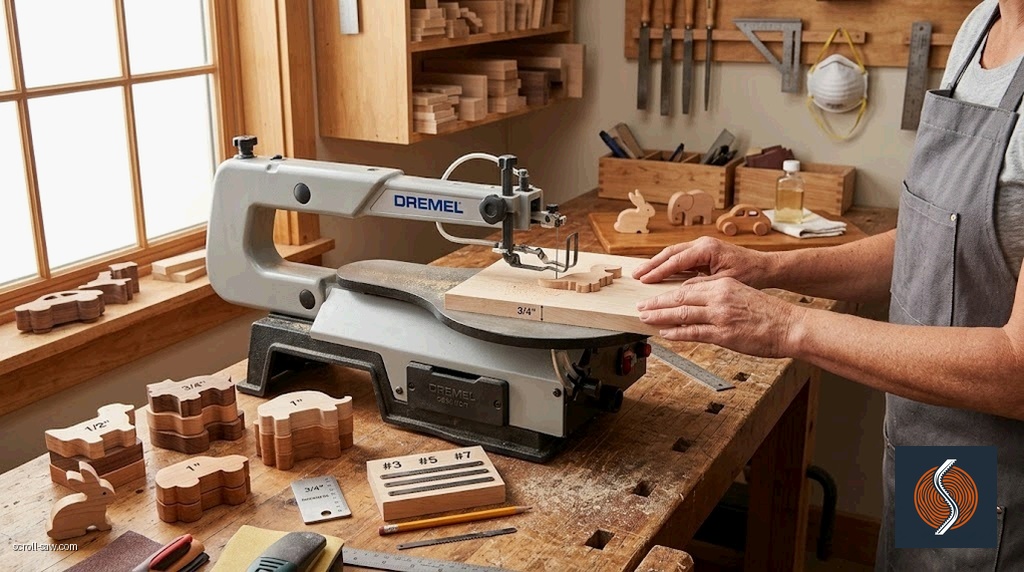
Quick answer: cut from 3/4 inch Baltic birch plywood for most toys, 1/2 inch for smaller pieces. Use a #7 skip-tooth for 3/4 inch stock, #5 for 1/2 inch. Sand every edge to remove splinters. Use dowel joinery with Titebond II for structural joints. Finish with mineral oil or CPSC-certified non-toxic acrylic paint.
Material thickness by toy type
Three-quarter inch Baltic birch plywood for standard push-toys, train cars, dollhouse walls, and structural components.
Half-inch Baltic birch for smaller push-toys, alphabet blocks, and detailed components.
One-inch or thicker plywood for ride-on toys where kid weight loads the structure.
Quarter-inch plywood for small ornamental components on assembled toys.
Wood choice
Baltic birch plywood is the standard for toys. Durable, splinter-resistant when properly sanded, doesn’t warp under handling, dimensionally stable.
Hard maple for premium heirloom toys. Denser than plywood, closed-grain, food-safe finish compatible.
Avoid pine (splits under handling and stress), MDF (dust and off-gassing concerns for children), and thin stock (under 3/8 inch) that feels flimsy under kid handling.
Blade size
A #7 skip-tooth blade for 3/4 inch stock. Standard toy work.
A #5 skip-tooth for 1/2 inch stock or tighter detail cuts.
A #9 skip-tooth for thicker stock or ride-on toy structural components.
A #3 reverse-tooth for detail cuts (eye pierces, decorative windows on dollhouses).
Fresh blades throughout. Dulled blades tear plywood face and leave splinters.
Structural joinery
Structural joints on assembled toys use dowel joinery reinforced with wood glue:
-
Cut all toy parts before starting assembly.
-
Drill dowel mounting holes in both mating surfaces with a drill press for perpendicular alignment.
-
Cut dowel rods to length (typically 1/4 to 3/8 inch diameter for standard toy work).
-
Apply Titebond II wood glue to dowel holes and dowel ends.
-
Assemble parts and clamp with tape or spring clamps.
-
Wipe glue squeeze-out immediately.
-
Cure 24 hours before finishing.
Dowel joinery is stronger than glue-only joints and handles impact loads (dropped toys, kids putting weight on the toy).
Wheeled toy assembly
-
Cut all parts (body, wheels, axles).
-
Drill axle holes perpendicular to the wheel face with a drill press.
-
Cut wooden axle rod to length (typically 1/4 inch diameter, 1/2 inch longer than needed for wheel positioning).
-
Insert axle rod through the toy body’s axle hole.
-
Attach wheels to axle ends. Wheels spin freely on the axle.
-
Fix the axle in place with either a small dowel pin through the wheel hub or with a small drop of Titebond II wood glue on the axle end.
-
Test wheel rotation. Wheels spin freely without wobbling or binding.
Where toy projects fail
Splinters on cut edges. Not sanded after cutting. Sand every edge with 220 grit.
Wheels wobble or bind. Axle hole drilled off-perpendicular. Use a drill press.
Structural joint fails during handling. Glue-only joint without dowel reinforcement. Use dowel joinery on any joint that carries load.
Paint chips during handling. Non-durable paint. Use CPSC-certified non-toxic acrylic paint with matte water-based polyurethane top coat.
Toy cracks under stress. Wood species too brittle or grain running across a thin section. Use Baltic birch or hard maple with grain along the toy’s dominant axis.
Ride-on toy fails under kid weight. Structural design underspecified. Use 1 inch or thicker plywood for ride-on toy structural components, with reinforced corner blocks and multiple dowel joints per corner.
Finishing notes for kid safety
Mineral oil for natural-finish toys. Non-toxic, food-safe, easily reapplied. Apply generously, let soak overnight, wipe off excess.
Mineral oil plus beeswax blend for slightly more protection.
CPSC-certified non-toxic acrylic paint for painted toys age 4+. Verify certification on the paint label. Apply over shellac sanding sealer. Top-coat with matte water-based polyurethane.
Avoid heavy polyurethane on toddler toys. Cracked film pieces are a swallowing hazard.
Avoid stains and dyes on toddler toys. Dye particles can leach when a child mouths the toy.
Toddler-appropriate finish (age 0-3): mineral oil only, unpainted wood.
Preschool-appropriate finish (age 4+): mineral oil, painted with CPSC-certified acrylic and sealed with matte water-based polyurethane, or natural stained with food-safe stain and sealed.
Comparing three toy projects
Simple wooden push-toy (duck, elephant, dog) with round wheels and dowel axles, 3/4 inch Baltic birch, mineral oil finish. The reliable first toy project. Cuts and assembles in a weekend.
Wooden train set with three cars (locomotive, box car, caboose) connected by hook-and-eye couplings, 3/4 inch Baltic birch, painted with CPSC-certified acrylic and sealed with matte water-based polyurethane. The mid-range project.
Wooden dollhouse with four rooms, cut-out windows and doors, wooden floor and roof, 1/2 inch Baltic birch, mineral oil finish, dowel-jointed corners. The signature toy project. Reserve two to three weekends for cutting and assembly.
Conclusion
Scroll saw toy projects produce safe kid-going toys when the wood is 3/4 inch Baltic birch or hard maple, structural joints use dowel joinery reinforced with wood glue, every cut edge is sanded to remove splinters, and the finish is mineral oil or CPSC-certified non-toxic paint. A #5, #7, or #9 skip-tooth blade depending on stock thickness. Titebond II glue with 24 hour cure. Do those and the finished toys survive handoff between siblings and generations without splinters, choking-hazard breakage, or structural failure.
Frequently asked questions
What wood works best for scroll saw toy projects? Three-quarter inch Baltic birch plywood for standard toys, 1/2 inch for smaller pieces, 1 inch or thicker for ride-on toy structural components. Hard maple for premium heirloom toys.
Which blade cuts 3/4 inch stock cleanest? A fresh #7 skip-tooth blade for 3/4 inch stock. Use #5 for 1/2 inch, #9 for thicker stock, #3 reverse for detail cuts.
How do I make wheels spin freely on the axle? Drill the axle hole slightly larger than the axle rod diameter with a drill press for perpendicular alignment. The wheel should slide easily on the axle without wobbling.
What finish is safe for a toddler toy? Mineral oil or mineral oil plus beeswax blend. Non-toxic, food-safe. For painted toys age 4+, CPSC-certified non-toxic acrylic paint sealed with matte water-based polyurethane.
How do I keep cut edges from splintering? Sand every edge with 220 grit after cutting. Reapply mineral oil finish when the finish dulls.
What glue holds structural toy joints? Titebond II wood glue with 24 hour cure, reinforced with dowel joinery on any joint that carries load.
What structural design does a ride-on toy need? One inch or thicker plywood for load-bearing structural components. Reinforced corner blocks. Multiple dowel joints per corner. Test the assembled toy under an adult’s weight before letting a child ride.
References
-
Consumer Product Safety Commission children’s toy guidelines: cpsc.gov
-
Steve Good, Scrollsaw Workshop toy pattern archive: scrollsawworkshop.blogspot.com
-
Scroll Saw Woodworking & Crafts toy resources: foxchapelpublishing.com


