
Getting Useful Results From a Hand Crank Scroll Saw: Setup and Technique
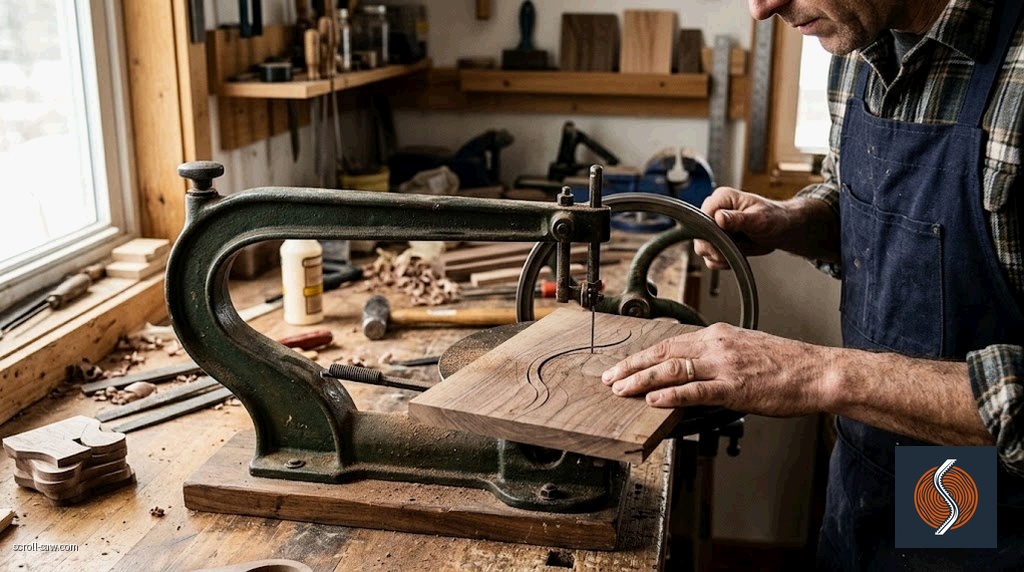
Getting Useful Results From a Hand Crank Scroll Saw: Setup and Technique
A hand crank scroll saw is one of those tools that raises the question “why would anyone want one” for the first ten seconds and then quietly answers it over the next hour. The saw is silent. It uses no electricity. It has no motor to overheat and no cord to snake across the shop. And in the hands of someone who has gotten used to the rhythm, it cuts fine detail with a control that some electric saws never quite match.
Hand crank scroll saws (and their close cousins, treadle scroll saws) are what most people used before affordable electric hobby saws arrived in the mid-20th century. Restored antiques and a few small modern reproductions cover the current market. This article is about setting one up and getting real work out of it.
Direct answer
A hand crank scroll saw is a scroll saw powered by a hand-turned flywheel that drives a reciprocating blade. The operator turns the crank with one hand and guides the workpiece with the other, or (on larger antique machines) uses a foot treadle to leave both hands free. Setup is similar to an electric saw, with additional attention to flywheel bearings, drive linkage, and blade tension.
Why anyone still uses one
A short list, because the answer is not obvious in a world of $200 electric saws.
Total speed control. The blade moves as fast as your hand turns the crank. Slow the crank and the blade slows. This is precise control that variable-speed electric saws approximate but do not quite match.
Silence. No motor noise. Useful in shared workshops, apartments, or shops where the family is nearby.
No electricity. Runs anywhere. Off-grid workshops, small ateliers, and demonstration setups do not need to plan around outlets.
Educational and heritage value. For teaching how a scroll saw actually works, or for restoring and preserving 19th-century hand tools as functional objects, nothing else does the job.
Meditative use. Some woodworkers genuinely prefer the rhythm of turning a crank while cutting. It is the same appeal as a hand plane over a power sander.
Against that: hand crank saws are slow, cannot handle production work, and are limited in stock thickness.
Setup for a hand crank scroll saw
Most surviving hand crank scroll saws are antiques. Setup starts with restoration to functional condition.
1. Flywheel bearings. The flywheel should spin freely and smoothly with no wobble. Old bearings often need cleaning and re-oiling. If pitted, they may need replacement, which for antique saws often means custom machining.
2. Drive linkage. The crank connects to the blade arm through a linkage (usually a pitman rod or connecting arm). Play in this linkage translates directly into blade vibration. Tighten or replace as needed.
3. Blade tension. Most antique saws use a spring-loaded upper arm to maintain tension. Springs weaken over decades. Replace with modern equivalents if tension cannot be raised to hold a fine blade steady.
4. Table and squareness. Same as any scroll saw. Level side to side. Square blade to table. Adjust tilt to zero and lock.
5. Blade clamps. Antique saws sometimes use pin-end blades or custom clamp designs that no longer have easy replacement parts. Some restorers convert to modern pin-less clamps; others source period-correct pin-end blades.
After setup, the saw should turn smoothly through several revolutions of the crank with no binding or unusual noise.
Technique that plays to the tool’s strengths
Hand crank scroll saws reward a specific kind of technique.
Rhythm before speed. Establish a steady, comfortable turning cadence and hold it. Uneven cranking produces uneven cuts. The blade should reciprocate at a metronome-like pace.
Feed matches crank speed. As the blade slows (during a tight turn), the workpiece feed slows to match. A hand crank saw is naturally sympathetic to this because your hand is doing both.
Two-handed hand crank use. One hand turns; the other guides. If the piece is small enough, you can pause the crank mid-cut to reposition. Practice with the pause and restart until it feels natural.
Treadle use frees both hands. Larger antique saws with foot treadles let both hands stay on the workpiece. Once the treadle rhythm is established, the setup is essentially equivalent to a foot-pedaled electric saw with slower operation.
Fine blade work is where the saw shines. The slow, controlled reciprocation is easier on fine blades than a fast electric saw. #2/0 and #1 blades often last longer in a well-tuned hand crank saw than in a poorly set up electric one.
Where a hand crank saw fits (and where it does not)
Fits:
-
Fine detail work in thin stock (1/8 to 1/2 inch)
-
Small ornament and jewelry-scale projects
-
Teaching, demonstration, and heritage-craft settings
-
Off-grid or noise-restricted environments
-
Meditative one-off project work
Does not fit:
-
Any production run beyond a handful of pieces per session
-
Stock over 3/4 inch (fatigue and cut time become impractical)
-
Long straight cuts (a bandsaw would do the same work in a fraction of the time)
-
Anyone who cannot commit hand or foot rhythm for extended sessions (physical limits are real)
Buying an antique hand crank scroll saw
Antique treadle scroll saws (New Rogers, Barnes, Millers Falls, Trump Brothers, and others) turn up at estate sales and antique markets. Before buying:
-
Turn the crank or treadle by hand. It should move through the full stroke without binding.
-
Check the flywheel for cracks or missing spokes.
-
Inspect the blade holders for damage or missing parts.
-
Look at the table for cracks around the throat and trunnion.
-
Confirm that the arm assembly is complete and not welded or repaired in a way that suggests catastrophic past failure.
A restorable saw is worth restoring. A saw with a cracked table casting or a broken arm assembly is often past the point of practical repair.
Verdict
A hand crank scroll saw is a slow, quiet, hands-on tool that does what electric saws do, but at a different pace and with different rewards. It is not a substitute for an electric hobby saw for volume work. It is a legitimate primary tool for a specific kind of scroller: one who values quiet, off-grid capability, or heritage craft, and who has the patience for the rhythm.
Restored antiques cost less than most modern hobby saws once you factor in what a rebuilt Barnes or New Rogers actually delivers. If the aesthetic and the pace appeal, one is worth setting up properly. If you need to cut ten ornaments an hour, buy an electric saw.
FAQ
Are hand crank scroll saws still made? A few small manufacturers produce new hand crank or treadle scroll saws, mostly for specialty and heritage-craft markets. The bulk of the market is restored antiques.
How fast can a hand crank scroll saw cut? Roughly a third to a half the speed of an electric hobby saw on the same material, depending on operator fitness and crank ratio. Treadle saws with heavy flywheels can approach electric-saw speeds in short bursts.
What blades fit an antique hand crank scroll saw? Many use pin-end blades in specific lengths. Some antique clamps have been converted to accept modern 5-inch pin-less blades. Check the specific saw before ordering.
Can I do fretwork on a hand crank scroll saw? Yes. The slow, controlled stroke is well suited to fretwork. It takes longer than on an electric saw but the cut quality can be excellent.
Is a treadle scroll saw the same as a hand crank scroll saw? Both use human power. A hand crank has a hand-turned mechanism; a treadle has a foot-driven rocker with a flywheel. Treadles free the hands and are typically the larger, more capable machines.
How do I maintain a hand crank scroll saw? Keep flywheel and drive bearings oiled. Inspect the drive linkage for play. Replace tension springs when they weaken. Store indoors to prevent rust on the working surfaces.
Where can I buy a hand crank scroll saw? Antique markets, estate sales, and specialty tool dealers. A few small modern manufacturers list them online. Prices vary widely with condition and rarity.


