
Is a Hand Operated Scroll Saw Useful? Applications, Limits, and Setup
Is a Hand Operated Scroll Saw Useful? Applications, Limits, and Setup
When electric scroll saws became affordable in the 1950s, the hand operated saw seemed like a museum piece within a generation. But every few years the category quietly comes back, sometimes for practical reasons (silence, no electricity, portability) and sometimes for craft reasons (control, meditation, heritage). The question of whether a hand operated scroll saw is actually useful in 2020s woodworking depends entirely on what you are trying to do.
This article covers the three main types (hand fret saw, hand crank scroll saw, and treadle scroll saw), where each still fits, and what setup and technique looks like in practice.
Direct answer
Hand operated scroll saws are useful for detail cutting when silence, off-grid capability, or hand control matter more than throughput. They are not useful for production work, thick stock, or long straight cuts. The three main types are hand fret saw (jeweler’s saw style), hand crank scroll saw, and treadle scroll saw.
The three types
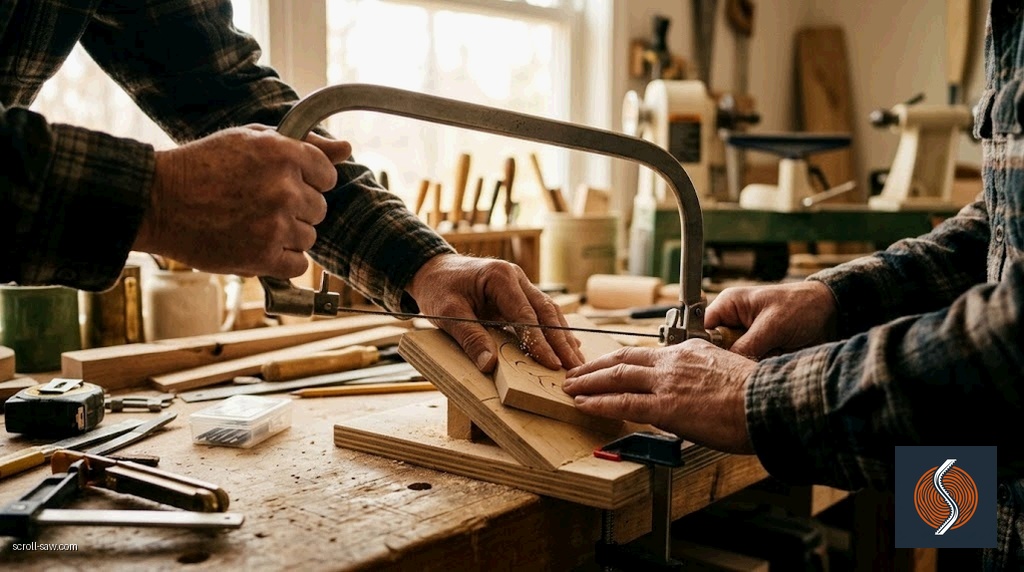
Hand fret saw. A U-shaped frame with a fine blade held under tension by wing nuts or a lever. Used two-handed with the workpiece on a bird’s mouth board that clamps to the bench. Similar in concept to a jeweler’s saw but larger. Cuts are made by moving the saw up and down while the workpiece pivots on the bird’s mouth.
Useful for: fine fretwork in thin stock, jewelry-scale work, on-location repairs, tight spaces where a bench saw does not fit.
Hand crank scroll saw. A benchtop scroll saw with a flywheel and hand crank instead of an electric motor. Operator turns the crank with one hand, guides the workpiece with the other.
Useful for: silent shops, teaching, off-grid work, restored antiques kept in service.
Treadle scroll saw. A larger version with a foot pedal driving a flywheel, freeing both hands for the workpiece. Common in the late 19th and early 20th century (New Rogers, Barnes, Millers Falls, and others).
Useful for: heritage craft, off-grid workshops, silence-preferred environments, and the same applications as a hand crank saw but with more capability.
Where each type still earns space
Hand fret saw. The most enduring of the three. Every serious scroller should own one. It handles repairs and small cuts that would take longer to set up on a bench saw. It also travels: fits in a toolbox, works on a folding stand, needs no electricity.
Hand crank scroll saw. More niche. Genuinely useful in specific settings (noise-sensitive environments, teaching, meditative work, heritage craft). For general hobby use it is slower than an electric saw of the same size.
Treadle scroll saw. Similar to hand crank but larger and more capable. Restored antiques are sought by collectors and by scrollers who want a truly hands-on primary saw. Modern reproductions are rare and expensive.
Where they do not fit
Any hand operated scroll saw fails for:
-
Production work (blade hours per piece are too high)
-
Thick stock over 3/4 inch (fatigue becomes a factor)
-
Long straight cuts (a bandsaw does the same work in a fraction of the time)
-
Anyone with physical limits on sustained cranking or treadling
For everything on that list, an electric saw is the correct answer.
Setup for a hand fret saw
Often called a bird’s mouth setup because of the workpiece support.
1. Bird’s mouth board. A short board with a V-notch cut into one end, clamped to the edge of the bench. The workpiece sits on the board over the V-notch, and cuts are made through the V.
2. Blade tension. The frame’s tension mechanism (wing nut, lever, or thumbscrew) pulls the blade tight. Tighter is generally better; a properly tensioned blade rings when plucked.
3. Blade direction. Teeth point downward (toward the handle). The cut happens on the down stroke.
4. Two-handed technique. One hand holds the frame; the other rotates the workpiece to steer the cut. The blade does not move sideways; the workpiece does.
5. Vertical stroke. Keep the saw perpendicular to the workpiece. Tilting produces beveled cuts.
A well-set-up hand fret saw handles interior cuts in 1/4-inch hardwood with surprising precision.
Setup for a hand crank or treadle scroll saw
Mostly restoration of an antique.
1. Flywheel bearings. Should turn smoothly with no wobble. Clean and re-oil old bearings; replace if pitted.
2. Drive linkage. Pitman rod or connecting arm should be tight with no play. Tighten hardware or replace worn parts.
3. Tension mechanism. Spring-loaded upper arm. Replace weakened springs with modern equivalents.
4. Blade clamps. Antique saws may use pin-end blades or custom clamps. Some restorers convert to modern pin-less clamps.
5. Table. Level and square as usual.
6. Overall integrity. No cracks in castings, no welded repairs of structural parts, arm assembly complete.
Technique on a hand operated saw
A few points that separate frustrating use from productive use.
Rhythm before speed. Consistent stroke or crank cadence produces clean cuts. Irregular motion produces irregular results.
Two-handed workflow. The hand not driving the blade guides the workpiece. Practice the coordination on scrap before starting a real project.
Slow when detail demands it. The tool is naturally forgiving of slow cutting because your hand controls the pace. Use that.
Rest before fatigue. Hand and foot muscles used continuously will fatigue. Take breaks; the tool does not care.
Break-in for antiques. A restored saw benefits from an hour or two of use before serious work, letting bearings settle and the mechanism find its rhythm.
Verdict
Hand operated scroll saws are genuinely useful, but not universally. A hand fret saw belongs in almost every scroll saw shop because it complements the bench saw and handles cuts the bench saw cannot easily reach. Hand crank and treadle saws are more specialized and appeal to specific use cases: silence, off-grid work, heritage craft, meditative use, or teaching.
Do not buy a hand operated saw as your only scroll saw unless you have specifically chosen the lifestyle it implies. Buy one as a complement to an electric bench saw, or as a heritage project you enjoy for its own sake.
Within those roles, they are among the most durable and satisfying tools in a shop.
FAQ
What is a hand fret saw? A hand-held scroll-style saw with a U-shaped frame that holds a fine blade under tension. Used with a bird’s mouth board on the bench edge. Enables fine fretwork without electricity.
Is a hand fret saw the same as a coping saw? Similar shape, different scale. A fret saw has a deeper throat and finer blades for detail work. A coping saw has a shallower throat and coarser blades for general trim carpentry.
Can I do fretwork with a hand crank scroll saw? Yes. The slow, controlled reciprocation is well suited to fine blades. It takes longer than on an electric saw but produces excellent cut quality.
Where can I buy a hand operated scroll saw? Hand fret saws are widely available new from tool retailers. Hand crank and treadle scroll saws are mostly available as restored antiques from specialty dealers or auction sites. A few small manufacturers produce new reproductions.
What blades fit a hand fret saw? Fret saw blades in various sizes (#3/0 to #12), sold in dozens. Standard scroll saw blades often fit as well. Check the frame’s clamp mechanism.
How long does a hand operated scroll saw cut take vs. electric? Roughly two to three times as long for the same cut, depending on operator fitness and blade choice. For a small project the difference is minutes.
Is a treadle scroll saw safer than an electric one? Not inherently. The blade is the same hazard. The lack of a motor means the blade stops when you stop driving it, which does eliminate one class of accident.


