
Homecraft Scroll Saw Explained: Purpose, Fit, and Practical Setup
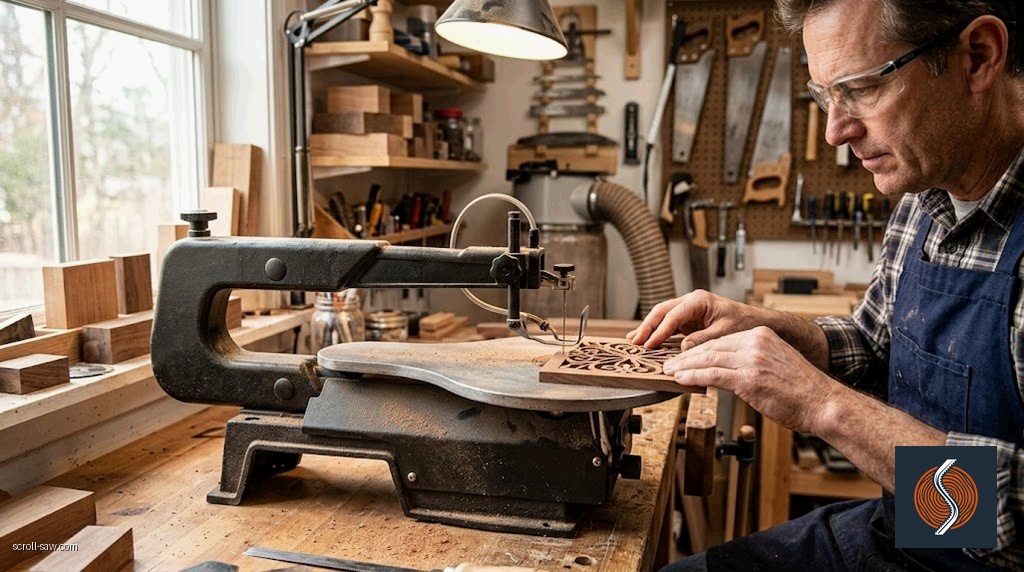
Homecraft Scroll Saw Explained: Purpose, Fit, and Practical Setup
Someone opens a garage they inherited from a grandparent and finds a small green or gray scroll saw with HOMECRAFT badging and Delta scripts on the arm. It is heavy, obviously old, probably dusty. The question is always the same: is this worth doing anything with?
Homecraft was Delta’s home-shop budget line from roughly the 1940s to the 1970s. The saws were sold to serious hobbyists at a lower price point than the professional Delta machines. Many are still functional. Some are worth restoring; some are worth using for parts. The difference depends on the specific model and its condition.
This article covers what to actually do with a Homecraft scroll saw you have inherited or found.
Direct answer
A Homecraft scroll saw is a vintage American-made hobby scroll saw manufactured by Delta from the 1940s to the 1970s. Many models are still usable with modest restoration. Setup follows standard vintage-saw practice: check the cord and switch, verify motor operation, service the blade holders, level and square the table. Parts availability is limited but not zero; blade clamps and blades in the correct pin-end sizes are typically the main sourcing challenges.
What a Homecraft actually is
Homecraft was the Delta Manufacturing (later Delta International) home-shop brand. The line included scroll saws, small drill presses, small bandsaws, and small lathes, all designed for hobbyist use and priced below Delta’s professional line.
Common features of a typical Homecraft scroll saw:
-
15-inch to 24-inch throat depth (varied by model and year)
-
Cast iron base and arm
-
Belt-driven from a separate motor (motor often sold separately)
-
Pin-end blade holders (some later models had pin-less options)
-
Simple mechanical construction with few electronic components
The mechanical simplicity is what has kept many of them running for decades. There is not much to break.
Where a working Homecraft fits
Assuming yours has been restored to working order.
Small ornament and craft work. The saws were designed for exactly this and still do it well.
Beginner learning. The simple construction makes them easy to understand and maintain, which is a good teaching tool.
Heritage craft. Restored Homecraft saws have a specific appeal for scrollers who value American mid-century tools kept in working service.
Secondary saw in a two-saw shop. As a dedicated ornament saw or beginner saw alongside a modern primary.
Where it does not fit as well.
Serious fretwork. Pin-end blade limitations mean the finest blades (which are pin-less) may not fit stock clamps. Some restorers convert to pin-less holders; the modification is not trivial.
Long production runs. The motor and belt drive are not built for continuous heavy use.
Any workflow requiring reliable parts availability. Common wear parts are findable but not always in stock.
Setup for a Homecraft that has been sitting
Before power is applied, walk through this sequence.
1. Cord and switch. Cracked insulation or damaged plug means the cord needs replacement. Old switches that stick or arc need replacement or thorough cleaning.
2. Motor. Hand-turn the motor by the pulley. Should turn smoothly. Rough turning indicates bearing wear. Universal motors have brushes that can be replaced; induction motors are usually less serviceable.
3. Belt. Check for cracks, glazing, or stretching. Replace if any of those are present. Belts are typically standard sizes and easy to source.
4. Blade clamps. Actuate the clamp mechanism. Both upper and lower should hold pressure and release cleanly. Worn clamps are the most common Homecraft failure.
5. Table. Verify the table is flat, tilts smoothly, and locks securely. Adjust the trunnion if the tilt is loose.
6. Arm assembly. Check for play in the arm pivot. Some play is normal on old saws; excessive play means bearings or bushings need service.
7. Lubrication. Light oil on the arm pivot, drive linkage, and any exposed moving parts. Do not over-oil; excess attracts sawdust.
Only after these checks should the saw be run under load.
Parts sourcing for Homecraft saws
A few practical paths.
Delta parts. Delta Machinery (now under various ownership arrangements) maintains some legacy parts support. Check current availability for the specific model number.
OWWM.org (Old Wood Working Machines). A community of vintage machine restorers. Extensive documentation and parts leads for Delta Homecraft and similar vintage tools.
Third-party parts specialists. Companies that focus on vintage tool parts stock common Homecraft items (belts, blade clamps, switches).
Fabrication. Simple parts (blade clamps, blower tubes) can be machined or fabricated by a competent shop.
Donor saws. For popular Homecraft models, buying a second (non-working) saw for parts is often the fastest path to a working restoration.
Modern equivalents. Belts, motor brushes, bearings, and cords are often standard sizes with modern replacements available.
Blade compatibility
Most Homecraft scroll saws use pin-end blades in specific lengths (commonly 5 inches or 6.5 inches depending on model). Pin-end blades are still manufactured and widely available, though the selection of tooth patterns is narrower than for pin-less blades.
If your Homecraft has been converted to pin-less clamps, standard 5-inch pin-less blades fit.
Confirm the blade type before ordering. A wrong-length or wrong-style blade will not fit.
Where restoration stops making sense
Honest signs a Homecraft is not worth restoring.
-
Cracked base or table casting
-
Motor that cannot be serviced or replaced
-
Multiple critical parts unavailable
-
Arm assembly damaged beyond simple repair
-
Combined restoration cost exceeds a working modern saw
At that point, strip the saw for usable parts (motor, blade clamps, table if it fits another saw, hardware) and let the rest go.
Verdict
A Homecraft scroll saw is a vintage Delta hobby saw with real character and, in working condition, real utility. Simple mechanical construction makes them easy to maintain. Parts availability is limited but manageable for the common wear items.
If you inherit or find one in decent condition, it is often worth the restoration effort. If it is in poor condition or missing critical parts, it is often better as a parts source.
Kept within its designed range (beginner and hobby work, standard-size projects, occasional use), a restored Homecraft will produce clean cuts for another few decades. Pushed past that range, or trusted without inspection, it will disappoint or fail.
FAQ
Who made Homecraft scroll saws? Delta Manufacturing (later Delta International). Homecraft was Delta’s home-shop budget brand from the 1940s to the 1970s.
Can I still buy parts for a Homecraft scroll saw? Many parts are available through Delta legacy support, third-party specialists, and vintage tool communities. Some parts require fabrication or donor saws.
What blades fit a Homecraft scroll saw? Most Homecraft models use pin-end blades in a specific length (5 inches or 6.5 inches). Confirm your model’s blade requirement before ordering.
How much is a Homecraft scroll saw worth? On the used market, working units command modest sums. Restored units in excellent condition are worth more, especially rarer models. Condition matters more than the badge.
Is a Homecraft scroll saw safe to use? Only after a pre-use safety check confirms cord, switch, motor, and mechanism are all sound. Any vintage saw that has been sitting should not be plugged in without inspection.
Can a Homecraft do fretwork? Light fretwork with the finer pin-end blades, yes. Serious fretwork requiring #2/0 pin-less blades is beyond most stock Homecraft models unless converted.
Where can I find a Homecraft scroll saw manual? OWWM.org has extensive vintage machine documentation. Delta legacy support and specialty vintage tool sites often host original manuals.


