
How Thick Can a Scroll Saw Cut? Capacity by Material and Blade
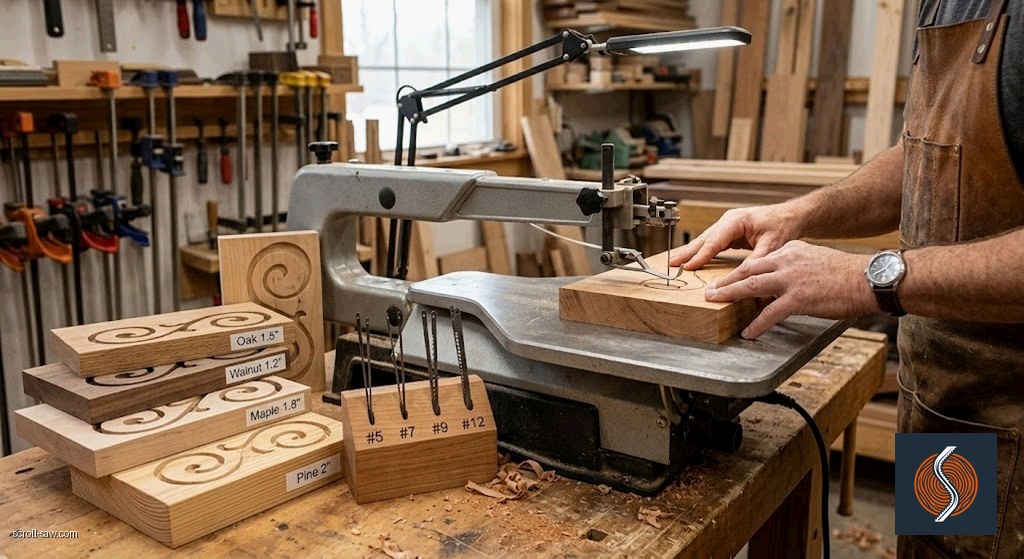
How Thick Can a Scroll Saw Cut? Capacity by Material and Blade
The answer written on most scroll saw boxes says something like “maximum thickness: 2 inches.” That number is technically correct and practically misleading. Most scroll saws will accept a 2-inch piece of soft wood under the blade guard. Whether they will actually cut it in less than an afternoon, without burning the wood or the blade, is a different question.
The real thickness capacity of a scroll saw depends on three things: the material, the blade, and how patient you are. This article gives honest numbers for the combinations that come up in real projects.
Direct answer
A typical modern hobby scroll saw will physically accept material up to about 2 inches thick. Practical cutting capacity depends on material: 2 inches of soft wood (pine, basswood) with a large blade, 1 inch of hardwood (oak, cherry) with careful feeding, 1/2 inch of dense hardwood (maple, walnut) for clean detail cuts, and typically no more than 1/4 to 1/2 inch for fine fretwork regardless of material.
The number on the box vs. real capacity
Every scroll saw manufacturer publishes a maximum thickness. It reflects the clearance under the blade guard and hold-down, not the practical cutting range.
Physical capacity. How thick a piece will fit under the guard. Usually 1.75 to 2.5 inches.
Practical capacity. How thick a piece the saw will cut cleanly and in reasonable time. Always less than physical capacity.
Fine detail capacity. How thick a piece the saw will cut with a fine blade for intricate detail. Much less than practical capacity.
Buying decisions should be based on practical and fine detail capacity, not the number on the box.
Practical capacity by material
A guide based on common scroll saw work.
Soft woods (pine, basswood, poplar, cedar).
-
Comfortable cutting: up to about 2 inches with a #9 or larger blade
-
Fine detail: up to about 1 inch with a #5 blade
-
Very fine detail: up to about 1/2 inch with a #2/0 or #1 blade
Medium hardwoods (cherry, walnut, alder).
-
Comfortable cutting: up to about 1 to 1.5 inches with a #7 or #9 blade
-
Fine detail: up to about 3/4 inch with a #5 blade
-
Very fine detail: up to about 1/4 to 1/2 inch with a #2/0 or #1 blade
Dense hardwoods (oak, maple, hickory).
-
Comfortable cutting: up to about 3/4 to 1 inch with a #9 blade
-
Fine detail: up to about 1/2 inch with a #5 blade
-
Very fine detail: up to about 1/4 inch with a #2/0 or #1 blade
Plywood (Baltic birch, quality craft plywood).
-
Comfortable cutting: up to about 3/4 inch with a #7 blade
-
Fine detail: up to about 1/2 inch with a #5 blade
-
Very fine detail: up to about 1/4 inch with a #2/0 or #1 blade
MDF.
-
Practical: up to about 3/4 inch with a #7 or larger blade
-
Fine detail: not recommended past about 1/4 inch; MDF dulls blades quickly
Acrylic and thin plastics.
- Comfortable: up to about 1/2 inch with specific plastic-cutting blades and slow feed to prevent melting
Thin non-ferrous metal.
- Very light aluminum, brass, and copper up to about 1/16 inch with specific metal-cutting blades
These are ranges, not absolutes. Individual saws, blades, and pieces of wood behave differently.
What determines real capacity
Several factors matter more than the saw’s rated maximum.
Blade size. Larger blades handle thicker material. A #12 blade cuts 2-inch pine comfortably. A #2/0 blade struggles in 1/2-inch pine.
Blade condition. A fresh blade cuts twice the thickness a dull blade can handle before burning.
Feed rate. Pushing too fast bogs the saw and burns the wood. Feeding too slow burns as well. The right feed is steady and unforced.
Wood species and grain. Straight-grained soft wood cuts easier than gnarly or knotty stock at the same thickness.
Motor power. Larger motors handle thicker stock without bogging. Cheap saws have less headroom.
Blade tension. Under-tensioned blades wander in thick stock. Tension until the blade rings.
Saw arm speed. Faster stroke handles thicker stock but is hard on fine blades. Slower stroke is easier on blades but slower in thick material.
Operator patience. Cutting 2-inch hardwood takes several times longer than 1/4-inch plywood. Some cuts just take time.
Signs you are at the saw’s real limit
The saw tells you when the stock is too thick for what you are asking.
Motor bogs down. RPM drops noticeably during the cut. Wood is too thick for the blade or the motor.
Blade burns wood. Cut leaves burn marks along the edge. Feed rate too slow, blade too fine, or wood too dense.
Blade breaks quickly. Blade lasts minutes instead of hours. Too much load on the blade for the setup.
Cut takes forever. A cut that would take one minute in 1/4-inch stock is taking twenty in 1.5-inch stock. Sometimes normal; sometimes a sign to step up the blade size.
Cut wanders even at slow feed. Blade cannot handle the stock thickness at that tension. Larger blade, higher tension, or thinner stock.
When these appear, step up the blade, slow the feed, or reduce the stock thickness. Do not push through; blades and motors both wear faster than they need to.
Stack cutting to work smarter
A reminder. If you need to cut multiple identical thin pieces, stack them and cut through the stack in one pass. Four pieces of 1/4-inch stock taped together become a 1-inch stack, and one careful cut produces four matching pieces.
Stack cutting is often faster and more accurate than cutting each piece separately, especially for ornaments, puzzle pieces, and intarsia.
Verdict
A scroll saw can cut thicker material than most beginners think, but the practical thickness depends on the material, blade, and cutting purpose. Two inches of pine with a large blade is comfortable. Two inches of oak with a fine blade is punishing.
Before starting a thick cut, match the blade to the material and thickness, verify tension, and adjust feed rate to match what the saw wants. Push past those and blades break, motors wear, and cuts burn.
Stay within the practical range for your saw and material and you will get clean cuts without fighting the tool.
FAQ
What is the maximum thickness a scroll saw can cut? Most modern hobby saws physically accept material up to about 2 inches. Practical cutting depends on material and blade choice.
Can a scroll saw cut 2-inch hardwood? Slowly and with a large blade. The cut will take substantial time and blades will wear fast. A bandsaw is a better tool for thick hardwood.
What blade do I need to cut thick wood on a scroll saw? Step up in blade size with thickness. #7 for 3/4 inch, #9 for 1 inch, #12 for 1.5 to 2 inches in soft wood.
Can I cut MDF thicker than 3/4 inch on a scroll saw? Technically yes but MDF dulls blades quickly and produces heavy dust. Not recommended past 3/4 inch.
How thick can a scroll saw cut aluminum? Up to about 1/16 inch with a specific metal-cutting blade. Beyond that, a jigsaw or bandsaw with a metal blade is more appropriate.
Why does my scroll saw bog down in thick wood? Blade is too fine for the thickness, motor is undersized, feed rate is too aggressive, or wood is denser than the blade can handle. Larger blade or slower feed usually fixes it.
Is stack cutting the same as cutting one thick piece? Mechanically similar, but stack cutting produces multiple matching thin pieces from one cut. Useful for ornaments, puzzle pieces, and any project needing identical parts.


