
How to Cut with a Scroll Saw Without Forcing the Blade
How to Cut with a Scroll Saw Without Forcing the Blade
Every experienced scroller can spot a beginner across a room. It is not the pattern choice or the finish quality. It is the way the shoulders hunch, the arms tense, and the workpiece gets pushed into the blade with a firm two-handed shove. The saw responds by burning the wood, snapping the blade, and cutting a line that wanders off the pattern.
Cutting with a scroll saw is a matter of guiding the workpiece, not pushing it. Once that shift happens, everything else about scroll saw work gets easier. This article is about how to make that shift.
Direct answer
Cutting with a scroll saw well means: setting the saw up correctly (blade square, tensioned, correct size for material), feeding the workpiece steadily but without force, letting the blade cut at its own pace, watching the cut line ahead of the blade rather than the blade itself, and rotating the workpiece with the wrists to steer through curves. The single biggest change most beginners need is to stop pushing so hard.
The core principle: let the blade cut
A scroll saw blade removes wood at a rate determined by its size, sharpness, and the material’s density. Pushing harder does not make it cut faster. It makes the blade deflect, burn, or break.
The correct feed rate is one where the wood is being removed at the blade’s natural pace. You should feel resistance, but not effort. The workpiece should move steadily forward at whatever pace the blade allows.
When you feel yourself pushing hard, one of three things is wrong: the blade is dull, the blade is too fine for the material, or you are feeding too fast. Fix the cause, do not add more force.
Before any cut: the setup checklist
A quick verification before starting.
Blade square to the table. Small drafting square against the blade and the table. Full contact top to bottom.
Table level. Torpedo level across the table in both directions.
Blade tensioned until it rings. Pluck the mounted blade. Clear high pitch.
Correct blade for the material and thickness. #3 or #5 for 1/4-inch stock, #7 for 3/4-inch, #9 or #12 for thicker. Reverse-tooth blades produce cleaner cuts on the bottom face.
Hold-down engaged and just clearing the workpiece. Not pressing hard; just close enough to prevent lifting.
Blower aimed at cut line. Keeps the pattern visible.
Fresh blade for critical cuts. Dull blades require force, and force is the problem.
The starting position
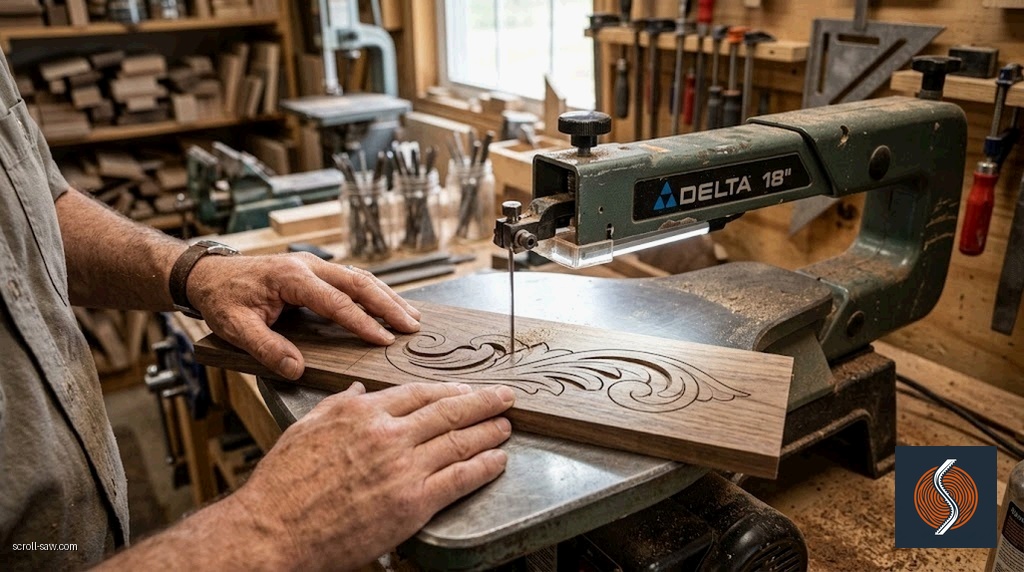
Sit or stand comfortably at the saw with both hands on the workpiece.
Both hands on the wood. One hand on each side of the cut, or one leading and one trailing depending on the direction. Never one hand near the blade.
Fingers curled back. Fingertips tucked so the blade cannot reach them if the wood shifts unexpectedly.
Shoulders relaxed. Tension in the shoulders transfers to your hands, and tense hands over-control the workpiece.
Eyes on the cut line. Look about half an inch ahead of where the blade is meeting the wood. This is where you are steering the cut.
Feet planted. A stable stance lets your hands make small adjustments without your whole body compensating.
The feed motion
Feeding the workpiece into the blade is a specific motion.
Steady, gentle pressure toward the blade. Just enough to keep contact. Not a push.
Feed rate that matches the blade. The blade tells you how fast to feed. If the blade slows or bows, feed slower. If the cut is smooth and rapid, feed at that pace.
Constant, not stop-start. A smooth continuous motion produces smooth continuous cuts. Stopping mid-cut and restarting produces bumps.
No lateral pressure. Do not push the workpiece sideways to try to correct the blade’s path. Adjust feed direction, not sideways force.
Ease off at the end. As the cut nears completion, ease pressure. The final section of the cut should almost complete itself.
Steering through curves
Curves are where scroll saw work shines.
Rotate the workpiece with the wrists. Not your whole arms, not by walking around the saw. The wrists do the turning. The workpiece rotates under your hands while feeding forward.
Tighter curves need slower feed. The blade needs time to cut sideways as well as forward. Slow down for tight turns.
Very tight turns benefit from short backward strokes. For a corner, cut into the corner, back the blade slightly, rotate the workpiece, then cut into the next direction. This is standard fret-work technique.
Watch the line, not the blade. Your eyes on the line half an inch ahead of the blade tell your hands where to steer.
Common mistakes and what they cause
Pushing too hard. Burns the wood. Breaks the blade. Cut wanders. The single biggest mistake.
Watching the blade instead of the line. Cuts drift because you cannot see where you are going.
Feeding sideways to correct drift. Twists the blade. Produces uneven cuts. Adjust feed direction instead.
Stopping mid-cut and restarting. Leaves visible bumps at every restart point. Plan cuts to have natural stopping points at pattern changes.
Using a dull blade. Requires more force. Burns wood. Produces poor cuts. Change blades often.
Wrong blade for the material. A fine blade in thick hardwood cannot cut fast enough. A coarse blade in thin plywood tears the top face.
Blade not tensioned. Wanders on any but the simplest cuts.
Signs you are doing it right
A good scroll saw cut has specific characteristics.
-
The blade sound is a smooth, steady buzzing, not a struggling growl
-
The wood removal rate is consistent
-
The cut edge is smooth, with no burn marks
-
Sawdust piles evenly on both sides of the cut
-
Your shoulders are relaxed after a long session
-
Blades last hours, not minutes
If all of those are true, your technique is solid. If any are off, adjust one thing and re-check.
Practice cuts
Before a real project, warm up with practice cuts.
-
Straight line. Follow a drawn line across a scrap. Should be smooth and on the line.
-
Curve. Cut a gentle curve. Should follow the line without wandering.
-
Tight turn. Cut a 90-degree turn. Should meet the corner cleanly.
-
Circle. Cut a circle from a scrap. Should be round and smooth.
-
Interior cut. Drill a starter hole, thread the blade, cut an interior shape.
Five minutes of warm-up cuts finds issues before they show up on a real project.
Verdict
Cutting with a scroll saw is a matter of guiding, not pushing. Set the saw up correctly, use the right blade, feed steadily but without force, watch the line, and rotate the workpiece with the wrists. When something goes wrong, fix the setup or blade rather than pushing harder.
The technique takes maybe a dozen honest sessions to become automatic. After that, cuts come out clean without conscious effort and the saw becomes a genuinely pleasant tool to use.
If you are still fighting the saw after a year, the odds are the setup is wrong. Check the blade squareness, tension, and size. Almost every persistent cutting problem traces back to one of those three.
FAQ
Why does my scroll saw burn the wood? Dull blade, blade too fine for the material, or feed rate too slow. Change the blade first; if that does not fix it, step up in blade size.
Why does my scroll saw blade keep breaking? Most commonly: pushing too hard, wrong blade for the material, or blade not seated fully in the clamp. Reduce feed pressure, verify blade size, and reseat blade.
How fast should I feed wood into a scroll saw? At the pace the blade wants to cut. Slow enough that the blade is not being pushed sideways, fast enough that the blade is actually removing wood. Practice finds the rhythm.
Should I push or pull the workpiece? Push from behind the cut, always. Pulling from in front of the blade is dangerous and produces poor control.
How do I keep my hands away from the blade? Two hands on the workpiece with fingers curled back so fingertips cannot reach the blade even if the workpiece shifts unexpectedly. Never one hand near the blade.
Can I cut fast on a scroll saw? Speed depends on material and blade. Thin soft wood with a large blade cuts quickly. Thick hardwood with a fine blade cuts slowly. Pushing to go faster than the setup allows makes cuts worse, not faster.
Should I use variable speed on my scroll saw? Yes, if your saw has it. Faster speed for straight cuts in thick soft wood; slower for detail work in hardwood, fine blades, or delicate turns.


