
How to Make Money with a Scroll Saw: What Actually Sells and What Does Not
How to Make Money with a Scroll Saw: What Actually Sells and What Does Not
Every scroll saw owner eventually thinks about selling their work. The projects pile up, family and friends run out of walls, and someone at a craft fair says “I would buy that.” The next thought is usually “I could quit my day job.”
That next thought is where most scroll saw side hustles end. Not because scroll saw work doesn’t sell, but because the math on time versus price is harder than it looks and the market for handmade wood pieces is more specific than beginners assume. This article is an honest look at what actually sells, where it sells, and how to price so you’re not paying customers to take your work.
Direct answer
You can make money with a scroll saw by focusing on personalized items (names, dates, hometown, family details), holiday and seasonal decor, small giftable items with clear utility, and custom orders for specific customers. Selling channels include craft fairs, Etsy, Facebook Marketplace, local farmers markets, and direct-to-customer through social media. Pricing must cover materials, time at a realistic hourly rate, and fees. Undercharging is the most common mistake.
What actually sells
Scroll saw work is a specific market. Some categories move; others sit.
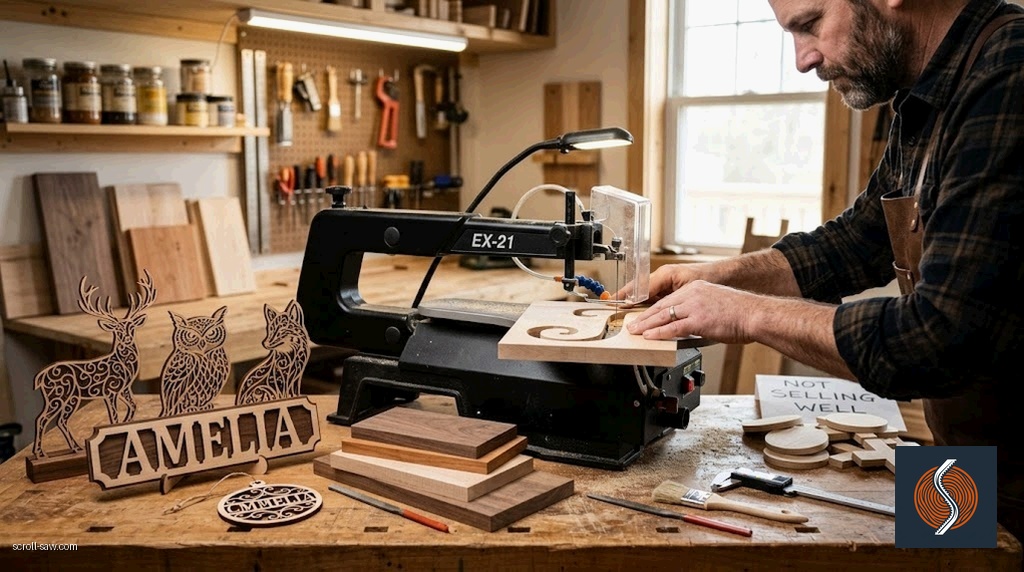
Personalized items. Anything with a name, date, wedding date, hometown, or family detail. These sell because they are gifts that cannot be bought at a store. Name signs for children’s rooms, wedding gifts with couple names and date, family established signs, address signs, custom Christmas ornaments. This category is the reliable seller.
Holiday and seasonal decor. Christmas ornaments, Halloween decorations, Thanksgiving pieces, Easter items. Seasonal demand is intense and short. Plan production months in advance and expect the bulk of sales in the six weeks before each holiday.
Small giftable items. Keychains, pins, small ornaments, jewelry-scale pieces. Low material cost, quick to produce, easy to sell as impulse purchases at craft fairs.
Puzzles. Custom shape puzzles, name puzzles for children, keepsake puzzles from photos. Higher labor cost but strong margins if priced correctly.
Freestanding pieces. Nativity scenes, silhouette scenes, standing decor. Longer to make; higher price points.
Utility items. Napkin holders, letter openers, small trays, coasters. Sell because they have a use beyond decoration.
Custom work. Someone brings you a photo, a family crest, or a specific design. Higher prices, longer turnaround, more communication. Not for beginners.
What does not sell well. Generic non-personalized decorative pieces (a plain scroll-cut butterfly), highly intricate portrait work at reasonable prices (too much labor for what people will pay), items with obvious plywood construction (buyers prefer solid wood look), oversized pieces (shipping and display space are barriers).
Where to sell
Each channel has different economics.
Craft fairs and holiday markets. Direct customer contact. Immediate sales. Booth fees vary. Personal energy investment is high. Best for personalized items, holiday decor, and small items sold in volume. Repeat customers if you become a regular.
Etsy. Global reach, established customer base looking for handmade. Etsy takes fees and requires SEO work. Best for personalized items and searchable products. Competition is intense.
Facebook Marketplace and Facebook groups. Local reach, no listing fees, direct payment. Best for local pickup items and custom orders through local community groups.
Farmers markets. Similar to craft fairs but often lower barrier. Weekly attendance builds a local following.
Instagram, TikTok, Pinterest. Not sales channels directly. Build audience, drive traffic to Etsy or direct order. Slow build, real payoff over years.
Consignment in local shops. Store takes a percentage (typically 30-50 percent). Passive income once placed. Best for gift shops, boutique stores, tourist areas.
Direct order through personal website. Highest margins because no marketplace fees. Requires marketing to drive traffic. Best for established makers with an audience.
Wholesale to retailers. Low margin per piece but volume sales. Best for makers with production capacity and standardized products.
Pricing without underselling
Most scroll saw makers undersell. The math for correct pricing.
Materials cost. What you paid for wood, finish, packaging, hardware.
Time cost. Hours from design to finished product multiplied by an honest hourly rate. Beginners often use $10-15 per hour; experienced makers should target $25-40 per hour.
Overhead. Blade wear, saw maintenance, shop supplies, utilities. Roughly 10-15 percent of materials cost.
Selling fees. Etsy fees, PayPal fees, credit card fees, booth fees averaged across expected sales.
Profit margin. What you actually keep. Add at least 25 percent on top of all the above.
Sum all of that. That’s your minimum price. Do not sell for less because you feel bad charging.
Example: A personalized wedding sign takes 3 hours from design to shipped. Materials $8, time at $25/hour = $75, overhead $2, fees $10, profit 25% = $24. Total minimum price: $119. Round to $125.
Makers who charge $40 for the same piece are not building a business. They are paying customers to take the work.
Common pricing mistakes
Pricing to beat competitors. There will always be someone charging less. Race to the bottom is not a business.
Not accounting for design and finishing time. Cut time is often less than half of total project time.
Free custom design work. Custom design should cost extra, always.
Free shipping. Shipping costs money. Include it in the price or charge separately.
Discounting for friends and family. They can pay full price or they can not have the item. Any other arrangement damages the business.
Not charging for personalization. Personalization adds value and takes time. Charge for it.
Production efficiency matters
Charging a fair price requires making pieces efficiently.
Batch production. Cut all pieces for one product line in one session. Sand all pieces in another. Finish all pieces in another. Vastly faster than one-at-a-time.
Stack cutting. Cut four identical pieces at once from a taped stack. Cuts per-piece time in half or better.
Standardized products. Ten designs made twenty times each is more profitable than two hundred one-off designs.
Templates and jigs. For repeated shapes, cut once, save the template, use it for every future order.
Pre-made blanks. Cut a supply of ornament blanks in advance so custom orders start from a blank, not a board.
The realistic income picture
Honest expectations.
Hobby-scale income. Selling at a few craft fairs a year and on Etsy occasionally: $500 to $3,000 per year in profit for most makers. This pays for the saw, wood, and finishing supplies with some left over. Not a living, but not nothing.
Serious side hustle. Regular Etsy presence, monthly craft fair booths, active social media: $5,000 to $20,000 per year in profit for makers who work at it. Meaningful supplemental income.
Full-time income. Full-time scroll saw business with wholesale, retail, custom orders, and multiple channels: $30,000+ per year is possible but requires business skills, marketing, and often employees. A small percentage of makers reach this.
The distribution is wide because effort and skill vary widely. Some makers make good money; most make a little.
Verdict
Making money with a scroll saw is realistic if you focus on what sells (personalized items, seasonal decor, small gifts), choose channels that fit your capacity (craft fairs for immediate sales, Etsy for global reach, local social media for direct orders), price to cover real costs and honest labor time, and produce efficiently through batching and templates.
The biggest limiter is not the saw or the market. It is undercharging. Most scroll saw makers charge less than their work is worth because they enjoy making it and feel guilty asking real prices. Do not do that.
If you are serious about the income, treat it as a business. Price correctly. Track time and costs. Focus on products that sell. Skip the ones that don’t. Reinvest in efficiency (better saw, better jigs, better finishing setup). Over a few years, this can grow into meaningful income.
FAQ
What scroll saw projects sell best? Personalized items (names, dates, hometown), holiday and seasonal decor, small giftable items, and custom orders for specific customers. Generic non-personalized decorative pieces sell poorly.
Where do I sell scroll saw work? Craft fairs, Etsy, Facebook Marketplace, local farmers markets, consignment in local shops, direct through social media, and eventually your own website.
How much should I charge for a personalized name sign? Depends on size and complexity. Small pieces $20-40, medium $50-100, large detailed pieces $100-250. Calculate cost of materials, time at $25+/hour, overhead, fees, and profit margin.
Can I make a living with a scroll saw? A small percentage of dedicated makers do. Most make hobby-scale or side-hustle income. Full-time income requires business skills, marketing, and often employees.
What is the biggest mistake selling scroll saw work? Undercharging. Most makers charge less than their work is worth because they feel guilty asking real prices. This is not sustainable and hurts the whole market.
Do I need a business license to sell scroll saw work? Requirements vary by location. Small hobby sales typically do not require a license. Regular sales at craft fairs or online usually do, plus sales tax collection. Check local regulations.
How do I find custom order customers? Social media presence, existing customers referring friends, craft fair contacts asking for custom work, and Etsy listings that mention custom availability. Word of mouth is the main driver for custom work.


