
Is a Bandsaw the Same As a Scroll Saw? A Practical Comparison for Woodworkers
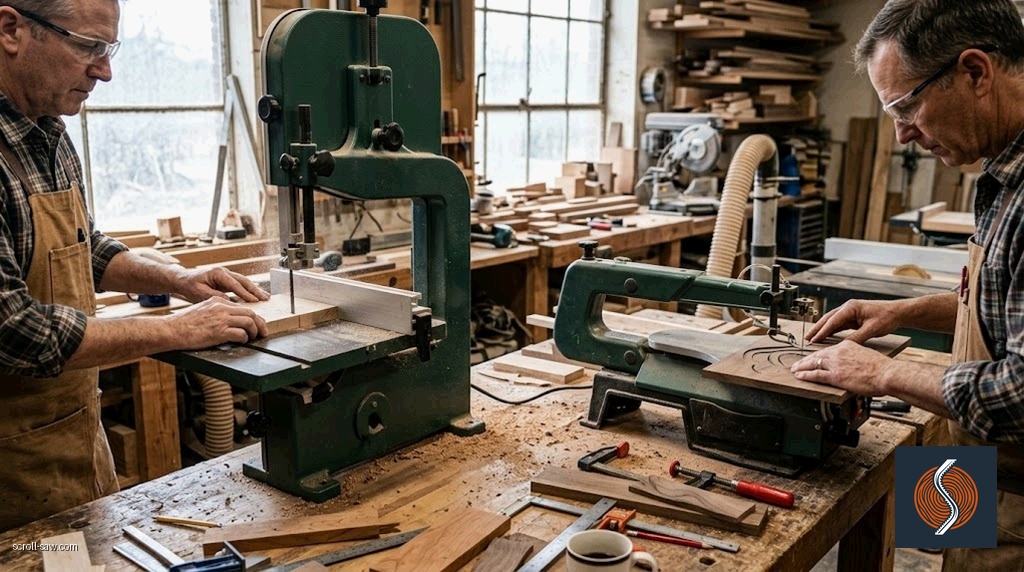
Is a Bandsaw the Same As a Scroll Saw? A Practical Comparison for Woodworkers
A new woodworker looks at a bandsaw and a scroll saw side by side, notices they both cut curves in wood, and asks the natural question: do I need both? The answer is that they are related tools solving different problems, and most serious hobby shops eventually own both because each does things the other cannot.
But for a new woodworker or a small shop with limited budget, choosing the right one first matters. This article covers what each tool actually does, where they overlap, where they do not, and how to decide which fits your work.
Direct answer
A bandsaw and a scroll saw are different tools that both cut curves in wood but solve different problems. A bandsaw uses a continuous loop blade running vertically, is designed for thick stock and rougher curved cuts, and can rip and resaw. A scroll saw uses a short reciprocating blade, is designed for thin stock and fine detail cuts including interior cuts through starter holes, and cannot rip or resaw.
The mechanical difference
Start with the machines themselves.
Bandsaw. A continuous loop blade runs vertically over two large wheels (three on some models). Blade width ranges from about 1/8 inch to 1 inch or more. The blade only cuts on one edge (typically the front) and runs continuously in one direction. Blade guides and thrust bearings keep it stable.
Scroll saw. A short (about 5 inches) straight blade is held under tension between two arms and reciprocates up and down at 400-1800 strokes per minute. Blade thickness is very small; blade width is very narrow (some scroll saw blades are the width of a hair). Blade is easily removable and can be threaded through a starter hole for interior cuts.
Different mechanisms produce different capabilities.
What a bandsaw does well
Thick stock cutting. A bandsaw can cut through 6 inches or more of hardwood, depending on the saw. Standard hobby bandsaws handle 6 inches; industrial models handle much more.
Resawing. Cutting a thick board into thinner boards along the grain. A bandsaw with a wide blade and proper technique produces book-matched or resawn stock that cannot be efficiently made any other way.
Ripping curved shapes. Curved cuts in thick stock with a moderately wide blade.
Straight cutting with a fence. With a good fence, a bandsaw makes accurate straight rip cuts.
Rough shape cutting. Cutting a rough shape from a large piece of stock, to be refined later on other tools.
Green wood work. Bandsaws handle green (wet) wood well; scroll saws do not.
Meat and non-wood work. Bandsaws with appropriate blades cut meat, plastic, and even some metals.
What a scroll saw does well
Fine detail cuts. The narrow blade cuts curves too tight for any other saw. Interior details, portraits, and intricate fretwork are scroll saw territory.
Interior cuts. By threading the blade through a starter hole, a scroll saw makes cuts inside a piece without cutting from the edge. Bandsaws cannot do this without cutting in from the edge, which is often unacceptable.
Thin stock. 1/4 inch and thinner stock scroll saws through cleanly. Bandsaws can cut thin stock but often chip the top face and require careful fence setup.
Intarsia and marquetry. Precise curved cuts in thin veneer or thin stock, where multiple pieces must fit together perfectly.
Puzzle cutting. Complex interlocking cuts.
Stack cutting. Multiple thin pieces taped together, cut as one, producing matched pieces. Bandsaws can do this but with less precision.
Pattern work. Following intricate pattern lines is easier on a scroll saw’s narrow blade.
Where they overlap
A few tasks either tool can handle.
Mid-thickness curves. 1/2 to 3/4 inch stock with gentle curves is comfortable on both tools. Choose based on which is already set up and what other cuts the piece needs.
Rough curved cutting followed by sanding. For cuts that will be sanded to shape anyway, either tool works.
Cutting small stock to shape. Both can handle small pieces, though scroll saws are safer for very small pieces because the smaller reciprocating blade is easier to control than a bandsaw blade.
Beyond these, the tools solve different problems.
Where they do not overlap
Bandsaw only. Resawing. Cutting stock over 2 inches thick. Ripping long boards. Green wood. Cutting metal or meat. Fast straight rip cuts.
Scroll saw only. Interior cuts through starter holes. Portrait detail work. Very tight curves. Intarsia and marquetry-precision cuts. Fretwork with the finest blades.
These non-overlapping capabilities are what determine which tool you need first.
Which one to buy first
Depends on the work.
Buy a bandsaw first if: you work with lumber (rough boards to dimensional stock), resawing matters to your projects, you build furniture, you work with stock over 3/4 inch thick, you want one saw that handles most curved cuts, or your projects involve mostly gentle curves in thicker material.
Buy a scroll saw first if: your work involves fine detail in thin stock (ornaments, portraits, fretwork), you need interior cuts through starter holes, your projects are jewelry or small craft scale, or you specifically want to do puzzle cutting, intarsia, or marquetry.
Most serious hobby woodworkers eventually own both because the tools do different things and both come up in real projects.
Common misconceptions
“A bandsaw can do everything a scroll saw does.” False. Bandsaws cannot make interior cuts starting from a drilled hole. Bandsaws cannot handle the fine detail scroll saws are designed for.
“A scroll saw is just a smaller bandsaw.” False. Different mechanism, different capabilities. Scroll saws are not a subset of bandsaw functionality.
“You only need one or the other.” True for beginners; false for most serious hobbyists. Both tools solve different problems that come up in real projects.
“A jigsaw is a portable bandsaw or scroll saw.” False. A jigsaw is a rough hand-held cutting tool, not a substitute for either bench saw for detail work.
Verdict
A bandsaw and a scroll saw are related tools solving different problems. Bandsaws handle thick stock, resawing, and general curved cuts in real dimensional lumber. Scroll saws handle fine detail, thin stock, interior cuts, and intricate pattern work.
Choose based on the work you actually do. If you work with dimensional lumber and thick stock, buy a bandsaw first. If you work with fine detail in thin stock, buy a scroll saw first. Most serious woodworkers eventually own both.
They are not the same tool. Trying to substitute one for the other produces frustration and poor results.
FAQ
Can a bandsaw cut as thin as a scroll saw blade? No. Bandsaw blades are wider than scroll saw blades. The narrowest bandsaw blades cannot cut the tight interior curves that scroll saw blades handle.
Can a scroll saw cut as thick as a bandsaw? Most scroll saws handle up to 2 inches physically. Practical cutting is thinner. Bandsaws handle 6 inches or more comfortably.
Which is more dangerous, a bandsaw or a scroll saw? Both require respect. Bandsaws have larger blades and can cause more severe injury. Scroll saws have less dangerous blades but can still injure. Follow standard safety practices with either.
Can I use a scroll saw blade in a bandsaw or vice versa? No. The blade holders, tension requirements, and mechanisms are completely different.
Which is louder, a bandsaw or a scroll saw? Depends on the specific machines. Modern scroll saws are typically quieter than bandsaws. Larger bandsaws with substantial motors can be quite loud.
Do I need both a bandsaw and a scroll saw? Eventually, if your work spans both thick lumber work and fine detail work. Start with the one that fits your current projects and add the other when a project requires it.
Can a scroll saw do resawing? No. Resawing requires a wide blade and a continuous motion; scroll saws have neither. Resawing is a bandsaw job.


