
Is a Scroll Saw the Same As a Jigsaw? Purpose, Fit, and Practical Differences
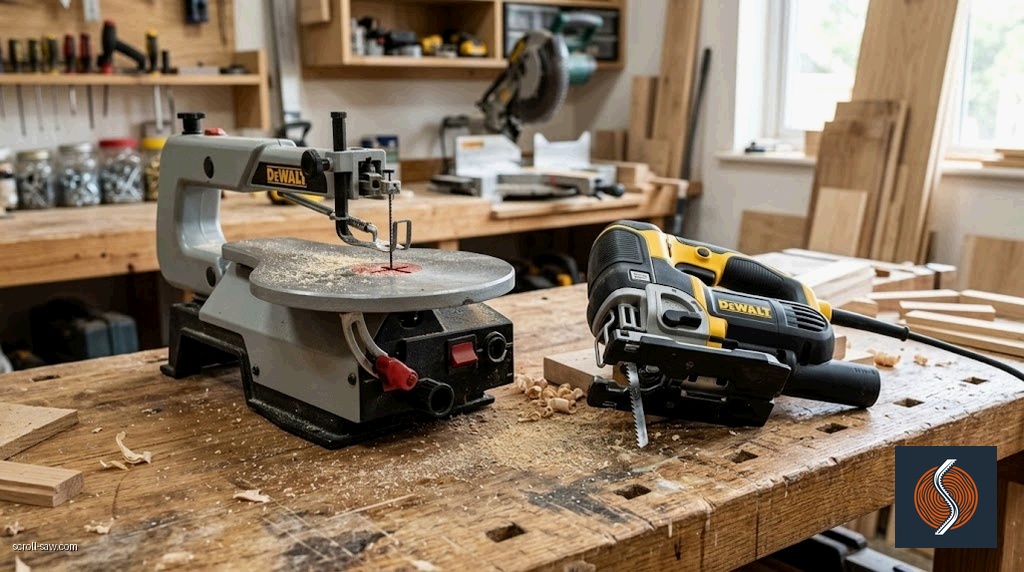
Is a Scroll Saw the Same As a Jigsaw? Purpose, Fit, and Practical Differences
One of the most common questions in beginner woodworking forums is whether a scroll saw and a jigsaw are the same tool. Both cut curves. Both have reciprocating blades. Both look somewhat similar in marketing photos. And in some parts of the world (particularly the U.K.), scroll saws are sometimes called “jigsaws,” which adds to the confusion.
They are not the same tool. They solve different problems and are designed for different workflows. This article separates them clearly.
Direct answer
A scroll saw and a jigsaw are different tools. A scroll saw is a benchtop machine that holds a short, thin reciprocating blade under tension between two arms, designed for fine detail cutting and interior cuts. A jigsaw is a handheld power tool with a single-ended reciprocating blade, designed for rough curved cutting in construction and general woodworking. They cannot substitute for each other for most work.
The physical difference
Scroll saw. Benchtop machine. Weighs 30-80 pounds. Stays on a workbench. The blade is held under tension between an upper and lower arm, both of which reciprocate together. The blade is short (about 5 inches) and very thin. The operator moves the workpiece under a stationary blade.
Jigsaw. Handheld power tool. Weighs 5-8 pounds. Portable. The blade is clamped only at the top; the bottom end swings free. The blade is single-ended and thicker than a scroll saw blade. The operator moves the tool over a stationary workpiece.
Different physical designs mean different use cases.
What a scroll saw does well
Fine detail cuts. The thin blade navigates tight curves and interior detail that no jigsaw can approach.
Interior cuts through starter holes. The blade can be released from the top clamp, threaded through a drilled hole, and re-clamped to cut interior shapes. Jigsaws can plunge-cut interior holes but with much less precision.
Thin stock. Handles 1/8 to 1/4 inch stock without tearout when set up correctly.
Pattern work. Following intricate pattern lines is easier with the thin blade.
Portraits, fretwork, intarsia, marquetry. All scroll saw work.
Stationary work. The workpiece rests on the table and moves under two-handed control. This produces more accurate cuts than moving a tool over a stationary workpiece.
What a jigsaw does well
Rough curved cuts in construction lumber. Cutting curves in 2x lumber, plywood sheets, dimensional stock.
Cutting curves in installed material. A jigsaw fits in tight spaces and can cut around obstacles that a benchtop saw cannot approach.
Large workpieces. Cutting a curved shape from a full sheet of plywood is a jigsaw job; a scroll saw’s throat is far too small.
Portability. On the job site, in the field, at a customer’s home. Scroll saws stay in the shop.
Plunge cuts through the middle of material. Jigsaws with plunge-cut capability can start a cut without a starter hole. Precision is less than scroll saws through starter holes.
Non-wood materials. With appropriate blades, jigsaws cut plastic, thin metal, laminate flooring, and other construction materials.
Where they overlap
Few tasks are equally suited to both.
Rough curved cuts in mid-thickness plywood or lumber. Both can do this. Jigsaw is faster and more portable; scroll saw is more precise.
Cutting a shape from small stock. Either works, though the scroll saw is more precise and the jigsaw is quicker to set up if the workpiece is small.
Interior cuts. Jigsaw with plunge-cut or a starter hole; scroll saw with a starter hole. Scroll saw is more precise.
Beyond these limited overlaps, the tools solve different problems.
Where they do not overlap
Scroll saw only. Fine detail cuts (portraits, fretwork). Intricate interior patterns. Intarsia and marquetry. Precision stack cutting. Puzzle cutting. Any work requiring the finest curved cuts in wood.
Jigsaw only. Large-scale curved cuts. On-site or in-place cutting. Cutting in installed material. Rough cuts in construction lumber. Portable cutting.
These non-overlapping applications are where the tools each belong.
Which one to buy first
Depends entirely on the work.
Buy a jigsaw first if: you do general woodworking or construction, work with sheet goods and dimensional lumber, need portability, work on installed materials, or your curves are gentle and roughly cut rather than intricate.
Buy a scroll saw first if: your work involves fine detail (ornaments, portraits, fretwork), you need interior cuts through starter holes with precision, your projects are jewelry or small craft scale, or you specifically want to do intarsia, marquetry, or intricate pattern work.
Most woodworkers eventually own both because the two tools cover very different applications.
Common misconceptions
“A jigsaw is just a hand-held scroll saw.” False. Very different mechanisms, precision levels, and use cases.
“You can do fretwork with a jigsaw.” Not meaningfully. Jigsaw blades are too wide and the tool’s handheld nature too imprecise for fretwork.
“A scroll saw can replace a jigsaw for construction work.” False. Scroll saws are stationary and have small throat depths. They cannot cut large sheet goods or work on installed material.
“Jigsaw blades and scroll saw blades are interchangeable.” Completely false. Different lengths, different clamp mechanisms, different blade profiles.
“UK jigsaws are the same as US scroll saws.” The term “jigsaw” in the UK can refer to what Americans call a scroll saw, but that is a naming convention, not a technical statement. The tools themselves remain physically different.
Verdict
A scroll saw and a jigsaw are different tools that both cut curves in wood but solve different problems. Scroll saws handle fine detail, interior cuts, and thin stock work. Jigsaws handle rough curves in dimensional lumber, portable cutting, and on-site work. Neither substitutes for the other in most applications.
Choose based on the work you actually do. Fine detail on the bench: scroll saw. Rough curves in the field or on large stock: jigsaw. Serious hobbyists and professionals often own both.
Do not try to substitute one for the other. The results are usually frustrating and often unsafe.
FAQ
Can a jigsaw replace a scroll saw? For rough curved cuts in construction lumber, yes. For fine detail, interior cuts, and pattern work, no.
Can a scroll saw replace a jigsaw? For small detail work in thin stock, yes if a jigsaw was your only option before. For large-scale cuts, on-site work, or installed material, no.
Do scroll saw blades fit a jigsaw? No. Different lengths, different clamp mechanisms.
In the UK, what is a jigsaw? The term is sometimes used for what Americans call a scroll saw. In modern use, most UK woodworkers use “jigsaw” for the handheld tool and “scroll saw” or “fret saw” for the benchtop tool, matching American usage.
Which is safer, a jigsaw or a scroll saw? Both require respect. Jigsaws can jump if the blade binds; scroll saws have exposed reciprocating blades. Follow standard safety practices for each.
Do I need both tools? If your work spans both fine detail and general construction, eventually yes. Start with the tool that fits your current projects.
Can I do fretwork with a jigsaw? No. Jigsaw blades are too wide and the tool is too imprecise for fretwork.


