
Jigsaw vs Scroll Saw: How to Pick the Right One for Your Project
Jigsaw vs Scroll Saw: How to Pick the Right One for Your Project
Jigsaw vs scroll saw is one of the first comparisons a hobbyist woodworker hits. Both cut curves. Both appear in tutorials alongside beautiful curved pieces. Both are available at the same price point. Picking the wrong one for the first purchase means six months of fighting the wrong tool before buying the right one.
The comparison is not about which tool is better. It is about which one your actual projects need. This article makes that concrete.
Direct answer
A jigsaw cuts curves in thick dimensional lumber and sheet goods, is portable, and is the right tool for rough or large-scale curved cuts. A scroll saw cuts curves in thin stock with fine detail, stays on a workbench, handles interior cuts through starter holes, and is the right tool for ornaments, portraits, fretwork, puzzles, and intricate pattern work. Choose based on your projects, not general popularity.
How the tools work
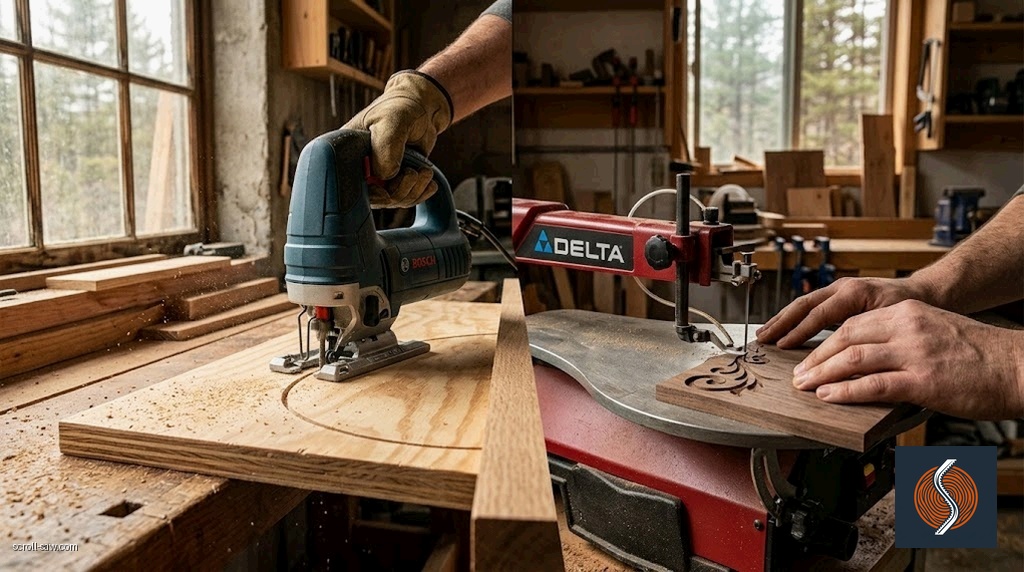
Jigsaw. Handheld. Blade clamps at the top; bottom end swings free. Operator moves the tool over a stationary workpiece. Blade is 3-4 inches long and wider than a scroll saw blade. Accepts T-shank or U-shank blades in many profiles. Cuts in a reciprocating motion with optional orbital (aggressive) action.
Scroll saw. Benchtop machine. Blade held under tension between two arms (top and bottom). Operator moves the workpiece under a stationary blade. Blade is about 5 inches long and very thin. Accepts pin-end or pin-less blades in sizes from coarse (#12) down to hair-thin (#2/0). Cuts in a pure vertical reciprocating motion.
The different designs produce different capabilities and different strengths.
Comparison by task
Rough curved cuts in plywood or lumber
-
Jigsaw: excellent, fast, portable
-
Scroll saw: capable but slower, table limits large sheets
-
Winner: jigsaw
Fine detail curves
-
Jigsaw: poor, blade too wide for tight curves
-
Scroll saw: excellent, narrow blade handles very tight turns
-
Winner: scroll saw
Interior cuts (holes inside a piece)
-
Jigsaw: plunge-cut possible but imprecise
-
Scroll saw: thread blade through starter hole, precise
-
Winner: scroll saw
Straight cuts
-
Jigsaw: good with a guide or fence
-
Scroll saw: possible with a fence but not the tool’s strength
-
Winner: jigsaw, or a table saw for serious straight cuts
Thick stock (over 1 inch)
-
Jigsaw: very good, up to 3-4 inches with right blade
-
Scroll saw: limited to about 2 inches max, slower
-
Winner: jigsaw (or bandsaw for thicker stock)
Thin stock (under 1/4 inch)
-
Jigsaw: tends to chatter, can chip thin faces
-
Scroll saw: excellent, smooth in thin veneer
-
Winner: scroll saw
Portrait or fretwork patterns
-
Jigsaw: cannot do this
-
Scroll saw: designed for exactly this
-
Winner: scroll saw
On-site or installed cuts
-
Jigsaw: yes, portable
-
Scroll saw: no, benchtop only
-
Winner: jigsaw
Large sheet goods
-
Jigsaw: yes
-
Scroll saw: no, throat depth too small
-
Winner: jigsaw
Puzzle cutting
-
Jigsaw: no
-
Scroll saw: yes
-
Winner: scroll saw
Specific project match
A decision framework.
Your project needs scroll saw if:
-
Interior cuts (shapes within a piece without cutting from the edge)
-
Fine detail patterns (portraits, fretwork, layered art)
-
Thin stock (ornaments, 1/8-inch or 1/4-inch)
-
Intarsia or marquetry (precisely fitting cut pieces)
-
Stacked craft cuts where pieces must match exactly
-
Puzzle cutting
Your project needs a jigsaw if:
-
Large, gentle curves in sheet goods or dimensional lumber
-
On-site or in-place cutting
-
Thick stock
-
Rough shapes to be refined by other means
-
Construction applications
-
Portability required
Either tool works for:
-
Simple gentle curves in mid-weight plywood (1/2-inch or 3/4-inch)
-
Small pieces where precision is not critical
Most projects sort cleanly into one category.
Cost comparison
At the entry level, both are available for similar prices. At the mid-range and above, scroll saws tend to cost more than jigsaws in the same tier because scroll saw performance differences are more significant between price points.
A mid-range jigsaw (Bosch, Dewalt, Makita) is a solid long-term tool. A mid-range scroll saw is functional but shows limitations on detailed work.
A good scroll saw (Dewalt DW788 or better) costs more than a good jigsaw and rewards the investment more directly for detail work. A good jigsaw works well at most price points.
Accessories and running costs
Blades. Both require specific blades. Jigsaw blades are widely available and relatively inexpensive. Scroll saw blades are smaller (a pack of a dozen fits in a shirt pocket) and typically last a shorter time per blade for fine work. Running costs are similar for similar volumes of cutting.
Setup time. A jigsaw is out of the bag and cutting in thirty seconds. A scroll saw requires a few minutes of blade change, tension, and squareness verification.
Workspace. A jigsaw stores in a small case. A scroll saw takes bench space permanently or takes five minutes to set up and put away.
What most hobbyists actually buy first
Most general hobbyist woodworkers have a jigsaw before they have a scroll saw, because jigsaws are in every general hardware store, show up in every beginner toolkit, and handle rough curved cuts that come up in all kinds of projects.
Scroll saws are typically the second purchase, after a specific project (ornaments, a portrait, a puzzle) makes clear that the jigsaw cannot do the work.
If you are entirely new to both: buy a jigsaw for general use. Add a scroll saw when a specific project requires fine detail.
Verdict
Jigsaw vs scroll saw is a false competition. They solve different problems and most serious hobbyists eventually own both.
Buy a jigsaw first if your work is general woodworking with rough curves and thick stock. Buy a scroll saw first if your work is specifically fine detail in thin stock. Let your actual project list make the decision.
If the project list includes portrait work, ornaments, fretwork, or puzzles, that is a scroll saw. If the project list includes furniture curves, on-site cuts, and sheet goods, that is a jigsaw. If it includes both, eventually both are the right answer.
FAQ
Can a jigsaw replace a scroll saw? For rough curved cuts in thick stock, yes. For fine detail, portraits, interior precision cuts, and thin stock work, no.
Can a scroll saw replace a jigsaw? For small detail pieces, partially. For large-scale cuts, on-site work, or thick stock, no.
Which is better for beginners, jigsaw or scroll saw? Depends on the beginner’s projects. A jigsaw is generally more versatile for a beginning woodworker. A scroll saw is the better first tool for a beginner focused on crafts, ornaments, and detail work.
Do professional woodworkers use both? Yes. Professional furniture makers and construction carpenters use jigsaws daily. Professional scroll saw artists use scroll saws daily. Different professions; often both tools in a full shop.
Can I do intarsia with a jigsaw? Not meaningfully. Intarsia requires precise cuts in thin stock with fine detail; jigsaw blades are too wide and the tool too imprecise.
Which cuts wood more cleanly, jigsaw or scroll saw? Scroll saw, for fine work in thin stock. Jigsaw, for fast rough cuts in thick stock. Each is clean for its intended work.
Is a scroll saw quieter than a jigsaw? Depends on the specific models. Modern scroll saws are typically quieter than jigsaws running at full speed. The scroll saw’s continuous low buzz is generally less intrusive than a jigsaw’s aggressive reciprocation.


