
Laser Cut vs Scroll Saw Patterns: How to Use Each and When They Cross Over
Laser Cut vs Scroll Saw Patterns: How to Use Each and When They Cross Over
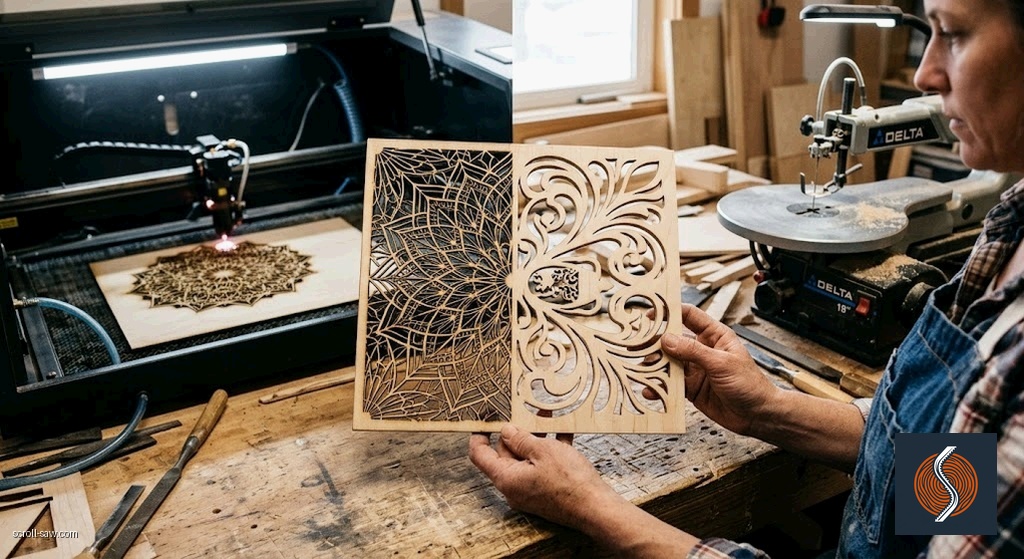
Laser cut and scroll saw patterns appear side by side in craft shops, pattern books, and online stores. To someone who has not worked with both, they look nearly identical. Both produce intricate wood cuts with fine details and crisp lines. The tools that make them, the skills required, and the results they produce are substantially different.
This article covers what laser-cut patterns are, how they relate to scroll saw work, where the two technologies cross over, and where each one produces results the other cannot.
Direct answer
Laser-cut scroll saw patterns are pattern files or pre-cut guides produced with a laser cutter, but the actual woodcutting is still done on a scroll saw. The “laser cut” refers to how the pattern template is made, not how the wood is cut. Scroll saws and laser cutters both produce detailed cuts in wood but are completely different machines; a laser cutter uses heat to vaporize material, while a scroll saw uses a blade to remove it.
What people mean by “laser cut scroll saw patterns”
The phrase is used in two different senses.
Laser-produced pattern templates. Pattern lines cut or engraved into a thin sheet (paper, thin plywood, acrylic) using a laser cutter. These templates are used to mark the design onto the scroll saw workpiece, similar to how a printed pattern is used. Precise, repeatable, and easy to transfer.
Scroll saw-style patterns for laser cutters. Intricate fretwork-style patterns designed to be executed on a laser cutter rather than a scroll saw. These produce scroll-saw-looking results via a completely different machine.
For scroll saw workers, the relevant meaning is the first: using laser-produced templates to guide scroll saw cutting. For laser cutter owners, the relevant meaning is the second: applying scroll saw aesthetics to laser cutting.
Using laser-cut templates with a scroll saw
A laser-cut template is a precise guide for transferring a pattern onto the scroll saw workpiece.
Why use a laser-cut template instead of a printed pattern?
-
Precision: laser-cut lines are exact, repeated identically every time
-
Durability: a template cut into thin plywood or acrylic survives hundreds of transfers
-
Tracing accuracy: tracing a groove is more accurate than tracing over a printed line
-
Commercial use: a durable template speeds production when the same pattern repeats
How to use a laser-cut template:
-
Position the template on the workpiece and secure with clamps or tape.
-
Trace the pattern lines onto the workpiece with a fine pencil or a marking awl.
-
Remove the template.
-
Scroll saw to the marked lines.
Alternatively: spray-mount a printed paper pattern directly to the workpiece and cut through the paper along with the wood. This is often faster than tracing a template for one-off cuts.
Scroll saw vs laser cutter for the same design
The two tools produce visually similar results by completely different means.
Scroll saw. Blade removes material. Cut width is very narrow (width of the blade). Cut edges are smooth wood that can be sanded and finished. All finishes (stain, paint, oil, wax) work on the cut surface. Three-dimensional detail is possible by tilting the table. Stack cutting produces multiple identical pieces from one pass.
Laser cutter. Heat vaporizes material. Cut width (kerf) varies by material thickness and settings. Cut edges are charred (dark, carbon-stained) and require cleaning or sanding before most finishes. Some materials cannot be laser cut safely (PVC, certain plastics). Extremely precise and fast for repeatable production.
Where a scroll saw does things a laser cannot
Interior curves with variable kerf. A scroll saw blade’s kerf varies slightly with operator technique, which allows inside corners to be cut differently from long curves. A laser’s kerf is mechanically fixed.
Beveled cuts. Tilting the scroll saw table produces beveled interior profiles useful for inlay and intarsia. A standard laser cutter produces perpendicular cuts only.
Thick stock. Most hobby laser cutters handle up to about 1/4 inch of hardwood. Scroll saws handle up to 2 inches or more.
Green or fresh wood. Laser cutters require consistent dry material for predictable kerf. Scroll saws handle a wider range of material conditions.
Traditional hand skills. Scroll saw work involves direct hand-guided skill that produces pieces with individual character. Laser cutting is typically computer-directed and produces identical copies. Both have value; which matters depends on the maker’s intentions.
Where a laser cutter does things a scroll saw cannot
Speed on thin stock. A laser cutter is dramatically faster than a scroll saw for production work in thin material.
Engraving. Laser cutters etch surface detail, text, and photos. Scroll saws cannot engrave.
Repeatability. Computer-directed cuts are identical every time, regardless of operator.
Very tight features. Laser kerfs can be narrower than the finest scroll saw blade, allowing features too small for any scroll saw blade.
Complex geometry without manual turning. The laser head moves automatically; no workpiece rotation required.
Using scroll saw patterns on a laser cutter
Scroll saw patterns are widely used as source files for laser cutting. The fretwork aesthetic works well on either machine. A few adjustments.
Kerf compensation. Scroll saw patterns assume hand-guided cuts with some variation. Laser cuts are exact; adjust inside dimensions to account for the fixed laser kerf.
Material limits. Laser cut patterns typically assume thinner material (1/8 inch to 1/4 inch) than scroll saw work often uses.
Edge finish. Laser-cut edges are charred. Expect to sand or seal edges if the pattern will be displayed closely.
Copyright. Many scroll saw patterns are sold for scroll saw use only. Using them on a laser cutter may or may not be covered by the purchase license. Check before using commercially.
Verdict
Laser-cut scroll saw patterns are either laser-produced templates for use on a scroll saw, or scroll saw-style patterns adapted for laser cutting. Both uses are legitimate and practical.
The tools themselves are complementary rather than competing. Scroll saws excel at thick stock, hand-guided character, beveled cuts, and the traditional craft skill of the process. Laser cutters excel at speed, repeatability, engraving, and very tight features.
For most scroll saw hobbyists, the laser cutter is not replacing the saw but offering a way to produce or use patterns more precisely. For someone running a production craft business, a laser cutter and a scroll saw serve different parts of the product line.
FAQ
What is a laser cut scroll saw pattern? Either a template cut with a laser cutter to guide scroll saw work, or a scroll saw-style pattern adapted for execution on a laser cutter.
Can I use scroll saw patterns on a laser cutter? Yes, with adjustments for kerf and material thickness. Check the pattern’s use license before using commercially.
Is a laser cutter better than a scroll saw? Neither is universally better. Laser cutters are faster and more precise for production in thin material. Scroll saws handle thick material, produce hand-guided work, and allow beveled cuts. Different tools for different purposes.
Can a laser cutter replace a scroll saw? For thin-material production with identical pieces, a laser cutter is often more efficient. For thick stock, beveled cuts, traditional hand work, and projects where the process matters, a scroll saw is still the appropriate tool.
How do I make a laser cut template for scroll saw work? Design the pattern in vector drawing software, send it to a laser cutter on thin plywood or acrylic, use the resulting template to transfer the design to scroll saw workpieces.
Do laser cut edges need to be sanded? Usually yes for display pieces. Laser charring on cut edges is visible and does not accept most finishes cleanly. Sand or seal before finishing.
Can a laser cutter cut thick wood? Most hobby laser cutters handle up to about 1/4 inch of hardwood. Industrial laser cutters can handle thicker material. Scroll saws handle up to 2 inches or more.


