
Lumber Scroll Saw Work: Choosing Stock, Setting Up, and Avoiding Common Failures
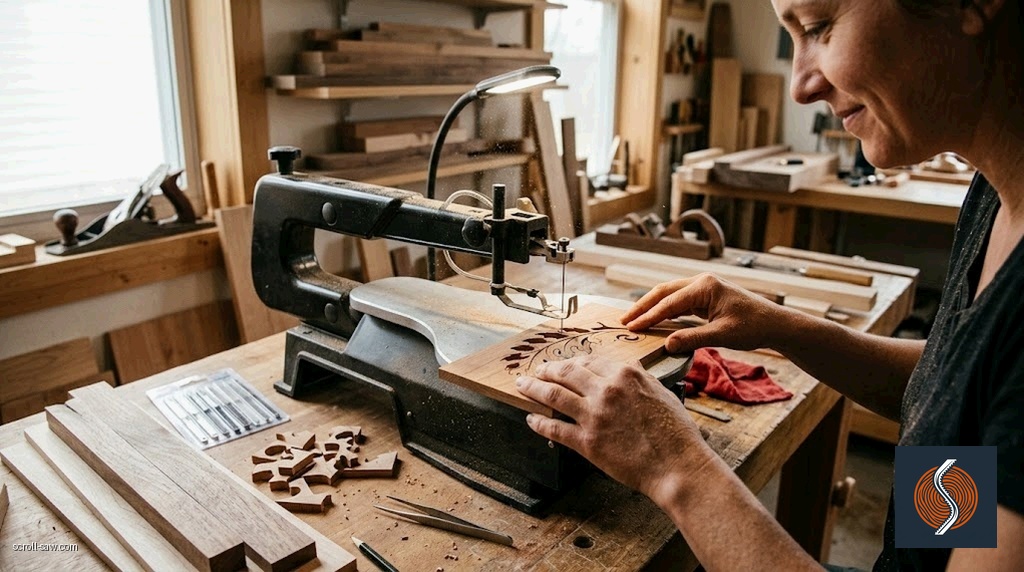
Lumber Scroll Saw Work: Choosing Stock, Setting Up, and Avoiding Common Failures
Most scroll saw work happens in thin craft plywood, basswood, or Baltic birch, and the patterns, blade charts, and beginner guides all assume you are working there. When you bring actual dimensional lumber to the scroll saw, the tool behaves differently, the blade selection changes, and the failure modes are different from anything the beginner materials warned you about.
This does not mean lumber is wrong for scroll saw work. Some of the most impressive scroll saw output comes from solid hardwood in real thickness. You just have to know what the material is going to do before you cut it.
Direct answer
Lumber scroll saw work requires dry, defect-free, straight-grained stock under about 1.5 inches in most hobby saws, a step up in blade size for the thickness, slower feed rate, more frequent blade changes, and realistic expectations about cut quality compared to thin plywood. Dense hardwoods (oak, maple) require more attention to setup than softer lumber (basswood, cherry, alder).
Choosing lumber for scroll saw work
Not all lumber behaves the same on a scroll saw.
Grain direction matters. Straight-grained wood cuts cleanly across its width. Diagonal or interlocked grain causes the blade to wander following the grain line. Choose boards with straight, visible grain lines.
Density determines difficulty. Soft lumber (pine, basswood, butternut, alder, poplar) cuts easily and cleanly with standard blades. Medium hardwoods (cherry, walnut, mahogany) cut well but need more blade changes. Dense hardwoods (oak, maple, hickory) are slow, hard on blades, and require proper tension management.
Moisture content is critical. Freshly cut or damp lumber moves as it dries. A board that is flat today can cup or bow by the time you finish a long cut. Work with lumber that has been dried to indoor equilibrium (around 6-8 percent in most climates). Green wood is almost always wrong on a scroll saw.
Defects to avoid. Knots, checks (cracks along the grain), pitch pockets, and grain reversals all cause the blade to behave unpredictably at worst and produce tearout at best. These defects are manageable in furniture work; on a scroll saw they often ruin the piece.
Thickness realistic for your saw. Most hobby scroll saws can physically accept 2 inches, but practical cutting in hardwood is more comfortable under 3/4 inch for most scroll saw work. Thick hardwood cuts slowly, dulls blades quickly, and requires a motor that can handle the load.
Blade selection for lumber
Step up blade size compared to thin craft stock.
| Lumber thickness | Recommended blade | Notes |
|---|---|---|
| 1/4 inch soft | #5 reverse-tooth | Standard for pine, basswood |
| 1/4 inch hardwood | #5 or #7 | Cherry, walnut, alder |
| 1/2 inch soft | #7 | Pine, poplar |
| 1/2 inch hardwood | #7 or #9 | Oak needs #9 |
| 3/4 inch soft | #9 | |
| 3/4 inch hardwood | #9 or #12 | Expect frequent blade changes |
| Over 1 inch soft | #12 | Consider a bandsaw instead |
| Over 1 inch hardwood | #12, slow feed | Bandsaw is often better |
Feed rate and speed
Lumber rewards patience.
Slower feed than thin stock. The blade has more material to remove per stroke. Rushing produces heat, burning, and drift. Slow the feed to the point where the blade is actually removing material, not pushing against it.
Medium to high saw speed for most lumber. Slower saw speed is easier on fine blades. For larger blades in thick lumber, medium-to-high speed (1000-1800 SPM) produces cleaner cuts than very slow.
Stop and cool if burning appears. A light scorch line on the cut edge means the blade is heating up. Back the workpiece out, let the blade run a moment in open air, then re-enter the cut. Persistent burning means the blade is dull; change it.
Change blades more often than in thin stock. The lifespan of a blade in 3/4-inch hardwood is a fraction of what it is in 1/4-inch plywood. A dull blade in thick stock produces burn marks and drift; the saw is telling you it is done.
Setup adjustments for thick lumber
Increase blade tension. Thicker material pushes the blade sideways more. Tension needs to be higher to counteract this. Tension until the blade rings; then go slightly higher.
Check blade square after tensioning. High tension can reveal small errors in the blade holder alignment that did not affect thin stock. Re-square if needed.
Hold-down adjusted for thickness. The hold-down foot needs to be positioned correctly for the actual thickness, not left at the previous setting.
Verify table is flat and level. Thick lumber warps during the cut if the table is not level. The piece can bind against the blade.
Support long pieces. A long board feeding into the saw can tip if unsupported on the far end. Use a roller stand or a second table at the same height.
Pattern considerations for lumber work
Patterns designed for thin plywood do not always work in thick solid wood.
Interior cuts get harder. Threading a blade through a starter hole in 3/4-inch hardwood, tensioning correctly, and cutting a precise interior curve is demanding. Fine blade work inside thick hardwood is not beginner territory.
Patterns with tight interior detail need thinner stock. If the pattern has detail finer than about 1/8 inch, use stock at 1/4 inch or thinner. Detail that looks manageable in a pattern photo was often cut in thin material.
Stack cutting is effective for thin lumber. Multiple pieces of thin lumber taped together produce matching pieces from one cut, and the stack is more manageable than one thick piece.
Common problems and fixes
Blade burns wood. Dull blade (change it), feed too slow, or blade too small for the thickness. Fix the cause.
Drift off the pattern line. Under-tension, grain following the blade, or blade too fine. Increase tension; step up blade size; choose straighter-grained stock.
Blade breaks near the clamp. Pushing too hard, blade end not seated correctly, or wrong blade for the thickness.
Tearout on the bottom face. Use a reverse-tooth blade with the piece show-face down, or apply painter’s tape to the bottom before cutting.
Lumber cups or warps mid-cut. Moisture content not fully equalized. Dry the wood properly before cutting; do not cut fresh lumber.
Saw bogs down. Motor underpowered for the wood density and thickness. Step up the blade, slow the feed, and accept that some combinations require a bandsaw or a more powerful saw.
Verdict
Lumber scroll saw work is rewarding and produces pieces with a depth and character that thin craft plywood cannot. Solid cherry, walnut, or alder under a clear finish is a different object than a plywood ornament.
The adjustments are real: larger blades, slower feed, more tension, drier and straighter-grained stock, and realistic expectations about how quickly blades wear. Work within those adjustments and lumber becomes a natural scroll saw material. Ignore them and the frustration is immediate.
If you are just beginning with lumber, start in basswood or alder at 1/2 inch. Learn what thick soft wood feels like before moving to oak or maple. The skills transfer; the shock of the first dull blade in hard thick lumber transfers less well.
FAQ
Can a scroll saw cut 2x4 lumber? Physically in most saws, yes. Practically, a 2x4 at 1.5 inches in pine cuts slowly and dulls blades fast. A bandsaw is a better tool for cutting dimensional 2x4 stock. A scroll saw is appropriate for decorative work in thin lumber.
What lumber works best on a scroll saw? Basswood, alder, and cherry are commonly used for scroll saw work in solid wood. All have fine, straight grain and cut cleanly. Avoid highly figured wood (bird’s-eye, curly) for scroll saw projects; the irregular grain causes drift.
Can I use pine for scroll saw work? Yes. Clear pine (no knots) cuts cleanly. Knotty pine is difficult; blades deflect around knots and knots can come out of the piece during cutting.
How do I prevent tearout on the bottom of lumber? Use a reverse-tooth blade with the show face down. The reverse teeth cut cleanly on the upstroke, leaving the bottom face (your show face) clean.
Does grain direction matter for scroll saw cutting? Yes. The blade tends to follow grain lines rather than stay on the pattern line. Straight-grained lumber is much easier to cut in curves than grain-irregular stock.
Why does my blade keep burning in hardwood? Usually a dull blade, feed too slow, or blade too fine for the thickness. Change the blade first. If burning returns quickly, step up to a larger blade size.
How thick should lumber be for scroll saw ornaments? 1/4 inch to 1/2 inch is the most workable range for decorative pieces. Thicker is possible but slows production and wears blades faster.


