
Makita 5500B Scroll Saw: Setup, Performance, and Honest Assessment
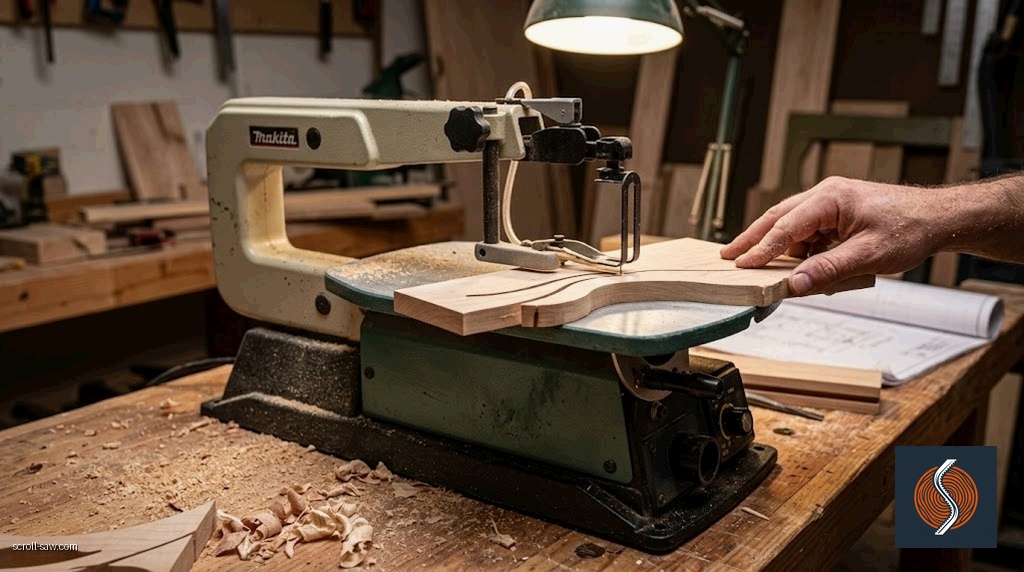
Makita 5500B Scroll Saw: Setup, Performance, and Honest Assessment
The Makita 5500B is the model that most people find when searching for a Makita scroll saw on the used market. It was a widely sold 18-inch scroll saw that earned a good reputation during its production run for solid construction and reliable operation. Units turn up regularly at estate sales and tool dealers, usually priced significantly below what a comparable new saw costs.
This article covers what the 5500B offers, what its limitations are, and the setup steps that bring a used unit back to full performance.
Direct answer
The Makita 5500B is an 18-inch bench scroll saw with a cast aluminum table, variable speed, and a parallel-arm design that produces a clean vertical stroke. It uses 5-inch pin-less blades and is well-suited to hobby work in 1/4-inch to 3/4-inch stock. Setup priorities on a used unit are blade clamp inspection, tension spring condition, and table squareness.
Specifications
Typical published specifications for the 5500B (verify on the specific unit for your market or production year).
-
Throat depth: 18 inches
-
Stroke: 3/4 inch
-
SPM: Variable, typically 400-1700 SPM
-
Table tilt: 0 to 45 degrees left, 15 degrees right (varies by year)
-
Table size: Approximately 15 x 12 inches
-
Blade type: 5-inch pin-less
-
Weight: Approximately 35-40 pounds
What the 5500B does well
Stable operation. The cast construction reduces vibration relative to sheet-metal-body saws at similar price points. A well-maintained 5500B runs smoothly and quietly.
Smooth variable speed. The electronic speed control responds predictably and holds speed under load reasonably well for a mid-tier machine.
Parallel-arm design. The blade stays perpendicular to the table through the full stroke, producing square cut edges without angled cleanup.
Blade holders. Accept standard 5-inch pin-less blades. The clamp design on the 5500B is one of the better-regarded features; it grips well and holds through long sessions.
General hobby work. Ornaments, decorative panels, moderate fretwork, and standard craft projects in thin to medium stock.
Limitations
Blade tension mechanism (on older units). The tension spring can weaken on saws that have seen years of use. A weak spring does not hold fine blades at proper tension, leading to drift.
Fine blade performance. Like most mid-tier saws, the 5500B handles #5 and larger blades well. For very fine work with #2/0 blades requiring maximum tension, a Hegner or Pegas is a step above.
Parts availability. Makita no longer lists the 5500B as a current model. Authorized parts availability varies by region. Fortunately, the machine is well-built and rarely needs parts beyond common wear items.
Dust blower power. Some users find the blower barely adequate. Aiming it carefully helps; a shop vac nozzle positioned nearby is a useful supplement.
Pre-use inspection on a used 5500B
1. Power cord. Inspect the full length. Cracked insulation or damaged plug requires replacement before use.
2. Switch. Should click cleanly on and off. Sticking switches need replacement.
3. Motor. Hand-turn the arm. Should move smoothly through the full stroke without roughness or binding.
4. Tension spring. Mount a #5 blade and tension it. Pluck the blade; should ring clearly. If the spring cannot achieve this, it has weakened and needs replacement.
5. Blade clamps. Actuate both upper and lower clamps. Should open and close cleanly. Worn clamps that slip need service.
6. Table. Verify it is flat, tilts smoothly, and locks securely at 0 degrees and at other angles.
7. Blade guard and hold-down. Should be present and functional.
8. Test cut in scrap. Before any real work, cut a straight line and a curve in soft scrap plywood. Both should be clean.
Setup for best performance
Table square. Use a small drafting square against the blade at the table surface. The 5500B’s 0-degree stop is reliable but worth verifying.
Tension as high as the blade allows. The 5500B’s spring holds fine blades better when the full tension range is used. Do not leave tension at a low-middle setting.
Variable speed matched to material. Medium speed (around 1000-1200 SPM) for most 1/4-inch stock work. Slower for hardwood or fine blades. Faster for thick soft wood with large blades.
Blower aimed correctly. The 5500B’s blower tube is adjustable. Aim it so the air stream hits the cut line just in front of the blade.
Mounted to a heavy bench. The 5500B benefits from being bolted to a heavy bench rather than sitting on a light surface.
Replacing the tension spring
If the tension spring is weak, this is the most common repair need on an older 5500B.
-
Consult the service manual for the spring specification.
-
Makita authorized service centers may have the part or can direct to a compatible substitute.
-
Heavy extension springs from industrial hardware suppliers can be adapted as substitutes if the original is unavailable; match the original spring’s free length and spring rate as closely as possible.
Verdict
The Makita 5500B is a well-built mid-tier scroll saw that represents good value on the used market for hobby use in standard project categories. Its parallel-arm design, cast construction, and good blade holders put it a step above budget imports.
It is not a machine for the most demanding fine-blade fretwork, and parts availability on older units is limited. For a hobby scroller who wants a quality saw at less than premium new saw pricing, a well-maintained 5500B is a legitimate choice.
Before buying used, insist on a test cut in scrap and verify the tension spring and blade clamps. Both are the most likely failure points on older units and both affect whether the saw cuts well.
FAQ
Is the Makita 5500B a good scroll saw? Yes, for hobby-level work. Solid construction, smooth variable speed, good blade holders. Not at the level of a Hegner for the finest fretwork.
Where can I get parts for the Makita 5500B? Makita authorized service centers are the first stop. Third-party parts specialists carry some Makita scroll saw parts. Standard wear items (belts, springs) sometimes have generic substitutes.
What blades fit the Makita 5500B? Standard 5-inch pin-less scroll saw blades. Any major brand is compatible.
How do I know if the tension spring on my 5500B needs replacing? Mount a #5 blade and tension fully. Pluck the blade; if it thuds rather than rings, the spring is weak and needs replacement.
Is the Makita 5500B good for fretwork? At hobby level, yes. For the finest portrait or intricate fretwork with #2/0 blades, a Hegner or Pegas is more commonly recommended.
How much is a used Makita 5500B worth? On the used market, a working unit in good condition typically falls between 40 and 60 percent of what an equivalent new mid-tier saw would cost.
Can I use the Makita 5500B for thick hardwood? Yes up to about 3/4 inch with appropriate blades (#7 or #9). Beyond that, cuts are slow and blades wear fast.


